How We Calculate Net Run Rate (NRR) in Cricket Tournaments
By Yug Shah
|
Mar 10, 2026
|
|
If you have ever followed a close points table during the ODI World Cup, you already know this feeling. Two teams have the same points. One goes through. The other is out. And the difference often comes down to a number that many people only partly understand.
That number is Net Run Rate (NRR).
Let’s break it down in a way that actually makes sense. No textbook jargon. Just real cricket logic, a bit of math, and insights from working with tournament organizers.
What is Net Run Rate (NRR)?
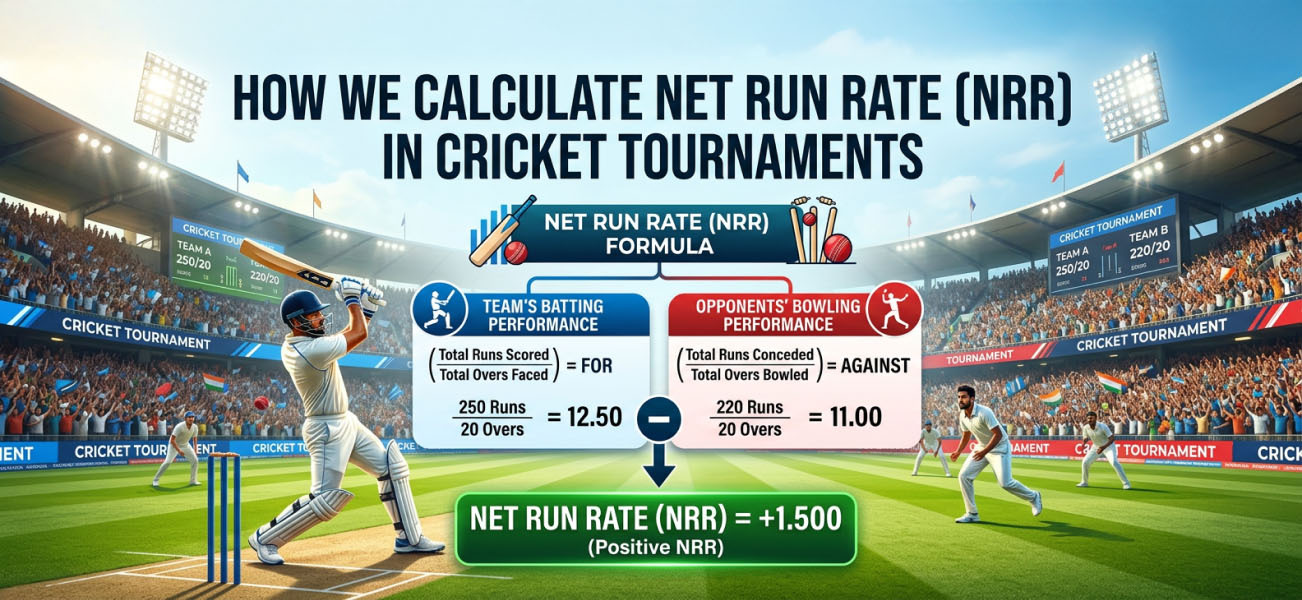
Net Run Rate (NRR) is a metric used in cricket tournaments to rank teams that have equal points.
In simple terms:
NRR shows how fast a team scores runs compared to how fast they allow the opposition to score.
It is not just about winning. It is about how you win.
Why NRR Matters in Cricket Tournaments
Points decide the table. NRR breaks the tie.
We noticed that in many local leagues and even semi-professional tournaments, teams ignore NRR early on. Then suddenly, in the last match, they are calculating impossible scenarios.
Here is where NRR becomes critical:
- When teams have equal points
- During group stages in tournaments
- In qualification scenarios
- In formats like round-robin leagues
In big tournaments like the ODI World Cup, NRR has often decided semi-finalists.
The Official NRR Formula
Let’s keep it clean and clear.
That’s it. Two parts:
- Your scoring rate
- Opponent’s scoring rate
Subtract one from the other.
Breaking Down the Formula

Let’s simplify each component.
1. Total Runs Scored
All runs your team has scored in the tournament.
2. Total Overs Faced
Total overs your team has batted.
Important note:
- If your team gets all out early, it is still counted as full overs (like 50 in ODI or 20 in T20)
3. Total Runs Conceded
All runs scored by opponents against your team.
4. Total Overs Bowled
Total overs your team has bowled.
A Simple Example of NRR Calculation
Let’s say:
- Team A scored 300 runs in 50 overs
- Team A conceded 250 runs in 50 overs
Now calculate:
- Run rate scored = 300 ÷ 50 = 6.00
- Run rate conceded = 250 ÷ 50 = 5.00
NRR = 6.00 – 5.00 = +1.00
That is a strong NRR.
What Happens When a Team Gets All Out?
This is where many people make mistakes.
When we worked with a client managing a district-level tournament, teams were calculating NRR incorrectly because they used actual overs faced instead of full quota.
Rule:
- If a team is all out in 35 overs in a 50-over match, it is still counted as 50 overs.
This lowers their run rate.
NRR in Real Match Situations

Let’s look at real scenarios.
Scenario 1: Big Win
- You chase 200 in 30 overs
- Your scoring rate becomes high
- Your NRR increases significantly
Scenario 2: Slow Win
- You chase 200 in 49 overs
- You win, but NRR barely improves
Scenario 3: Heavy Loss
- Opponent scores 350
- You get all out for 150
- NRR takes a major hit
Why Teams Care About NRR Strategy
This is where cricket becomes tactical.
In our experience, teams that understand NRR play smarter cricket in league stages.
Examples:
- Accelerating chase even when the match is safe
- Restricting opponents even after losing control
- Avoiding collapses
We noticed that professional teams constantly monitor NRR mid-tournament, not just at the end.
NRR Strategy During the ODI World Cup
In the ODI World Cup, NRR often decides qualification.
Teams consider:
- Whether to chase quickly
- Whether to declare intent early
- Bowling changes to restrict scoring
One match can shift NRR dramatically.
Common Mistakes While Calculating NRR

Let’s clear the confusion.
Mistake 1: Ignoring Full Overs Rule
All-out innings must be counted as full quota.
Mistake 2: Calculating Match-wise Instead of Tournament-wise
NRR is cumulative across matches.
Mistake 3: Forgetting Abandoned Matches
Matches with no result are excluded from NRR.
Mistake 4: Using Wrong Overs Conversion
Overs must be converted properly.
Example:
- 49.3 overs = 49 + 3/6 = 49.5 overs
- Not 49.3 in decimal
Step-by-Step NRR Calculation Guide
Here is a practical method.
Step 1: Add Total Runs Scored
Across all matches.
Step 2: Add Total Overs Faced
Use full overs if all out.
Step 3: Add Total Runs Conceded
Step 4: Add Total Overs Bowled
Step 5: Apply Formula
You now have the Net Run Rate.
Real Use Case from Tournament Management
When we worked with a client organizing a corporate cricket league, NRR calculation became a serious issue.
Teams were:
- Disputing rankings
- Questioning match results
- Confused about qualification
We introduced automated scoring and live NRR updates.
Result:
- Zero disputes
- Clear standings
- Better engagement
That is when we realized how important accurate NRR calculation is for tournament success.
How Technology Simplifies NRR Calculation
Manual calculation works for small events.
But once you scale:
- Multiple matches per day
- Different formats
- Live scoring
You need a system.
This is where platforms like The 12th Men come in.
Why The 12th Men is the Best for Cricket Tournaments
If you are running a tournament, this is not just about scoring. It is about trust.
At The 12th Men, we focus on:
- Real-time NRR calculation
- Automated points table updates
- Error-free scoring
- Easy-to-use dashboards
In our experience, organizers save hours of manual work and avoid conflicts between teams.
We noticed that once organizers switch to automated systems, they never go back to manual tracking.
Advanced Insight: NRR vs Run Rate

People often mix these up.
Run Rate
- Measures scoring speed in a single match
Net Run Rate
- Measures overall performance across matches
NRR includes both batting and bowling performance.
What Researchers Say About Match Metrics
Two useful research perspectives help understand why metrics like NRR matter.
1. Performance Metrics in Cricket
A study published by International Journal of Sports Science highlights that:
- Match outcome is strongly linked to scoring rates
- Teams with consistent run rate advantage perform better over tournaments
2. Data Analytics in Cricket Strategy
Research from MIT Sloan Sports Analytics Conference discusses:
- Use of statistical metrics in decision making
- Importance of run rate-based evaluation in limited overs cricket
How Teams Can Improve Their NRR
Here are practical tips.
While Batting
- Start strong in powerplay
- Avoid middle overs slowdown
- Finish aggressively
While Bowling
- Take early wickets
- Control run flow
- Avoid death over leaks
Overall Strategy
- Track NRR after every match
- Plan scenarios in advance
- Don’t leave it for last match
Frequently Asked Questions
What is a good NRR?
Anything above +0.5 is strong in most tournaments.
Can NRR be negative?
Yes. If you concede runs faster than you score.
Does NRR reset every match?
No. It is cumulative across the tournament.
Why do teams chase quickly even when winning is easy?
To improve NRR.
Final Thoughts
Net Run Rate (NRR) is not just a statistic. It is a reflection of how well a team performs across all phases of the game.
We have seen tournaments where the best team did not qualify because they ignored NRR early on. And we have seen average teams qualify because they played smart cricket.
If you are organizing a tournament, getting NRR right is not optional.
It shapes rankings. It decides outcomes. It builds credibility.
And if you want to avoid confusion, disputes, and manual errors, platforms like The 12th Men make the entire process simple and reliable.
That is the difference between running matches and running a professional cricket tournament.
Related Articles

Cricket
How Real-Time Bidding Improves the Cricket Auction Experience
Learn how real-time bidding makes cricket auctions easier by helping teams track bids, budgets, players, and auction results in one place.
Read More > Yug Shah|Aug 24, 2026|
Cricket
Turf Cricket Tournament App for Modern Organizers
Learn how a turf cricket tournament app helps organizers manage registrations, fixtures, live scoring, player auctions, and tournament operations with less manual work.
Read More >Yug Shah|Jul 29, 2026|