How Real-Time Bidding Improves the Cricket Auction Experience

Quick Summary / Key Takeaways
The right cricket auction software can keep bidding, budgets, and player records synchronized from the start.
- Real-time bidding gives every team a clear view of the current player price.
- Digital auctions reduce confusion caused by manual bids, paper records, and delayed updates.
- A cricket team management app can connect auction activity with squad management, budgets, and player records.
- Live purse tracking helps team owners avoid overspending early in the auction.
- Organizers get a better record of bids, sold players, team selections, and auction results.
- A well-planned auction system can make the experience fairer for teams and easier to manage for organizers.
Why Real-Time Bidding Matters in Cricket Auctions
A cricket auction can become difficult to manage once several teams start bidding for the same player. A cricket team management app helps keep bids, player records, and team budgets visible while the auction is moving. An auctioneer calls the player, one team raises the bid, another team responds, and the price keeps moving. When this happens quickly, even a small delay in recording a bid can create confusion.
This is where Real-Time Cricket Bidding can make a practical difference.
A modern cricket team management app can keep bidding information, player details, team budgets, and squad selections connected in one place. Team owners can follow the current price while organizers can maintain a clear record of every bid.
The goal is not to make the auction complicated. It is to remove the small problems that tend to slow the event down.
The International Cricket Council (ICC) provides the rules and framework for international cricket, but local leagues, corporate tournaments, academies, and franchise-style competitions often create their own auction formats. For these organizers, digital auction tools can make the process much easier to control.
What Is Real-Time Cricket Bidding?

Real-time bidding means that bids are recorded and displayed as they happen.
Instead of relying completely on an auctioneer, assistants, spreadsheets, or handwritten notes, teams can see the latest bid through a digital system.
A typical flow looks like this:
- The organizer introduces a player.
- The player's base price and details appear on the auction screen.
- Team A places a bid.
- The new bid is instantly visible to the other teams.
- Team B raises the price.
- The system updates the current bid.
- The auctioneer closes the bidding.
- The winning team and final price are recorded automatically.
This sounds simple, but the difference becomes clear when an auction has dozens of players and several teams competing at the same time.
Manual Auction vs Real-Time Auction
| Area | Manual Auction | Real-Time Digital Auction |
|---|---|---|
| Bid recording | Paper or spreadsheet | Digital record |
| Current bid | Announced verbally | Displayed live |
| Team purse | Manually calculated | Updated automatically |
| Player status | Manually marked | Updated after sale |
| Bid history | Harder to track | Stored digitally |
| Auction records | May require manual work | Available in the system |
| Team visibility | Depends on announcements | Live dashboard |
The difference is not about replacing the auctioneer. The auctioneer still controls the event. The software simply keeps the information organized around the auction.
How a Cricket Team Management App Supports Live Auctions
In sports events, treating the auction as a separate activity from team management creates duplicate work.
The two are closely connected.
When a team buys a player, its available budget changes. Its squad size changes too. The player's status changes from available to sold. If these updates are handled manually, organizers have to maintain several records at once.
A connected team dashboard can keep these actions in sync.
For example, imagine a league with eight teams and a purse of ₹10 lakh per team. Team A spends ₹2.5 lakh on its first player.
The system can immediately show:
- Amount spent: ₹2.5 lakh
- Remaining purse: ₹7.5 lakh
- Players purchased: 1
- Remaining squad slots
- Purchased player details
- Previous bids
Team owners do not need to wait for someone to update a spreadsheet.
5 Ways Real-Time Bidding Improves the Cricket Auction Experience
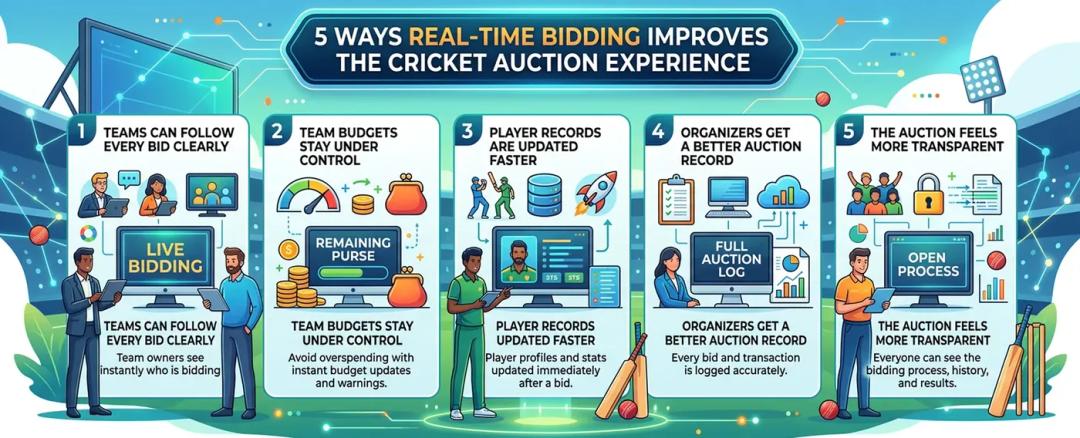
1. Teams Can Follow Every Bid Clearly
During a fast auction, verbal communication can become difficult.
Someone may miss a bid because they were discussing strategy with another team member. A live bidding screen gives everyone the same reference point.
Team owners can see:
- Current player
- Current bid
- Bidding team
- Base price
- Bid history
- Auction status
This is particularly useful when several teams are actively competing.
2. Team Budgets Stay Under Control
Budget management is one of the biggest concerns during player auctions.
Suppose a team starts with ₹15 lakh. It spends ₹7 lakh on two popular players early in the auction. If the remaining purse is not updated properly, the team could enter another bid without realizing how much money is left.
A digital system can show the purse after every purchase.
| Auction Activity | Amount | Remaining Purse |
|---|---|---|
| Starting budget | ₹15,00,000 | ₹15,00,000 |
| Player 1 | ₹4,00,000 | ₹11,00,000 |
| Player 2 | ₹2,50,000 | ₹8,50,000 |
| Player 3 | ₹1,75,000 | ₹6,75,000 |
| Player 4 | ₹2,00,000 | ₹4,75,000 |
Budget visibility becomes even more useful in longer auctions. Teams need to think about the next 10 to 20 players, not just the player currently on screen.
3. Player Records Are Updated Faster
Once a player is sold, the information should not remain marked as "available."
In a Cricket Player Auction App, the player can move through clear stages such as:
Available, bidding, sold, and assigned to team
That creates a cleaner player database for organizers.
It also reduces one common problem: two different people working from different versions of the player list.
4. Organizers Get a Better Auction Record
After the event, organizers may need to answer questions such as:
- Which team purchased the player?
- What was the final price?
- What was the base price?
- Which teams bid?
- How many players did each team purchase?
- How much budget did each team spend?
When this information is recorded digitally during the auction, organizers don't have to reconstruct everything later.
This is one of the less visible benefits of real-time auction software. The value is not limited to the live event.
5. The Auction Feels More Transparent
Players and team owners want to know that the auction process is being handled fairly.
A visible bidding sequence helps everyone understand how the price moved.
For example:
Base Price: ₹50,000 Team A: ₹60,000 Team B: ₹70,000 Team C: ₹80,000 Team A: ₹90,000 Team C: ₹1,00,000 Sold: Team C - ₹1,00,000
A clear record leaves less room for arguments about who made the final bid.

Real-Time Bidding and the Online Cricket Auction Platform
Run the desk from the live-auction guide and give off-site owners the remote-bidding guide. An Online Cricket Auction Platform becomes especially useful when team owners, organizers, or participants are not sitting in the same location.
A team owner may be travelling. Another may be joining from a different city. A league may have remote team managers handling the auction.
A web-based platform can give authorized users access to the same auction information without requiring everyone to stand around one auction table.
This can work well for:
- Corporate cricket leagues
- Local franchise tournaments
- School and college competitions
- Academy tournaments
- Community cricket leagues
- Private cricket events
The key is to keep the interface simple. If team owners need several minutes to understand where the bid button or purse information is located, the technology starts becoming a problem rather than a solution.
What Organizers Should Look for in real-time auction software
Not every auction system needs the same features. A small six-team league does not need the same setup as a large multi-day tournament.
Still, a good real-time auction software solution should cover the basics.
| Feature | Why It Matters |
|---|---|
| Live bidding | Keeps all teams updated |
| Player database | Stores player information |
| Purse tracking | Helps teams control spending |
| Bid history | Creates a record of auction activity |
| Team dashboard | Shows squad and budget status |
| Player status | Prevents duplicate selections |
| Auction controls | Gives organizers control over bidding |
| Reports | Helps after-auction review |
One thing that often gets overlooked is the organizer dashboard.
The team owner's screen and the organizer's screen should not necessarily show the same controls. Organizers need tools to pause an auction, correct a mistake, change player status, or review bidding activity.
Real-Time Bidding Works Best With Team Management

An auction ends when players are sold, but team management continues.
That is why connecting auction functionality with Cricket Tournament Management Software can be useful.
Once the auction finishes, the organizer may need to manage:
- Team squads
- Match fixtures
- Player availability
- Match results
- Live scores
- Points tables
- Player statistics
- Tournament schedules
The player auction becomes the first step in building the tournament database.
For example, if a player is purchased by Team B during the auction, that player's team assignment can already exist in the system when the tournament schedule begins.
This saves organizers from entering the same information again.
Where Sports Event Management Software Fits In
For organizers running more than just cricket auctions, Sports Event Management Software can bring several event activities together.
A tournament may include registration, player management, scheduling, scoring, notifications, payments, auction management, and reporting.
Keeping these processes connected can reduce duplicate data entry.
| Before the Auction | During the Auction | After the Auction |
|---|---|---|
| Player registration | Live bidding | Squad management |
| Player verification | Purse tracking | Match scheduling |
| Team registration | Bid history | Live scoring |
| Auction rules | Player assignment | Points table |
| Base prices | Sold-player updates | Player statistics |
This broader setup is useful for organizers who run multiple tournaments rather than a single annual auction.
A Practical Example: An Eight-Team Cricket League
Consider an eight-team corporate cricket league.
Each team receives a ₹10 lakh auction purse. There are 100 registered players.
In a manual setup, the organizer may have one person managing the player list, another tracking team budgets, and the auctioneer handling bids.
As the auction speeds up, mistakes become more likely.
Now consider the same event using a Cricket Player Auction App.
The organizer selects the next player. Team owners see the player details and current bid. Every bid updates on the screen. Once the player is sold, the winning team is updated automatically and its purse is reduced.
The organizer can move directly to the next player.
The benefit is not that the auction becomes faster at all costs. The real benefit is that everyone spends less time checking whether the information is correct.
Common Mistakes Organizers Should Avoid
Technology alone will not fix a poorly planned auction.
A few basic decisions still need attention.
Setting unclear bidding rules
Before the first player appears, teams should know:
- Starting price
- Bid increments
- Maximum squad size
- Minimum squad requirements
- Purse amount
- Unsold-player rules
- Tie or dispute procedure
Making the interface too complicated
Team owners should not need training sessions just to place a bid.
Keep the important information visible and easy to understand.
Ignoring internet reliability
Online bidding depends on connectivity. Organizers should have a backup process for temporary network problems.
Forgetting the post-auction stage
The auction data should remain useful after the event. Exportable reports, squad information, player records, and spending history can save considerable work later.
How The 12th Men Can Fit Into the Process
For organizers, the bigger requirement is usually not just an auction tool. They need a way to manage the tournament around the auction.
The 12th Men is built around sports event management, with tools covering areas such as auctions, team management, tournament operations, and live scoring.
The practical advantage of bringing these activities together is straightforward: organizers can spend less time maintaining separate records and more time running the tournament.
For a cricket league, the journey can look like:
Player registration, team setup, auction, squad formation, match scheduling, live scoring, and tournament results
That workflow gives the organizer a single operational view instead of several disconnected spreadsheets and tools.
What Does the Future of Cricket Auctions Look Like?

Cricket auctions are likely to become more connected to the rest of tournament management.
The next stage is not simply adding more buttons to an auction screen. It is about connecting player information, team budgets, auction results, schedules, and match performance.
Organizers may also look more closely at past auction prices, player demand, team spending patterns, and squad composition when preparing future events.
For smaller leagues, the biggest gain may still be much simpler: fewer spreadsheets, fewer calculations, and fewer arguments over what happened during the auction.
Final Thoughts
A cricket auction has a lot happening at once. Players are being selected, budgets are changing, and team owners are making decisions in seconds.
Real-time bidding gives everyone a clearer view of what is happening.
For organizers, the bigger benefit comes when auction data continues into team management and tournament operations. A connected system can link those pieces, from the first player registration to the final match result.
The 12th Men takes this broader approach to sports event management, helping organizers manage auctions, teams, tournaments, and live scoring from a connected platform.
Planning your next cricket league or player auction? Explore The 12th Men and see how a digital sports event management platform can simplify your tournament workflow.
Related reading
- Best Cricket Auction App for Local Tournaments in 2026
- Best Cricket Auction App for Local Tournaments in 2026
- Cricket Auction Rules: How to Set Base Price, Purse and Bids
Ready to run your auction online? See pricing (free up to 20 teams) or Book a free demo.
Continue with The 12th Men
Read next: Remote Cricket Auctions: Online Bidding for Team Owners
Need help setting up your event? Auction day set up for your event: categories, purses, rules, branded display and sponsor screens.


Sports Enthusiast
Sports enthusiast and writer passionate about sports technology, tournament management, player auctions, and scoring solutions. Sharing insights, trends, and ideas that help organizers, players, and fans enhance their sporting experience.
FAQ
Got Questions? We've Got Answers.
Real-time cricket bidding is a digital auction process where bids, player prices, and bidding activity are updated as the auction happens.
A cricket team management app can connect player selection with team budgets, squad records, player assignments, and other tournament activities.
A Cricket Player Auction App records bids, player status, team purchases, and auction information digitally, while manual auctions often depend on paper records, spreadsheets, and verbal updates.
Yes. An Online Cricket Auction Platform can allow authorized team owners to participate from different locations, provided the platform and event setup support remote access.
Yes. Cricket Auction Software can form part of a wider Cricket Tournament Management Software setup covering team management, scheduling, scoring, player records, and tournament reporting. When these tools connect with a cricket team management app, organizers get a clearer workflow from auction planning to final results.
Related Articles
Cricket
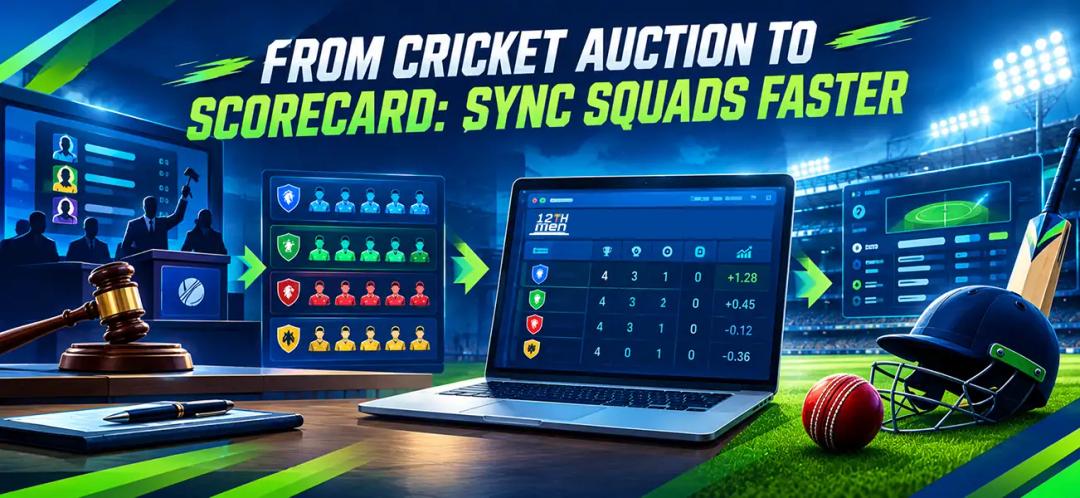
From Cricket Auction to Scorecard: Sync Squads Faster
Carry approved auction squads into tournament fixtures and scorecards without retyping players. Learn how to verify identities, team branding, match selections and standings before the opening fixture.
Read More > Yug Shah|Oct 29, 2026|
Cricket
Cricket Points Table Tie-Break Rules: Scoring Guide
Prevent qualification disputes by publishing the tie-break chain early. This guide explains how points, wins, net run rate, head-to-head results and other approved criteria should be ordered and applied consistently.
Read More >Yug Shah|Oct 27, 2026|