Badminton Match Scheduling Software for Busy Clubs
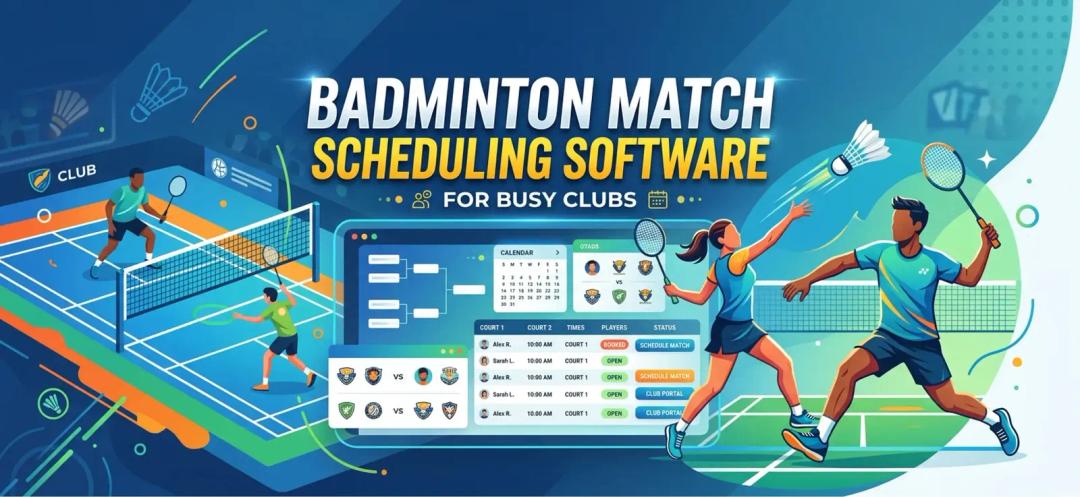
Managing a badminton club is rewarding, but match days become difficult when scheduling and scoring are handled separately. Courts are limited, players have different availability, and organizers need reliable score visibility during active fixtures. Badminton Match Scheduling Software with a Live Scoring Feature helps clubs keep fixtures, court plans, and result updates clear without relying on spreadsheets, paper schedules, or endless WhatsApp messages.
Many organizers begin with manual scheduling because it seems simple. As participation grows, things quickly become harder to manage. Match timings overlap, courts remain unused, and players keep asking for schedule updates. Clubs running weekly leagues often spend substantial time every week just creating and updating fixtures.
The good news is that scheduling no longer has to be a manual process. Clubs can keep fixtures and score updates together with badminton match scheduling.
Quick Summary
| Key Takeaway | Why It Matters |
|---|---|
| Automates match scheduling | Saves hours of manual work |
| Prevents court conflicts | Better court utilization |
| Supports multiple tournament formats | Suitable for leagues and championships |
| Updates fixtures instantly | Players stay informed |
| Improves organizer experience | Less stress during tournaments |
| Works well for clubs of every size | Easy to scale events |
Why Scheduling Becomes Difficult for Busy Badminton Clubs
A small weekend tournament might have only a handful of matches. Running a club league with 80 or 100 players is a completely different experience.
Organizers usually have to consider:
- Court availability
- Player availability
- Age categories
- Singles and doubles matches
- Match duration
- Break time between games
- Tournament format
- Last-minute withdrawals
One thing that often gets overlooked is court balancing. If one court remains empty while another has matches waiting, the tournament slows down for everyone.
Manual planning rarely accounts for these small details.
Common Scheduling Problems Clubs Face
| Challenge | Manual Process | Using Software |
|---|---|---|
| Fixture creation | Time-consuming | Automatic |
| Court allocation | Manual adjustments | Smart allocation |
| Schedule updates | Phone calls & messages | Instant updates |
| Last-minute changes | Difficult | Easy |
| Player communication | Separate messaging | Centralized notifications |
Many businesses run into this issue when participation increases. The same happens with badminton clubs. What worked for 20 players no longer works for 150.
What Is Badminton Match Scheduling Software?

Badminton Match Scheduling Software is a platform that creates tournament fixtures, assigns courts, manages match timings, and updates schedules automatically whenever changes occur. When it also works as Live Scoring Software, organizers can connect fixtures with Real-Time Score Updates and Real-Time Tournament Notifications.
Instead of creating brackets manually, organizers enter player details, choose the tournament format, and let the system prepare the schedule.
Modern software also helps manage:
- Registration
- Fixtures
- Court assignments
- Live scoring
- Standings
- Results
- Player notifications
Scheduling becomes part of one complete tournament management process rather than a separate task.
Signs Your Club Has Outgrown Manual Scheduling
Most clubs don't switch to software immediately.
They usually reach a point where organizers start spending more time managing spreadsheets than actually running the event.
You may need Badminton Tournament Scheduling Software if your club experiences:
- Players asking repeatedly about match timings
- Frequent fixture changes
- Double-booked courts
- Delayed match starts
- Multiple organizers maintaining separate schedules
- Confusion over standings
- Long gaps between matches
Clubs running weekly tournaments notice these issues much earlier than seasonal events.
How Automated Scheduling Saves Organizers Time
Creating a tournament schedule manually can take several hours.
Changing that schedule after registrations close can take even longer.
Software handles many repetitive tasks automatically.
For example:
A club hosting a Sunday doubles tournament receives five late registrations on Saturday evening.
With manual scheduling, organizers may need to recreate the entire fixture.
With scheduling software, new players can be added, courts reassigned, and fixtures updated within minutes.
That difference becomes even more noticeable during large competitions.
Features Every Club Should Look For
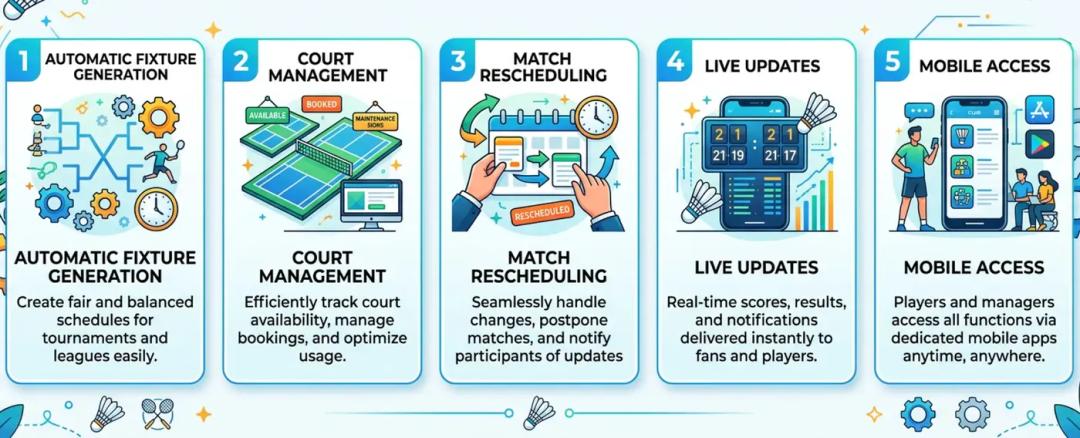
Not every scheduling system is built for badminton tournaments.
Look for features that solve real operational problems.
Automatic Fixture Generation
Create fixtures based on:
- Round Robin
- Knockout
- League
- Group Stage
- Custom formats
Court Management
Assign courts automatically while reducing idle time.
Match Rescheduling
Handle rain delays, player absences, or court maintenance without rebuilding the tournament.
Live Updates
Players receive updated schedules instead of calling organizers repeatedly.
Mobile Access
Organizers should be able to make changes directly from their phones during the event.
Comparing Manual Scheduling vs Software
| Feature | Manual Scheduling | Badminton Match Scheduling Software |
|---|---|---|
| Fixture Generation | Manual | Automatic |
| Court Assignment | Manual | Automatic |
| Schedule Updates | Slow | Instant |
| Notifications | Manual | Automatic |
| Standings | Manual | Auto Calculated |
| Result Tracking | Separate | Built-in |
| Time Required | High | Much Lower |
Clubs sometimes adopt digital registrations while continuing to manage fixtures manually. That creates two separate workflows instead of one connected process.
Different Tournament Formats Supported
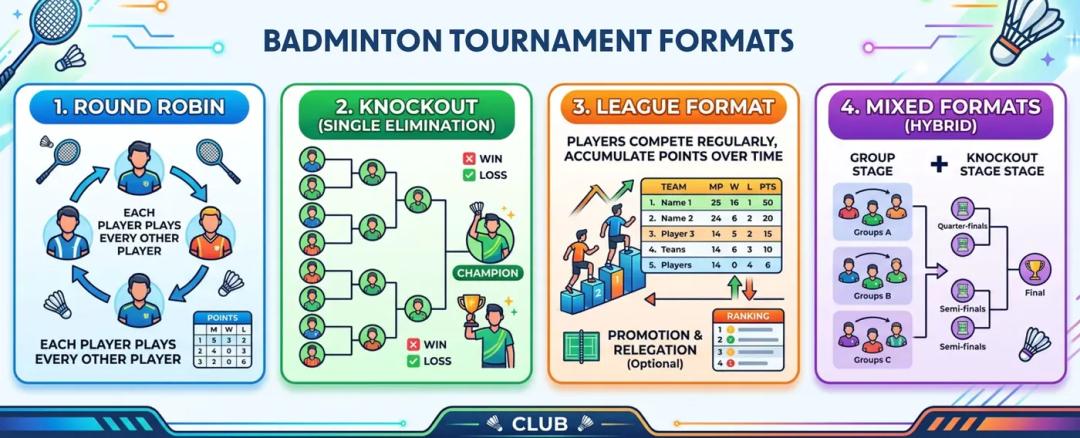
Every badminton club runs events differently.
Good scheduling software supports several formats.
Round Robin
Ideal when every participant should play multiple matches.
Best for:
- Club leagues
- Practice competitions
- Community tournaments
Knockout
Suitable for larger events with limited time.
Best for:
- Open championships
- District tournaments
- Weekend competitions
League Format
Perfect for season-based competitions where standings are updated after every match.
Mixed Formats
Some events combine group stages with knockout rounds.
The software should handle both without requiring manual adjustments.

Better Court Management Means Better Player Experience
Players notice delays quickly.
When courts remain empty while players wait, frustration builds.
Badminton clubs often have limited courts available.
Proper scheduling keeps matches moving consistently throughout the day.
Instead of organizers constantly announcing court changes, updated schedules are available for everyone to see.
This alone reduces organizer interruptions during tournaments.
Managing More Than Just Match Schedules
Scheduling is only one part of running a successful badminton club. Organizers also need to manage registrations, player lists, payments, score updates, standings, and communication. When these tasks are handled through different tools, small mistakes are almost unavoidable.
A connected platform brings everything together in one place. Instead of switching between spreadsheets, messaging apps, and paper scorecards, organizers can manage the entire tournament from a single dashboard.
This is where Badminton Tournament Management Software becomes valuable as part of Sports Tournament Management Software. The schedule connects with registrations, results, and standings, so every update appears automatically across the tournament. For organizers who manage multiple sports, the same workflow can support a Cricket Scoring App or Cricket Tournament Live Scoring without rebuilding the event process.
Before generating fixtures, use the team registration guide to confirm every club entry and avoid rebuilding the schedule around missing teams.
Illustrative Scenario: Managing a Busy Community Tournament
Consider a hypothetical badminton club hosting a monthly tournament with 96 players across singles, doubles, and mixed doubles categories.
A manual process might include:
- Registrations collected through online forms
- Fixtures created in spreadsheets
- Court assignments written on a whiteboard
- Schedule updates shared through messaging groups
- Results entered manually after each match
If players arrive late, a court becomes unavailable, or participants withdraw, organizers may spend more time rebuilding schedules than managing matches.
A dedicated Badminton Match Scheduler can change the workflow:
| Manual workflow | Digital workflow |
|---|---|
| Fixtures recreated manually | Automatic schedule updates |
| Players repeatedly ask for timings | Live fixture access |
| Court clashes require manual fixes | Rule-based court allocation |
| Standings updated manually | Automatic leaderboard updates |
| Organizers handle routine calls | Players check schedules themselves |
Better scheduling can reduce repetitive coordination, although organizers still need enough staff for match-day operations.
Choosing the Right Badminton Match Scheduling Software
Not every scheduling tool is designed for badminton tournaments.
Before selecting software, ask a few practical questions.
Can it handle different tournament formats?
Many clubs organize league matches throughout the year and knockout tournaments during special events. The software should support both without extra work.
Can multiple organizers access the system?
Large tournaments often have separate volunteers managing registrations, scoring, and fixtures.
Role-based access makes collaboration much easier.
Does it support live score updates?
Live scoring keeps players, coaches, and spectators informed without repeated announcements.
Is it mobile-friendly?
Most organizers spend tournament day walking between courts.
Being able to update schedules from a phone saves valuable time.
Can it grow with your club?
A solution that works for 50 players should also handle 500 participants as your tournaments become larger.
Common Scheduling Mistakes Clubs Can Avoid
Even experienced organizers face scheduling challenges.
Common scheduling mistakes include:
1. Scheduling Too Many Matches Back-to-Back
Players need reasonable recovery time, especially during doubles competitions.
2. Ignoring Court Availability
Adding matches without checking available courts creates delays throughout the tournament.
3. Last-Minute Manual Changes
Editing fixtures manually often creates new conflicts elsewhere in the schedule.
4. Separate Communication Channels
If schedules are updated in one place but players receive messages somewhere else, confusion follows quickly.
5. Waiting Until Tournament Day
Scheduling should be completed and shared well before players arrive.
Why Busy Clubs Prefer Automated Scheduling
As clubs grow, organizers often become volunteers managing tournaments alongside full-time jobs.
Saving even two or three hours every week makes a noticeable difference.
Clubs using automated scheduling spend less time answering routine questions such as:
- "When is my next match?"
- "Which court am I playing on?"
- "Has the schedule changed?"
- "Who is my next opponent?"
Players find answers themselves because the information is always available.
That creates a smoother experience for everyone involved.
How Scheduling Supports Fair Play
Fair scheduling isn't just about convenience.
It also helps create a better competition.
Good scheduling software can reduce:
- Uneven rest periods
- Court overuse
- Match overlaps
- Long waiting times
- Conflicting fixtures
These details may seem small individually, but together they improve the overall tournament experience.
Organizations like the Badminton Association of India encourage structured tournament management and proper match administration during competitive events. Following organized scheduling practices helps clubs prepare players for larger competitions while creating a professional event environment.
Connecting Scheduling with Tournament Features
Scheduling becomes even more valuable when it's connected with other tournament tools.
Instead of treating fixtures as a separate task, organizers can manage everything through one platform.
Some useful connected features include:
| Feature | Benefit for Clubs |
|---|---|
| Online Registration | Collect player details before scheduling |
| Fixture Generator | Create schedules automatically |
| Live Scoring | Update scores instantly |
| Standings | Rankings update after every match |
| Player Notifications | Share schedule changes automatically |
| Reports | Review tournament performance after completion |
For clubs looking to simplify the entire tournament process, exploring Sports Event Management Features can help identify tools that support scheduling, scoring, registrations, and communication in one system.
Preparing Your Club for Future Tournaments

Participation in badminton continues to grow across schools, academies, residential communities, and corporate leagues.
With more players comes more planning.
Clubs that still depend on manual scheduling often reach a point where organizing tournaments becomes stressful instead of enjoyable.
Moving to dedicated Court Scheduling Software for Badminton doesn't change how tournaments are played.
It changes how easily they are managed.
The result is more time spent supporting players and less time fixing spreadsheets.
Final Thoughts
Running a badminton tournament involves hundreds of small decisions. Match schedules sit at the center of all of them. A delayed fixture affects court availability, player experience, scoring, and the overall flow of the event.
The right Badminton Match Scheduling Software helps organizers reduce manual work, avoid scheduling conflicts, and keep tournaments running on time. Whether you're managing a community club, school championship, academy league, or district event, better scheduling creates a better experience for everyone involved.
As your club grows, choosing software that combines scheduling, fixtures, scoring, and tournament management becomes a practical investment rather than an added expense.
Ready to Simplify Your Next Badminton Tournament?
Managing tournaments shouldn't mean spending hours updating spreadsheets or answering the same scheduling questions all day.
The 12th Men helps badminton clubs manage registrations, generate fixtures, schedule matches, track live scores, and run tournaments from one platform. Whether you're organizing weekly club games or large championships, our platform gives organizers more control while creating a smoother experience for players.
Explore The 12th Men today and see how smart tournament management can save time, reduce scheduling hassles, and help your badminton club grow with confidence.
Related reading
- How to Run a Badminton League: Step-by-Step Guide
- Best Badminton Scoring App for Tournaments & Academies
- Best Badminton Auction App for Clubs & Leagues in 2026
Continue with The 12th Men
Read next: How to Run a Badminton League: Step-by-Step Guide
Need help setting up your event? Your whole event set up for you: registration form, payments, auction, fixtures and scoring.


Sports Enthusiast
Sports enthusiast and writer passionate about sports technology, tournament management, player auctions, and scoring solutions. Sharing insights, trends, and ideas that help organizers, players, and fans enhance their sporting experience.
Related Articles

Badminton
How to Create a Badminton Tournament Bracket
Learn how a badminton tournament bracket generator supports singles and doubles events, fair seeding, court scheduling, live result updates, and smoother competition management for busy clubs. It also highlights practical steps, common pitfalls.
Read More >Yug Shah|Sep 21, 2026|
Badminton
How to Run a Badminton League: Step-by-Step Guide
Learn how badminton league management software helps organizers create brackets, schedule matches, manage players, track scores, and run badminton tournaments with less manual work.
Read More >Yug Shah|Aug 17, 2026|