Badminton Tournament Bracket Generator: Easy Guide

By Yug Shah
|
Sep 21, 2026
|
|
Badminton Tournament Bracket Generator: Easy Guide
Thirteen names do not fit neatly into sixteen boxes. That does not mean three people are missing.
For this worked example, imagine an academy closing entries for a singles cup with 13 confirmed competitors. The coach opens a draw template, sees empty spaces, and wonders whether to recruit more players or remove someone.
Neither is necessary.
A Badminton Tournament Bracket Generator arranges entrants into a competition draw, handles empty positions through byes, and maps progression toward the final. This guide explains how to build that draw, schedule it, and keep results accurate.
The empty boxes have a purpose. Understanding them comes before clicking Generate.
Quick Summary: Key Takeaways
- Count entries correctly. One singles player or one doubles pair occupies one position.
- Choose the format first. Decide whether the priority is finding a champion or providing repeated competitive practice.
- Explain seeds and byes. Publish the method before publishing opponents.
- Separate the draw from the timetable. Courts, shared players, rest requirements, and scoring settings need their own checks.
What Does a Badminton Tournament Bracket Generator Do?
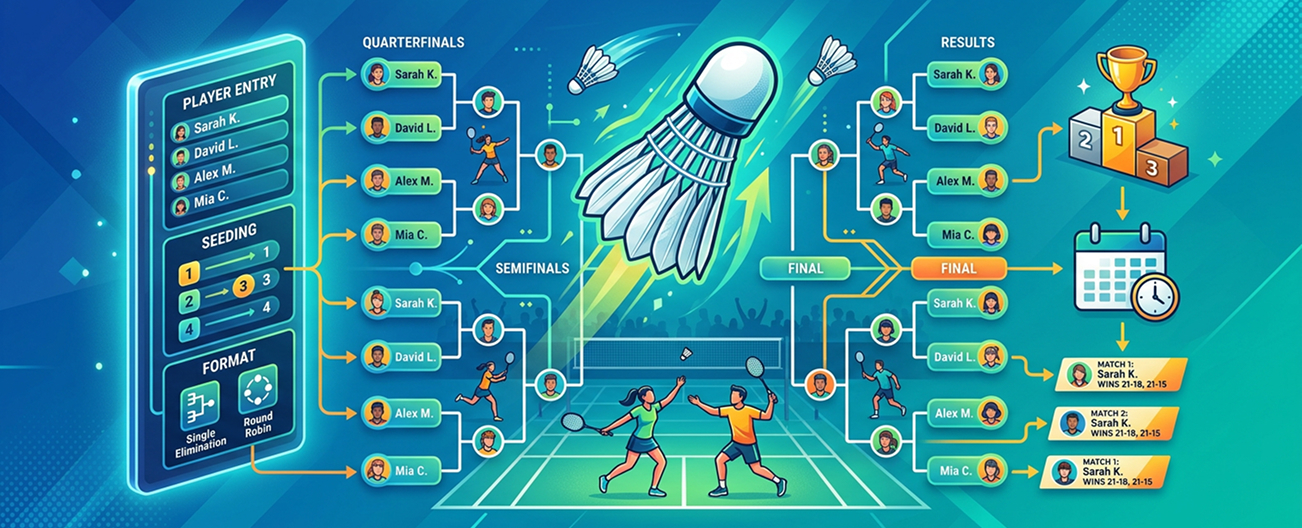
It creates the route through a competition. A complete event platform may also assign courts and times, record scores, and update results.
Those are related jobs, but they are not interchangeable.
| Tool | Main job | Question it answers |
|---|---|---|
| Badminton draw generator | Arrange opponents and progression | Who plays whom? |
| Badminton scheduling software | Allocate available courts and playing times | Where and when? |
| Badminton scoring app | Record points, games, and match results | What happened, and who advances? |
The 12th Men publishes registration, scheduling, scoring, and broader event management capabilities. Its badminton page specifically lists bracket generation, court assignments, and time-slot management.
Check how those functions work together in your chosen setup. A printable bracket alone cannot tell you whether two fixtures require the same player simultaneously.
Which Format Suits a Badminton Club or Academy?
Choose knockout for a shorter route to a winner, round robin for repeated opponents, or groups followed by knockout for a combination.
Our 13-player singles cup needs 12 matches in straight knockout, assuming every fixture is played and there are no placement matches. Each result eliminates one contender until one remains.
A full round robin needs 78 matches: 13 multiplied by 12, divided by two. Every entrant faces twelve opponents.
Quite a different booking.
For a development event, we would consider small groups or a consolation competition before promising everyone several matches. Decide how many qualify and how tied groups are resolved before accepting entries.
Unequal groups deserve attention too. Comparing raw wins across groups of different sizes can be misleading. Publish a qualification method that accounts for the structure you actually use.
How Do You Create the Bracket Step by Step?
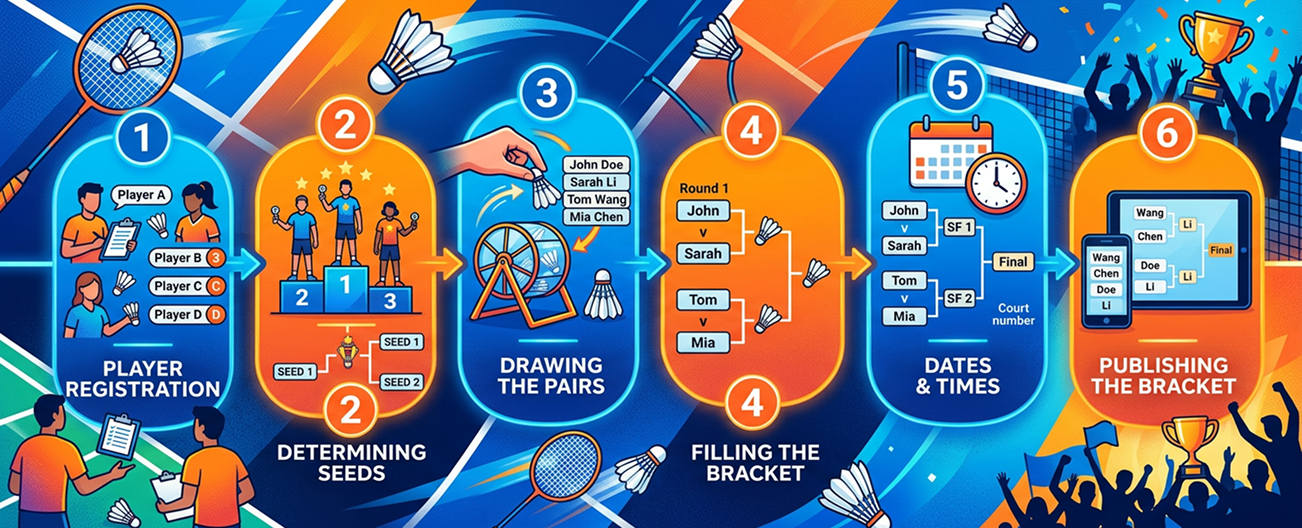
1. Finalize entrants, categories, and doubles pairs
Start with confirmed entries, not everyone who expressed interest.
Separate age divisions and playing categories. Check spelling, duplicates, eligibility, withdrawals, and partner assignments before generating anything.
For doubles, 26 people form 13 pairs, not a 26-entry bracket. Keep each pair together while retaining both individuals’ identities for schedule checks.
That matters when someone enters singles and mixed doubles. Their name may appear in separate draws, but the scheduler still needs to recognize one person.
Set an entry deadline and a process for corrections. We would rather settle one disputed category now than explain a changed opponent after families have planned their journey.
2. Calculate byes without inventing matches
A bye advances an entrant without an opening-round match. It fills the gap between your entry count and the next bracket size: 4, 8, 16, 32, and so on.
For thirteen entries, use sixteen positions:
16 positions minus 13 entrants equals 3 byes.
Ten competitors contest five opening matches. Their five winners join the three bye recipients in the quarterfinals.
Here are calculated examples for standard knockout brackets, excluding withdrawals, consolation rounds, and third-place playoffs:
| Entries | Bracket positions | Opening-round byes | Opening matches | Total matches |
|---|---|---|---|---|
| 10 | 16 | 6 | 2 | 9 |
| 13 | 16 | 3 | 5 | 12 |
| 16 | 16 | 0 | 8 | 15 |
| 19 | 32 | 13 | 3 | 18 |
Do not record a bye as a played victory with invented game scores. Nobody served a shuttle.
The label should also be understandable to families: “Advances to quarterfinal” tells them more than an unexplained empty box. Publish the recipient’s actual reporting instructions so they do not arrive expecting an opening match.
3. Set seeding rules before drawing opponents
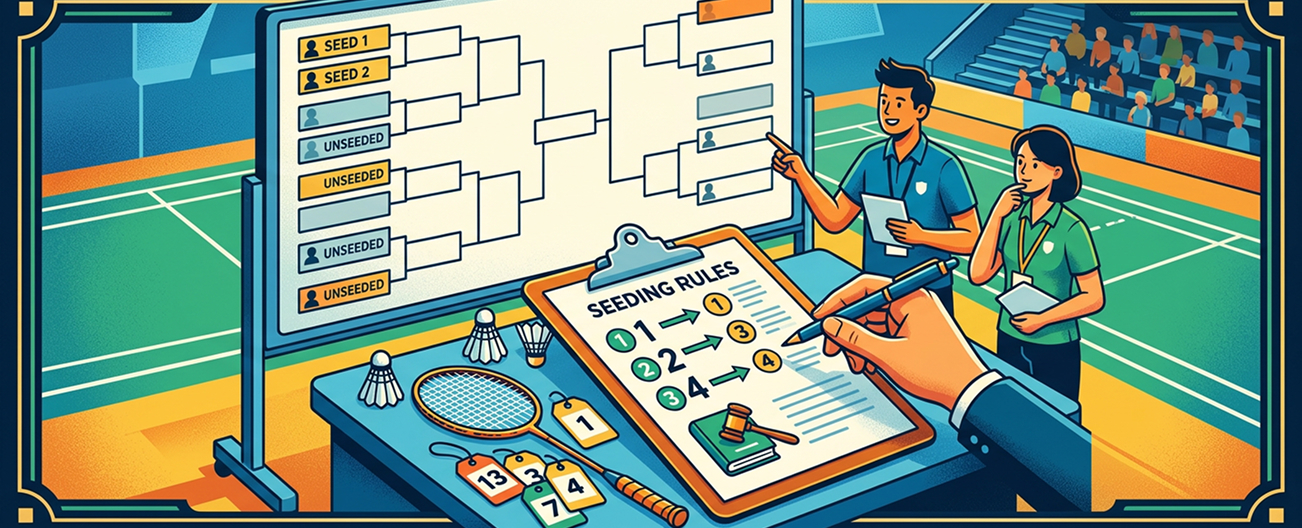
Seeding places selected entrants according to a declared ranking or assessment. It is different from repeatedly shuffling until the pairings look attractive.
For a sanctioned competition, use the applicable association regulations. For an internal academy event, state whether seeds come from recent results, a club ladder, or documented coach assessments. Agree on bye allocation at the same time.
Research helps explain why placement matters. In their 2020 paper, Ritxar Arlegi and Dinko Dimitrov examined fairness in elimination competitions. Their mathematical analysis showed that some structures can give a weaker participant a greater chance of winning than a stronger one, depending on matchup probabilities. This was tournament-design research, not a software trial.
Our practical takeaway: a tidy diagram is not proof of fairness.
Explain the method, preserve the published version, and record authorized changes. Avoid moving a favored player simply because an early opponent looks difficult.
4. Turn the draw into a court schedule
The bracket is ready. The academy’s afternoon is not.
Assign available courts, opening hours, estimated match lengths, changeover allowances, and the rest intervals required by your competition rules. Check shared entrants across every category, including both members of each doubles pair.
Do not schedule the final solely because a court is free. Both finalists must have completed their semifinals and satisfied the event’s rest requirements.
Actual badminton research shows why timing assumptions deserve scrutiny. Algislayne Fatchner Coenga and colleagues, in a study published January 5, 2026, analyzed 124 matches from the 2019 Pan-American Junior Championships. Across their sample, two-game contests averaged 23 minutes, while three-game contests averaged about 41. The analysis covered quarterfinals onward under the 21-point format.
Those are not ready-made time slots for your academy. They suggest why a single average can hide substantial variation.
Use your own event history and scoring format, then allow room for overruns. The 12th Men’s match scheduling and scoring system describes fixture planning around court availability, event duration, and rest rules. Test those settings with your own entries.
5. Match scoring settings to your event rules
Before the first serve, confirm the games per match, points per game, deuce behavior, and scoring cap. Then test whether the correct winner advances.
This is particularly relevant during the scoring transition. USA Badminton reports that BWF’s approved best-of-three, 15-point system takes effect on January 4, 2027. Follow your event and association’s published rules rather than assuming every competition changes on the same local timetable.
Ask the badminton scoring app to demonstrate a close finish, an accidental point, and a corrected match result. Check what happens to later fixtures if the recorded winner changes.
Treat these as separate tests. Point entry can be correct while progression is wrong, especially when someone corrects an earlier round after the next fixture has been announced. Assign one official to approve those changes, and confirm which participants need updated instructions before play resumes.
A walkover, retirement, and completed match should remain distinguishable in the records. Ask how each is handled under your competition regulations.
Advancement should follow a confirmed result, not an assumption at the desk.
6. Review before publishing
Have someone who did not create the draw inspect it.
Ask them to follow one singles entrant and one doubles pair through possible rounds. Look for overlapping assignments, unexplained byes, missing opponents, and unavailable courts.
Share one current public version with the category, round, court, reporting instructions, and update time visible. Keep a printable backup, but replace outdated copies after corrections.
If an entrant withdraws, follow the announced procedure rather than casually regenerating the whole draw. Your remaining participants should be able to understand what changed and why.
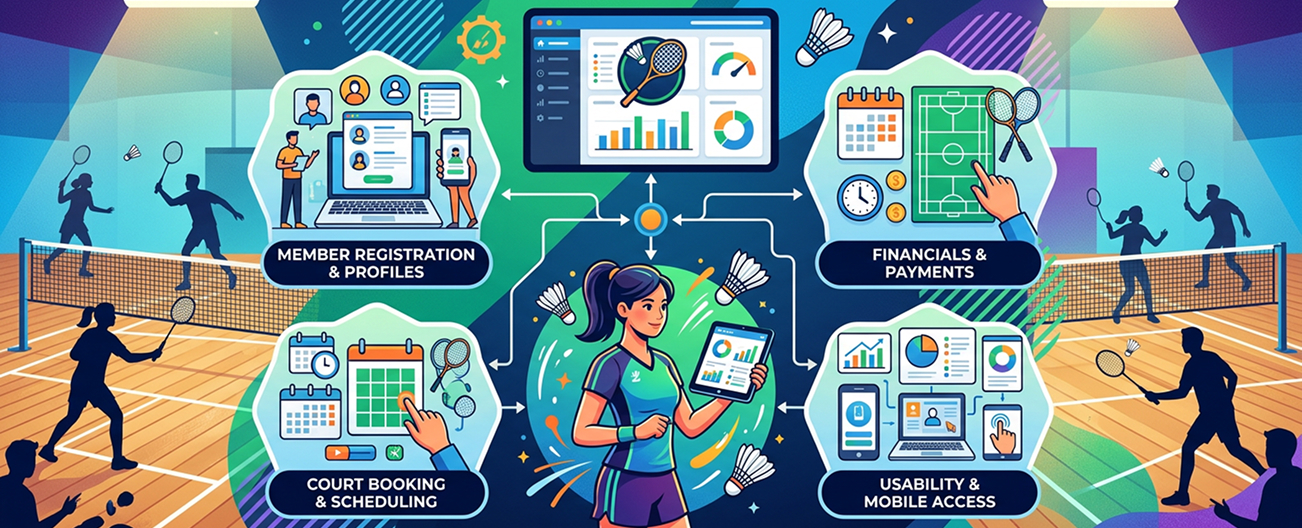
Use the thirteen-entry example as a rehearsal. Add three byes, enter a doubles pair, move a court assignment, and correct a result.
These are proposed checks, not claims that every product handles them identically.
Give an academy volunteer the controls for the rehearsal. Watch where they hesitate. Ask whether results can be exported and whether a second organizer can understand the event without a lengthy handover.
The 12th Men’s badminton offering lists live scoring, bracket generation, player rankings, and scheduling. Confirm your required formats and correction controls during a demonstration rather than assuming every option is included.
Before choosing a plan, ask about entry limits, separate age-group draws, print exports, additional administrators, and recurring costs. A weekly academy ladder and an annual invitational may need different arrangements.
Use a representative roster during the demonstration. Compare the resulting draw with your published policies, not just a screenshot that looks orderly. Also check whether you can retain results between seasons without purchasing features your volunteers will never use.
For broader event planning, browse our sports tournament guides and keep notes on questions relevant to your badminton program.
Make Room for the Thirteenth Entry
Our academy did not need to reject anyone or recruit three extra competitors. It needed a sixteen-position draw, three explained byes, and twelve matches scheduled with care.
The useful outcome is not a prettier bracket. It is a competition whose instructions hold up when players and parents ask questions.
Bring your categories, entry counts, and court availability to The 12th Men’s badminton tournament platform. Request a demo using your next academy event and check the full journey from the first draw to the confirmed final result.
FAQ
Got Questions? We've Got Answers.
Yes. For standard knockout, select the next suitable bracket size and allocate byes according to your event rules. Thirteen entrants fit a sixteen-position draw with three opening-round byes.
It means the entrant advances without playing that round. Keep it separate from a completed match result and do not invent points or game scores.
Choose a system that supports individual and paired entries. Check whether scheduling recognizes both partners across other categories, not just the doubles team’s display name.
The draw determines opponents and progression. The schedule assigns those matches to courts and times while accounting for availability, earlier results, and competition requirements.
For repeated competitive practice, consider round robin or small groups. Straight knockout guarantees only one played match when everyone attends. A consolation format can add opportunities, but budget the extra court time first.
Related Articles
Guide
Real-Time Tournament Notifications: Organizer Guide
See how instant alerts reduce confusion on tournament day. This guide covers fixture reminders, venue updates, score notifications, delay announcements, and practical communication workflows for organizers. It also highlights practical steps.
Read More >Yug Shah|Sep 17, 2026|
Guide
Best Table Tennis Tournament Software for Clubs in 2026
Learn what clubs should look for in table tennis tournament software, including easy registration, automated draws, court scheduling, score updates, standings, and clear communication for players. It also highlights practical steps, common.
Read More >Yug Shah|Sep 16, 2026|