How Pickleball League Software Helps Clubs Manage Multi-Venue Tournaments

By Yug Shah
|
Aug 10, 2026
|
5 min read
|
Guide
Quick Summary
- Multi-venue pickleball tournaments bring scheduling and communication challenges.
- Pickleball league software keeps registrations, fixtures, live scores, and court assignments in one place.
- Clubs save time by reducing manual coordination across different venues.
- Better communication improves the experience for players, officials, and volunteers.
- Reports from Sports Event Analytics Software help clubs plan stronger tournaments in the future.
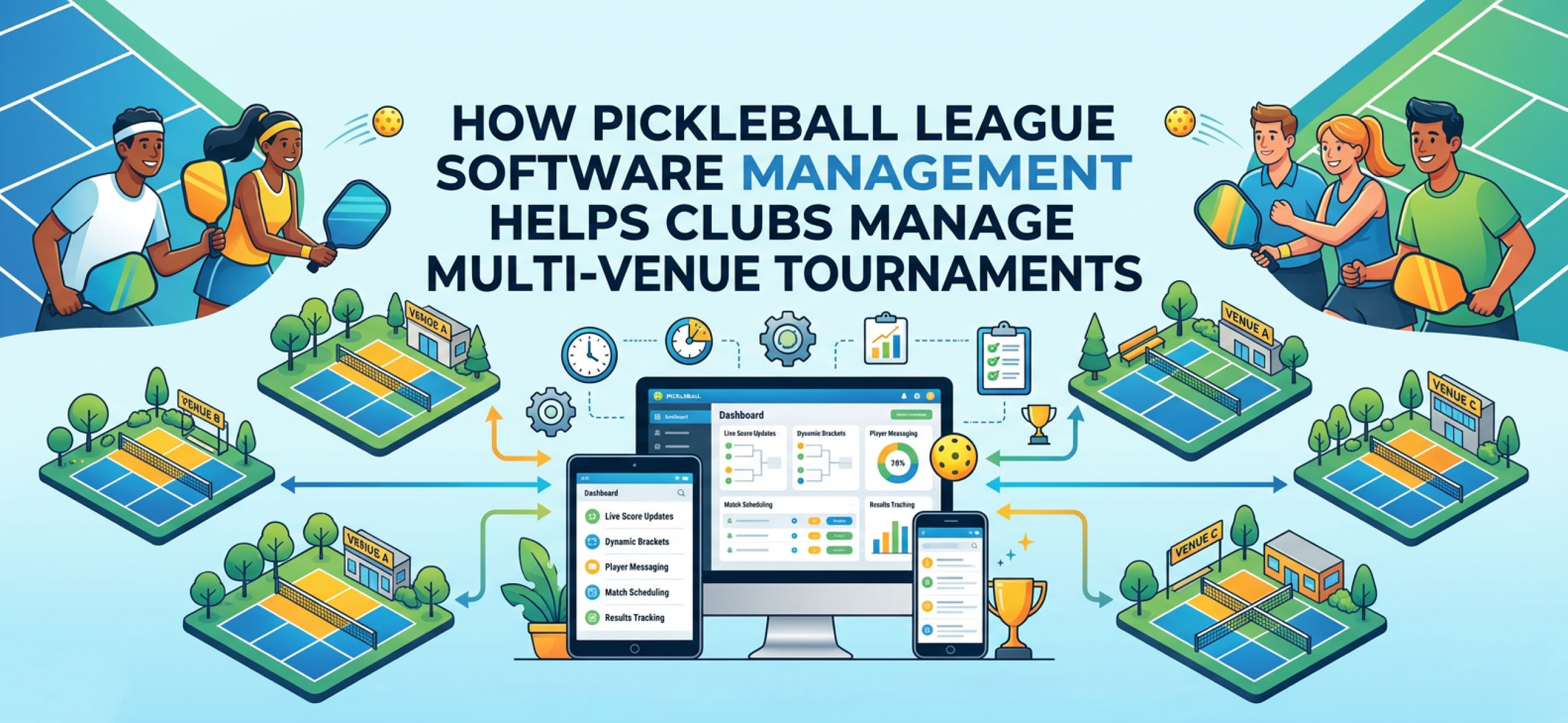
Pickleball league software is becoming essential as local tournaments grow beyond one court or one-day formats. What used to be a single-venue event is now often spread across multiple courts, sports complexes, or even different cities. As participation grows, organizers need a clear way to manage schedules, scores, venues, and player communication without depending on spreadsheets or messaging groups.
That is why many clubs are moving to a connected league platform. Instead of managing registrations, fixtures, player updates, and scores through separate tools, everything can be handled from one platform. Whether you are organizing a weekend league or a three-day championship, the right software helps everyone stay on the same page.
In our experience, most organizers don't start looking for software because they enjoy learning new tools. They start looking after running one tournament that became much harder than expected.
Pickleball Is Growing Faster Than Many Clubs Expected
Pickleball is no longer limited to recreational games in local parks. Schools, residential communities, corporate organizations, and sports clubs are hosting competitions throughout the year.
This growth is exciting, but it also creates new responsibilities for organizers.
Today, a club may need to manage:
- Multiple age categories
- Men's, women's, and mixed doubles events
- Separate beginner and advanced divisions
- Several playing venues
- Hundreds of player registrations
- Live score updates throughout the day
Managing all of these activities manually takes far more time than most organizers anticipate.
We've noticed that clubs often underestimate how quickly tournament administration grows. A tournament with 60 players may only need one coordinator. Increase that number to 250 players across three venues, and the workload changes completely.
Why Multi-Venue Events Are More Challenging
Running matches at different locations sounds simple during the planning stage.
The reality is quite different.
Every venue needs updated schedules, court assignments, volunteers, referees, and scorekeepers. Players also expect instant updates whenever something changes.
Even a small delay at one venue can affect matches scheduled later in the day.
Without proper coordination, organizers spend most of their time answering phone calls instead of managing the event.
Common Challenges
| Challenge | What Usually Happens |
|---|---|
| Schedule changes | Players arrive at the wrong court |
| Court delays | Multiple matches start late |
| Manual score updates | Spectators wait for results |
| Venue communication | Volunteers receive different information |
| Player questions | Organizers spend hours responding individually |
One thing that often gets overlooked is how much communication increases during a tournament. Before the first match begins, most questions are about registration. Once the tournament starts, nearly every question is related to schedules or court assignments.
When Spreadsheets Stop Working
There is nothing wrong with using Excel for a small competition.
Many clubs begin that way.
The problem appears when organizers continue using the same process after the tournament has doubled or tripled in size.
A common mistake we see is adding more spreadsheets every year instead of improving the overall process.
Eventually, organizers find themselves managing:
- Registration sheets
- Fixture sheets
- Payment records
- Volunteer schedules
- Court allocations
- Player contact lists
Each document needs to stay updated.
One forgotten edit can create confusion across the entire event.
Manual Management vs Pickleball League Software
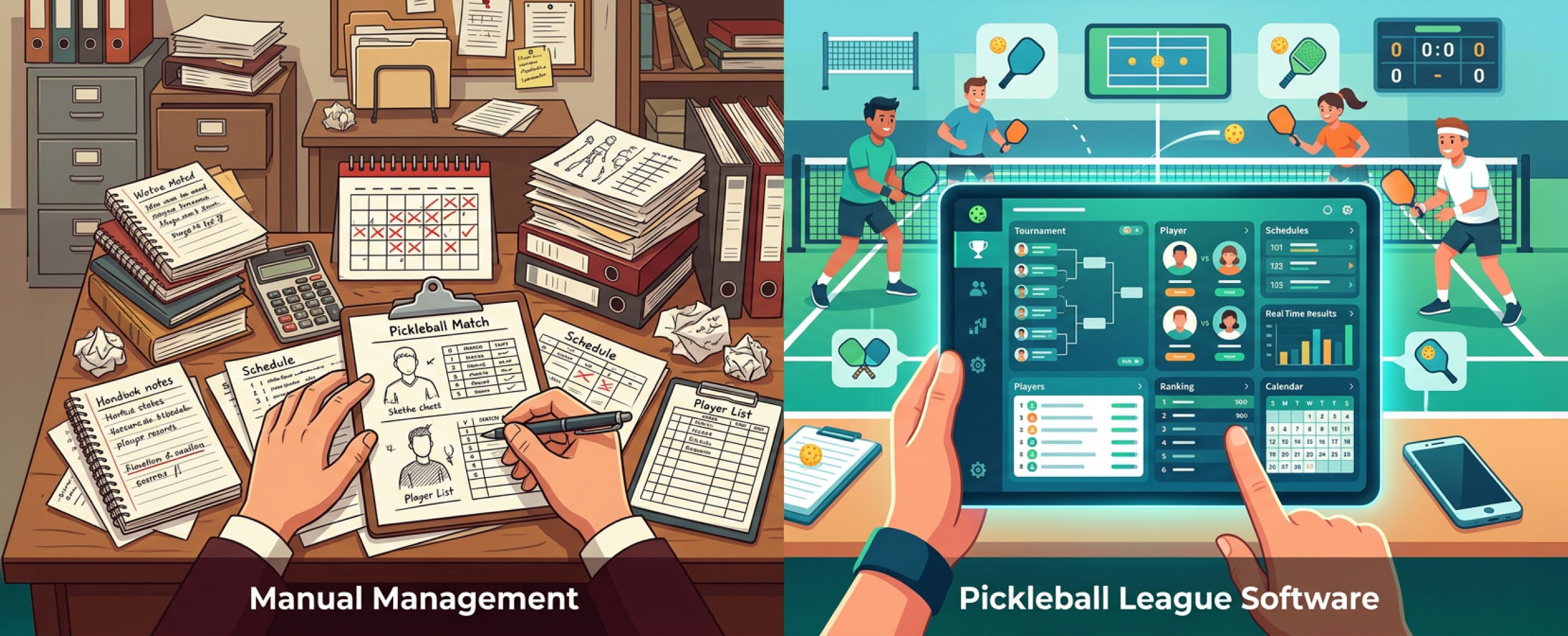
| Manual Process | Using Pickleball League Software |
|---|---|
| Multiple spreadsheets | One centralized dashboard |
| Phone calls for updates | Automatic player notifications |
| Printed fixtures | Digital schedules |
| Manual score entry | Live score updates |
| Separate payment records | Online registration and payment tracking |
| Difficult reporting | Built-in tournament reports |
Many businesses run into this issue after their events become successful. Growth is great for participation, but it also increases administrative work.
Software doesn't remove every challenge. It simply gives organizers more time to focus on the tournament instead of paperwork.
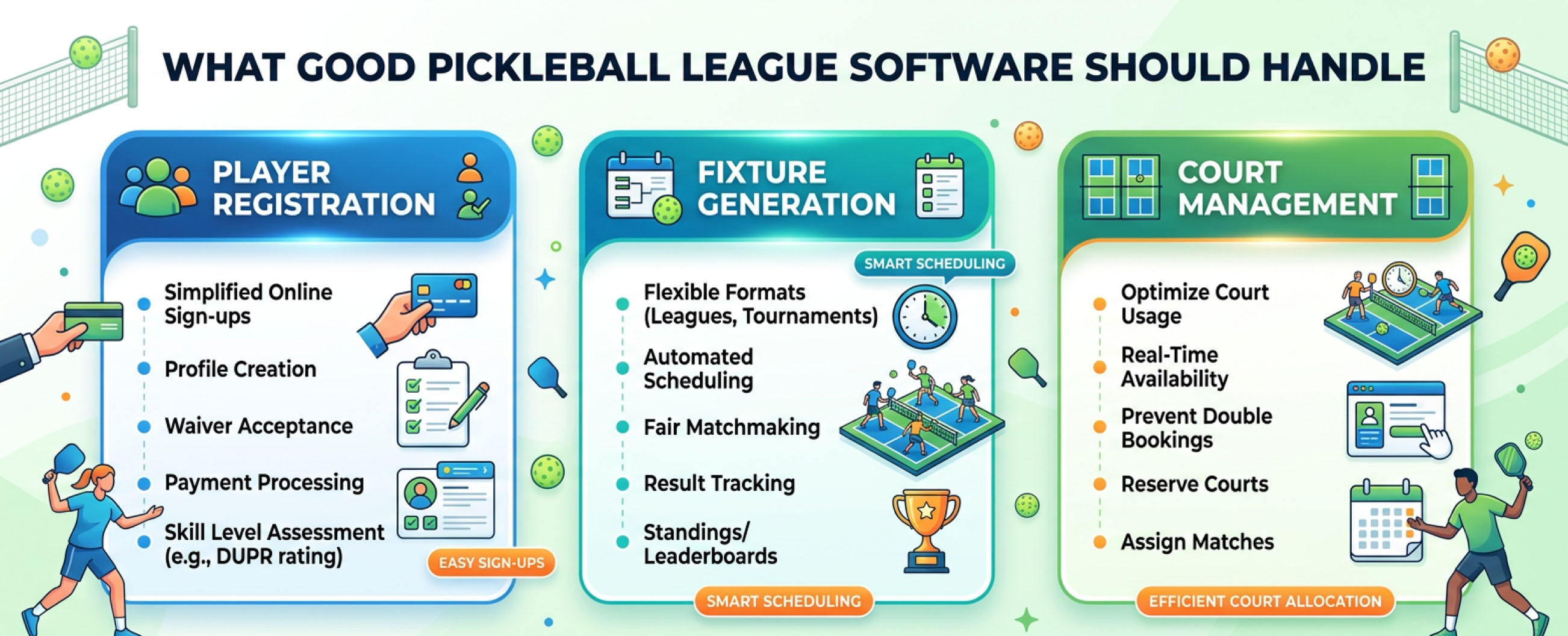
What Good Pickleball League Software Should Handle
Not every platform offers the same features.
Some products only create tournament brackets.
Others focus only on club memberships.
A complete solution should support the entire tournament journey.
Player Registration
Registration is usually the first interaction players have with your event.
A good system allows organizers to:
- Accept online registrations
- Collect participation fees
- Create different event categories
- Limit player capacity
- Approve or reject entries
- Track payment status
Players receive confirmation immediately, while organizers avoid manually copying information into spreadsheets.
Fixture Generation
Creating fixtures is often one of the longest tasks before the tournament begins.
If players withdraw at the last minute, the work starts all over again.
Pickleball tournament management software makes fixture creation much easier by supporting formats such as:
- Round Robin
- Knockout
- League Format
- Pool Play
- Mixed Competition
Instead of rebuilding everything manually, organizers can make adjustments without affecting the entire schedule.
Court Management
Multi-venue tournaments require careful planning.
Imagine a tournament using three locations:
| Venue | Number of Courts | Competition |
|---|---|---|
| City Indoor Stadium | 8 | Singles |
| Community Sports Club | 6 | Doubles |
| University Sports Hall | 4 | Junior Events |
Without software, keeping every venue updated becomes difficult.
If rain delays matches at one location or a court becomes unavailable, organizers need to adjust schedules quickly.
We've seen volunteers spend nearly an hour rewriting printed fixture sheets because one court became unavailable. Situations like this are exactly why digital scheduling has become so valuable.
Better Communication Creates Better Tournaments
Players appreciate clear communication more than organizers sometimes realize.
Nobody enjoys wondering:
- Which court am I playing on?
- Has my match started?
- Is the schedule delayed?
- Where are today's results?
Instead of making repeated announcements throughout the venue, organizers can send updates directly through the tournament platform.
That small change reduces confusion and gives volunteers more time to support the event itself.
Parents, coaches, and spectators also benefit because they can follow tournament progress without constantly asking staff members for updates.
Live Scoring Changes the Tournament Experience
Live scoring has become one of the most requested features among clubs.
Years ago, spectators gathered around printed scoreboards waiting for updates.
Now they expect to check scores from their phones.
For organizers, live scoring offers more than convenience.
It reduces mistakes, keeps brackets updated, and allows players to prepare for their next matches without waiting for announcements.
In our experience, clubs that introduce live scoring rarely return to manual scoreboards. Once players experience instant updates, it quickly becomes an expected part of every tournament.
Why Clubs Are Choosing Pickleball Club Management Software Instead of Separate Tools
A tournament may only last a few days, but a club operates throughout the year.
Members renew subscriptions, courts need to be booked, coaching sessions continue, and local leagues return every season. Managing these activities with different applications often creates extra work instead of reducing it.
This is where pickleball club management software becomes valuable. It connects day-to-day club operations with tournament management, giving organizers a complete picture of their members and events.
Many clubs start with tournament software and later realize they also need a better way to manage memberships and regular activities. Choosing one platform for both usually saves time and avoids duplicate records.
A typical club can manage:
- Member registrations
- Court bookings
- Coaching schedules
- Seasonal leagues
- Tournament entries
- Player rankings
- Payment records
- Event announcements
Instead of updating the same player's information in multiple places, everything stays connected.
Looking Beyond Match Results
Finishing a tournament isn't the end of the job.
Most organizers gather their volunteers and ask questions like:
- Which event attracted the most players?
- Which category filled up first?
- Which venue handled the highest number of matches?
- How many new participants joined the club?
- Which communication channels worked best?
Without proper reports, these answers are often based on guesses.
Sports Event Analytics Software helps organizers understand registrations, court usage, match results, revenue, and participation trends so they can improve the next event.
Rather than simply displaying scores, it helps organizers understand what happened during the event and what should change before the next one.
We've noticed that clubs holding tournaments every few months improve much faster when they review event reports instead of relying on memory.
Reports That Actually Help Organizers
| Report | Why It Matters |
|---|---|
| Player registrations | Understand participation trends |
| Match completion | Track tournament progress |
| Revenue summary | Review registration income |
| Court usage | Identify busy and underused courts |
| Player categories | Plan future competitions |
| Volunteer activity | Improve staffing for upcoming events |
These reports don't replace experience.
They simply give organizers clearer information before planning the next tournament.
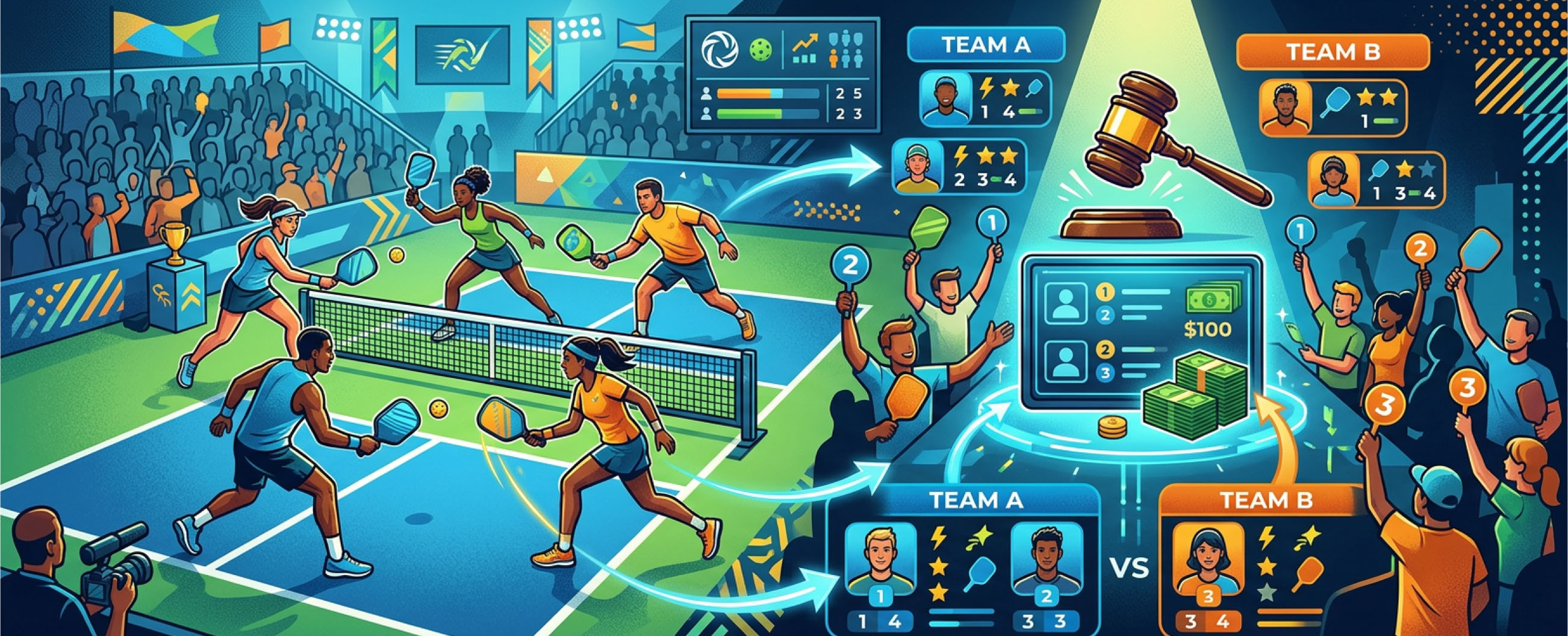
Can Pickleball Use Auction-Based Team Formats?
Most pickleball tournaments still follow traditional league or knockout formats.
At the same time, clubs are experimenting with new ways to keep events engaging.
Corporate leagues, exhibition matches, charity tournaments, and community festivals sometimes include player drafts before the competition begins.
Instead of assigning players randomly, team captains select participants through an auction or draft process.
This approach has been popular in cricket for years and is slowly attracting interest from other sports.
A pickleball auction platform helps organizers:
- Register available players
- Create team owners
- Conduct digital player auctions
- Build balanced teams
- Display auction results live
For clubs already using a Sports Auction Platform for other sports, introducing auction-based pickleball leagues can create a fresh experience without changing the actual rules of the game.
While this format isn't suitable for every tournament, it works well for promotional events and community competitions where entertainment is just as important as competition.
A Real Example from a Growing Club
Imagine a sports club organizing its annual pickleball championship.
The previous year's tournament attracted 85 players and was managed using spreadsheets.
Everything worked reasonably well.
The following year, registrations reached 240 players.
The club booked three venues, expanded to new age categories, and added mixed doubles.
Suddenly, the original process no longer worked.
Players called to confirm match times.
Volunteers struggled to update printed fixtures.
Some participants reached the wrong venue after schedule changes.
The organizing team spent most of the morning answering questions instead of welcoming players.
For the next event, the club moved to pickleball tournament management software.
Registrations were collected online.
Fixtures were shared digitally.
Live scores updated automatically after each match.
Volunteers focused on helping players instead of rewriting schedules.
The tournament still faced challenges, as every event does, but the organizers finished the weekend far less exhausted than the previous year.
Stories like this have become increasingly common as pickleball continues to grow.
Choosing the Right Platform
Not every club has the same requirements.
A small community club and a state-level association will look for different features.
Before making a decision, ask practical questions instead of comparing long feature lists.
| Question | Why It Helps |
|---|---|
| Can it manage multiple venues? | Useful as tournaments grow |
| Does it support league and knockout formats? | Different competitions need different structures |
| Is live scoring included? | Improves player and spectator experience |
| Can players register online? | Saves administrative work |
| Are reports available after the tournament? | Helps future planning |
| Can memberships be managed too? | Useful for clubs operating year-round |
The right choice depends on how your club plans to grow over the next few years, not just the next tournament.
The Future of Pickleball Tournament Management

Participation numbers continue to rise in many regions.
Players now expect online registration, digital schedules, instant notifications, and live scores as standard features rather than optional extras.
Tournament organizers also face higher expectations.
Sponsors want better visibility.
Participants expect faster communication.
Clubs want clear reports that help them plan future events.
This is why more organizers are investing in sports event management software that supports every stage of an event instead of relying on several disconnected tools.
Technology doesn't make tournaments successful on its own.
Good planning, experienced volunteers, and clear communication will always matter.
Software simply helps organizers spend less time managing paperwork and more time creating a better experience for everyone involved.
Final Thoughts
Every successful tournament reaches a point where manual processes begin slowing things down.
At first, it's a few extra phone calls.
Then it's multiple spreadsheets.
Soon, volunteers are trying to keep schedules, scores, and registrations updated across different venues.
That is usually the moment clubs begin looking for a better system.
When combined with pickleball tournament management software and pickleball club management software, organizers gain a simpler way to manage registrations, fixtures, court assignments, player communication, live scoring, and reports from one place.
Whether you're hosting a local league or a regional championship, choosing the right system allows your team to focus on delivering a tournament that players remember for the right reasons.
Ready to Run Your Next Pickleball Tournament with Less Manual Work?
Whether you're organizing a local club competition, a city-wide league, or a multi-venue championship, The 12th Men gives organizers the tools to manage registrations, fixtures, live scoring, player communication, memberships, and tournament reports from a single platform.
If your club needs reliable league operations backed by complete sports event management software, explore how The 12th Men can simplify planning and deliver a better experience for players, volunteers, officials, and spectators.
Book a demo today and see how your next pickleball tournament can be easier to manage from start to finish.
FAQ
Got Questions? We've Got Answers.
Pickleball league software helps clubs organize leagues and tournaments by managing player registrations, fixtures, standings, schedules, live scores, and communication from a single platform.
Tournament software focuses on managing individual competitions, including brackets, court assignments, match scheduling, and results. League software also supports ongoing seasonal competitions, rankings, and recurring fixtures.
Yes. Many platforms allow clubs to handle memberships, player records, coaching schedules, court bookings, tournament registrations, and payments within one system.
It provides reports on registrations, participation, revenue, court usage, and event performance, helping organizers make better decisions for future tournaments.
When using Pickleball league software, tournament organizers should still refer to USA Pickleball for the latest official rules, equipment standards, and tournament guidelines before planning competitive events.
Related Articles
Guide
Badminton Tournament Bracket Generator: Easy Guide
Learn how a badminton tournament bracket generator supports singles and doubles events, fair seeding, court scheduling, live result updates, and smoother competition management for busy clubs. It also highlights practical steps, common pitfalls.
Read More >Yug Shah|Sep 21, 2026|5 min read
Guide
Real-Time Tournament Notifications: Organizer Guide
See how instant alerts reduce confusion on tournament day. This guide covers fixture reminders, venue updates, score notifications, delay announcements, and practical communication workflows for organizers. It also highlights practical steps.
Read More >Yug Shah|Sep 17, 2026|5 min read