Bonus Points in Cricket Tournaments: Rules and Examples

Table of contents
How much more should a dominant win be worth than an ordinary one? Settle that before the season starts, while nobody has points to protect.
For tournaments managed with The 12th Men, bonus points cricket tournament rules should define when extra standings points are awarded beyond the normal match result. Publish the qualifying condition, calculation, exceptions, and approval process before the competition begins.
Quick Summary: Key Takeaways
- Choose the performance your bonus is meant to reward.
- Keep ordinary result points, bonuses, and NRR separate.
- Publish exact chase deadlines and rain procedures.
- Test the calculation before sharing a branded points table.
What Should Your Cricket Bonus Point System Reward?

Decide whether you want to reward convincing wins or another clearly defined achievement. The condition should be measurable from the approved match record, not dependent on someone judging whether a team played entertaining cricket.
A 2020 study of bonus incentives by Robert Butler, Liam Lenten, and Patrick Massey examined an elite European rugby competition. It found qualified evidence that teams increased effort to earn the bonus without reducing scoring afterward. This was rugby research, not proof that the same policy improves local cricket.
Our practical reading is to start with a purpose and review the outcome after the season. Do not promise more attacking cricket merely because you added another column.
In this hypothetical worked example, suppose the league committee approves this structure:
| Match outcome | Ordinary points | Possible bonus |
|---|---|---|
| Win | 4 | 1 if the published condition is met |
| Unresolved tie | 2 per team | None |
| No result | 2 per team | None |
| Loss | 0 | None |
The scale mirrors the ICC's ODI playing conditions, clause 16, which lists 5 points for a win with a bonus, 4 for a win without one, 2 for a tie or no result, and 0 for a loss. It is still a proposed local policy, not a universal cricket rule.
One qualifying win earns 4 + 1 = 5 points; two ordinary wins earn 2 × 4 = 8. The base win remains more valuable than the extra reward. Before adopting anything similar, check your association's requirements and publish how Super Over wins, forfeits, and abandoned games will be handled.
How Does the 1.25 Run-Rate Bonus Work?
One published model appears in the ICC's 2017 bonus-point appendix. It awards one bonus point to a winning team whose run rate is 1.25 times its opponent's rate, uses the full allocation when an innings ends all out, and fixes the chasing deadline in advance.
That means 25 percent faster, not 1.25 additional runs per over. The hypothetical twenty-over examples below adopt that model; they do not suggest every competition awards bonuses.
Example 1: Defending 180
Suppose your team makes 180 from twenty overs. Its rate is 180 ÷ 20 = 9 runs per over.
To satisfy the bonus condition, the opponent's rate must be no higher than:
9 ÷ 1.25 = 7.2 runs per over.
Across its twenty-over allocation, that means 7.2 × 20 = 144 runs. Restricting the opponent to 144 meets the threshold exactly, producing a 36-run victory and one bonus under this model.
If it finishes on 145, the match is still won, but the bonus is missed. One run changes the standings award, not the winner.
Example 2: Chasing 161
Now the opponent scores 160 from twenty overs. Its rate is 160 ÷ 20 = 8, so the required bonus rate is 8 × 1.25 = 10.
To reach the target of 161 at that rate, the maximum delivery allowance is:
161 × 6 ÷ 10 = 96.6 balls.
Only whole deliveries count, so the deadline is 96 legal balls, or 16.0 overs. Publish that deadline before the chase.
| Chase outcome | Ordinary win points | Bonus | Total |
|---|---|---|---|
| Target reached by 15.5 overs | 4 | 1 | 5 |
| Target reached at 16.0 overs | 4 | 1 | 5 |
| Target reached at 16.1 overs | 4 | 0 | 4 |
Under the appendix's fixed-cutoff approach, a later boundary or extra cannot restore the bonus once the deadline has passed. Do not recalculate from an oversized winning hit and award a point afterward.
Does Being All Out Change the Calculation?
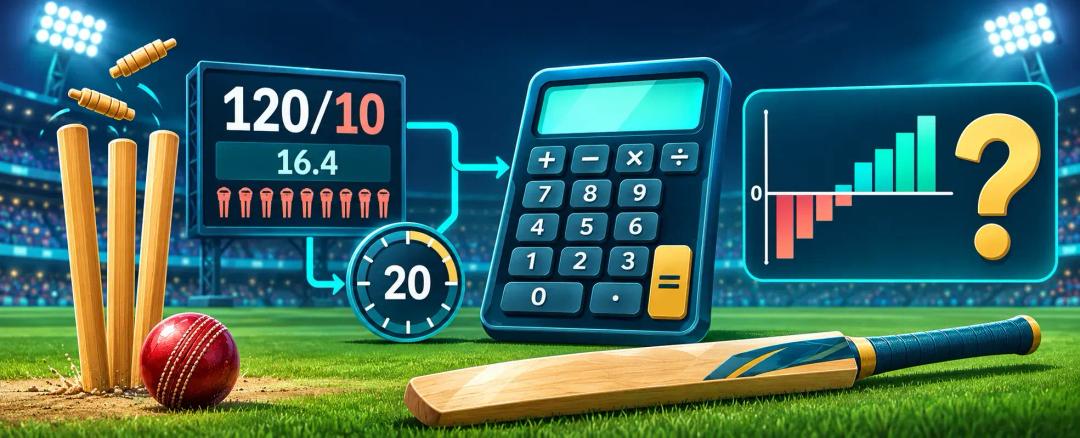
Under this model, use the innings' full allocation, not the shorter duration on the scorecard. If the opponent is dismissed for 144 in seventeen overs while chasing 181, its bonus-calculation rate remains 144 ÷ 20 = 7.2.
Using 144 divided by seventeen would answer the wrong question. Preserve actual deliveries for the scorecard and the allotted quota for the bonus calculation.
Keep numeric precision until the decision is made. A rounded display should explain an approved bonus, not determine whether a borderline performance qualifies.
Has a Bonus Point Changed a Real League Table?
Yes. On January 12, 2026, Pretoria Capitals scored 185/6 and restricted MI Cape Town to 132/7 in the SA20. The league's official match report records a 53-run, bonus-point victory that lifted Pretoria to the top of the table.
That is a documented outcome, not a guarantee that every large win earns an extra point. The competition's own conditions determine the award.
For a commissioner, the lesson is that the extra reward can change a standings position. It deserves the same checking process as the ordinary win points.
How Should Rain-Affected Matches Be Treated?
Write the answer into the regulations before the forecast becomes relevant. Under the cited ICC bonus model, a DLS-revised target means bonus calculations use the revised target minus one and the new allocation.
Assume the authorized revised target is 121 from fifteen overs. This is an illustration, not a target calculated here using DLS.
The reference rate becomes 120 ÷ 15 = 8, and the bonus rate becomes 8 × 1.25 = 10. The chasing deadline is 121 × 6 ÷ 10 = 72.6 balls, so the target must be reached within 72 legal balls, or 12.0 overs.
Do not carry an earlier deadline into the revised chase. Have the designated official approve and communicate the new requirement.
If rain ends play permanently, apply your rulebook's specific provision. A DLS win does not, by itself, establish a bonus entitlement, and a no result receives no bonus under our sample policy.
What Is the Difference Between Net Run Rate and Bonus Points?

Net run rate and bonus points are separate calculations. NRR compares aggregate scoring and conceding rates across eligible matches; a bonus adds standings points when its stated condition is met.
The ICC clause cited above calculates NRR from aggregate rates, uses the full quota for early all-out innings, and lists the bonus point as a separate item. Teams level on points are then separated by wins, head-to-head wins, bonus points, and only then NRR.
Our isolated 180-versus-144 example illustrates the distinction:
- Match rate difference: 9 minus 7.2 = +1.800.
- Standings award: four win points plus one bonus point = five.
The bonus does not turn +1.800 into +2.800. For the underlying arithmetic, read How Net Run Rate Is Calculated in Cricket Tournaments.
Now consider three teams in a hypothetical league, each having completed four matches without ties or no results:
| Team | Wins | Ordinary points | Bonus points | Total |
|---|---|---|---|---|
| Team A | 3 | 12 | 2 | 14 |
| Team B | 3 | 12 | 0 | 12 |
| Team C | 2 | 8 | 2 | 10 |
The totals are 12 + 2 = 14, 12 + 0 = 12, and 8 + 2 = 10. Team B cannot overtake Team A solely through a better NRR when total points rank first.
Where totals remain equal, apply the published ranking sequence. Cricket Points Table Tie-Break Rules: Scoring Guide addresses that separate decision.
Will Bonus Points Automatically Make the League Fairer?
Not necessarily. Decide what fairness means for this event before choosing a threshold.
In a study of World Test Championship points, published online in 2024 and appearing in a 2025 journal issue, Bireshwar Bhattacharjee and colleagues proposed an alternative model considering factors including opposition strength, home advantage, and winning margin. It was a research proposal, not an adopted ICC rule.
For a community league, that raises a practical question: do teams face comparable opponents? Rewarding large margins against very different opposition may not fit your intended competition.
We would test the proposed system against a previous season's scorecards before introducing it. Explain any changed rankings, obtain agreement, and freeze the policy before fixtures begin.
How Should Points Table Bonus Points Be Displayed?
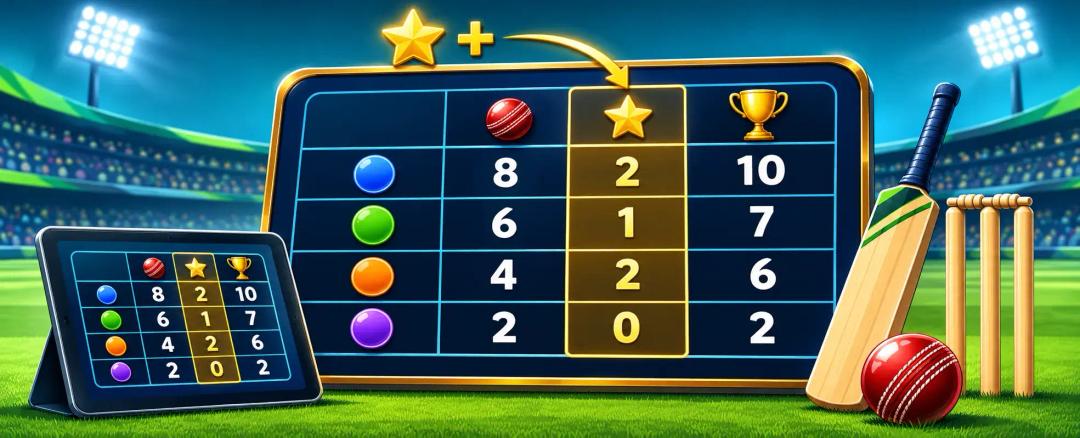
Begin with the approved rule sheet, then the software configuration, then the public presentation. Branding should make the calculation easier to understand.
The 12th Men's scheduling and scoring tools keep live scores and standings in one tournament workflow. Confirm the approved bonus rule and recording process before fixtures begin so organizers and captains use the same published method.
Assign the approving official, document how the award is recorded, and state how a corrected score changes the table before the tournament begins.
Keep an award record with these fields:
- Match and winning team
- Applicable allocation and qualifying threshold
- Actual outcome
- Approving official
- Approved scorecard and any revised-target document
This gives the next administrator something to check. It also lets captains ask about a specific calculation instead of arguing over an unexplained point.
In your published standings, give ordinary points, bonus points, deductions where applicable, and totals separate labels. Include the league name, season, team identities, update time, and a clearly marked provisional or confirmed status.
Keep sponsor artwork outside those figures. Pair a result graphic with a plain explanation such as “Four points for the win, one for meeting the published bonus threshold.”
Have a second official reproduce the calculation before releasing the table. A polished graphic should report the decision, not replace the evidence behind it.
Write Your Bonus Points Cricket Tournament Rules Before the First Ball
Go back to the opening question. Under the sample policy, two ordinary wins earn eight points and one qualifying win earns five.
Everyone should know that arithmetic before anyone benefits from it.
Use the rules and format guide to document the threshold, exceptions, and approval process before the first ball. Bring a borderline chase and a rain-adjusted example to the walkthrough, book a demo, or view pricing before setting up your next tournament.
Sources
- ICC Men's ODI Playing Conditions, Appendix F: Bonus Point System
- ICC Men's ODI Playing Conditions, Clause 16: The Result
- SA20 match report: Pretoria Capitals bonus-point win over MI Cape Town, January 12, 2026
- Butler, Lenten and Massey 2020, Scottish Journal of Political Economy
- Bhattacharjee et al. 2024, Management and Labour Studies

Sports Enthusiast
Sports enthusiast and writer passionate about sports technology, tournament management, player auctions, and scoring solutions. Sharing insights, trends, and ideas that help organizers, players, and fans enhance their sporting experience.
FAQ
Got Questions? We've Got Answers.
No. Apply the competition's published points policy. The sample system in this guide uses one bonus for a qualifying victory, but it is not a universal cricket requirement.
Not under our win-based sample rule. Other systems need their own published eligibility conditions. Do not borrow an award from another competition without adopting its full definition.
No. The deadline depends on the target, reference rate, allocation, and governing rule. Sixteen overs is the calculated cutoff for the specific 161-run target example above.
No. Add them to the standings points total. Calculate NRR separately using the match inputs and adjustments required by your competition.
Related Articles
Cricket
From Cricket Auction to Scorecard: Sync Squads Faster
Carry approved auction squads into tournament fixtures and scorecards without retyping players. Learn how to verify identities, team branding, match selections and standings before the opening fixture.
Read More > Yug Shah|Oct 29, 2026|

Cricket
Cricket Points Table Tie-Break Rules: Scoring Guide
Prevent qualification disputes by publishing the tie-break chain early. This guide explains how points, wins, net run rate, head-to-head results and other approved criteria should be ordered and applied consistently.
Read More >Yug Shah|Oct 27, 2026|