Cricket Points Table Tie-Break Rules: Scoring Guide
To apply cricket points table tie-break rules, verify the points, then follow the competition’s published ranking criteria in order. Do not assume net run rate or head-to-head automatically comes first.
During a fictional academy auction, an administrator turns over the player list and writes three headings: points, wins, NRR. The team badges are ready, but the owners have not agreed which heading decides qualification.
That decision belongs before the first fixture, not after the last result.
Quick Summary: Key Takeaways
- Publish the ranking order before competition begins.
- Separate a tied match from teams tied on points.
- Check scoring inputs before trusting the standings.
- Explain qualification decisions beside the branded table.
What Should You Set Up Before the First Fixture?
Prepare one competition document covering points, ranking priorities, incomplete matches, and who approves results. Give captains and scorers the same version. For an affiliated event, obtain the governing association’s approved conditions before choosing any local variation.
Record its issue date, the deadline for raising a scoring query, and the official responsible for interpreting unclear situations. Keep that version available at the scoring desk throughout the event.
For a school, academy, corporate, or community league, decide how many teams advance from each group. Specify whether records carry into later rounds, what happens after a withdrawal, and the final fallback if every listed criterion remains equal.
Do not leave that last step as an improvised committee vote.
Research supports treating ranking as a design decision. László Csató’s tie-breaking study, first posted in 2022, used football simulations to show that ranking priorities can affect whether late fixtures still have competitive stakes. It did not test cricket’s NRR rules. The practical implication for our academy is to settle priorities before teams plan around them.
We would also run two sample tables through the proposed policy. One should contain equal points with different win totals; the other should contain three teams that have beaten one another.
If the committee cannot explain both outcomes, the policy needs more work.
Which Cricket Points Table Tie-Break Rules Apply First?
Use your event’s regulations, not the default order displayed by an app.
For a concrete reference, the 2026 Men’s T20 World Cup playing conditions, clause 16.10.4, used this sequence after equal group points:
| Priority | Comparison |
|---|---|
| First | Greater number of group wins |
| Second | Higher group NRR |
| Third | Head-to-head outcome if still level |
| Final fallback | ICC men’s T20I rankings dated February 6, 2026 |
That final fallback belongs to this international event. An academy league needs its own published, applicable equivalent.
By contrast, the ICC men’s T20I conditions effective October 2026, clause 16.10.1, put wins against the other tied teams before NRR in their league-competition provision. Identify the document governing your event rather than mixing the two sequences.
Stop when a criterion separates the teams. A later criterion does not override an earlier one simply because an owner prefers its outcome.
Keep the distinction visible when configuring The 12th Men scheduling and scoring tools or another event platform. Ask whether its ranking behavior matches your approved policy before relying on automatic qualification.
Can Teams Have Equal Points but Different Win Totals?
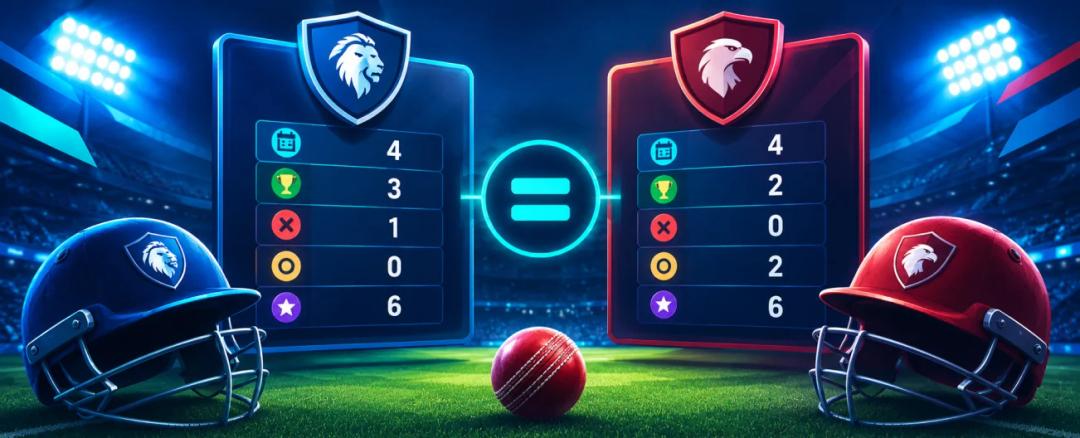
Yes. Here is a fictional example using two points for a win, one for a no result, and none for a loss. Neither team has a tied match.
| Team | Matches | Wins | Losses | No results | Points |
|---|---|---|---|---|---|
| Ashoka CC | 4 | 3 | 1 | 0 | 6 |
| Mill Road XI | 4 | 2 | 0 | 2 | 6 |
Ashoka’s calculation is 3 × 2 = 6. Mill Road’s is (2 × 2) + (2 × 1) = 6.
Under a wins-before-NRR policy, Ashoka ranks higher. Mill Road could have the better NRR and still finish below it.
That is not a scoring malfunction. It follows the assumed rule order.
Back at our auction, this is the example worth showing owners before discussing logos or a qualification graphic. Once both teams also have equal wins, move to the next criterion.

How Do You Resolve a Three-Team Tie?
Compare the tied group using the rulebook’s multi-team procedure. Do not pick a convenient pair and ignore the third side.
Suppose three teams remain equal when the head-to-head step is reached. Ashoka beats Mill Road, Mill Road beats Orchard, and Orchard beats Ashoka. Each has one victory against the other tied teams, so those head-to-head wins alone do not separate them.
Your policy must explain what comes next.
The ICC’s published explanation of the 2003 World Cup rules illustrates why wording matters: it specified continuing down the criteria rather than restarting after partially separating teams. That instruction belongs to the cited competition, not every possible league format.
For a local mini-table, define which matches count and whether the procedure restarts when only two teams remain level. Do not invent either instruction after the results are known.
Which NRR Details Should Scorers Verify?

Use aggregate scoring and conceding rates, not an average of individual match NRRs. For an early all-out innings, use the full allotted quota.
In a fictional twenty-over fixture, a team dismissed for 126 in 15.4 overs therefore contributes a batting rate of 126 ÷ 20 = 6.3 runs per over.
Keep actual deliveries and the NRR allowance as separate records. They answer different questions.
For ordinary six-ball overs, 17.2 means 104 legal balls: (17 × 6) + 2. It is not 17.2 decimal overs.
Retain calculation precision before formatting the display. Two figures shown as +0.450 might differ underneath, so establish whether your regulations compare unrounded values or a specified precision.
Our How Net Run Rate Is Calculated in Cricket Tournaments article covers the arithmetic. Once ranking priorities are settled, NRR Qualification Guide: What Do We Need? addresses the separate question of qualification scenarios.
Are a Tied Match and Equal Points the Same Problem?
No. A tied match concerns one result. Equal points concern the order of teams across a competition.
ICC T20I conditions provide Super Overs for tied matches. The World Cup’s NRR rules exclude those extra innings. Neither provision creates a playoff between teams merely level on group points.
Do not combine these procedures in your scoring settings.
For weather and administrative outcomes, separate points allocation from NRR treatment:
| Situation | What the scoring team should verify |
|---|---|
| No result | Apply the points policy; exclude the match from NRR |
| DLS result | Record the official outcome and prescribed NRR adjustments |
| Forfeit or awarded match | Apply the event’s specific provision, not a guessed score |
ICC conditions distinguish these cases. Rain alone does not tell you which row applies.
Keep the official DLS target or par-score record with the scorecard. An interrupted match that finishes against a revised target needs different NRR inputs from an abandoned chase with a declared DLS result.
Set knockout contingencies separately too. A washed-out semifinal and an incomplete group fixture need not have the same consequence. Publish the approved fallback rather than allowing a screen label to decide who advances.
What Should Cricket Scorer Training Include?

Start with result verification, not just tapping runs into a phone. Assign responsibility for confirming totals, checking the result, and approving the table.
The ICC’s published scorer duties call for regular agreement checks between scorers and consultation with umpires where needed. Use that discipline in your cricket scorer training.
Then rehearse a short innings with extras, a wicket, an interrupted chase, and an input correction. Ask the trainee to explain the resulting points and NRR inputs, not merely finish the scorecard.
Cricket research offers a useful verification example. In their 2023 study of batting near a century, Leo Roberts and colleagues reconstructed individual innings totals from delivery data and compared them with another database before analyzing performance. The study investigated batting behavior, not tie-break administration; its checking method is the relevant lesson here.
For ball-by-ball scoring, compare the recorded innings with the approved total before releasing qualification graphics.
A corrected entry is not permission to reopen a finalized result. ICC T20I conditions prohibit changing the result once umpires and scorers have agreed the concluding scores. Escalate discrepancies through the authorized process.
Never move a team manually just to make the table match a captain’s preferred interpretation.
How Should You Configure and Brand the Published Table?
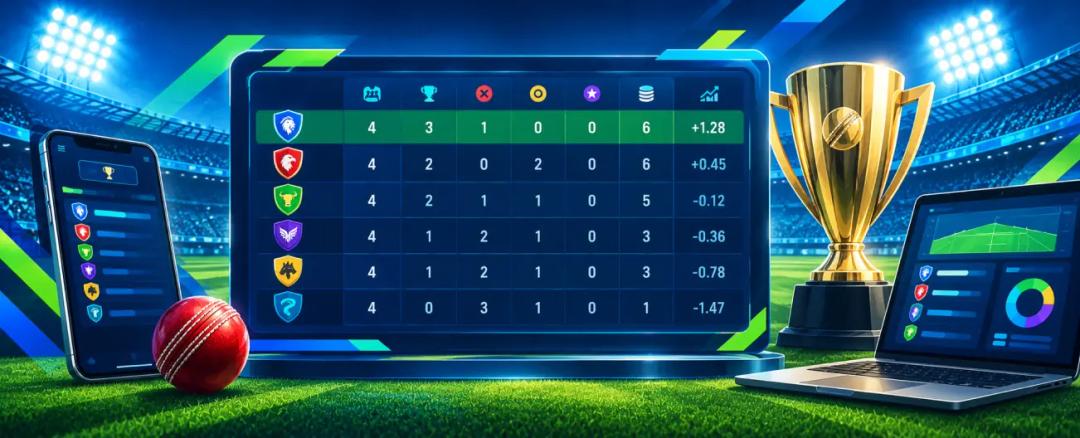
After agreeing the rules, create the groups and fixtures, assign scoring responsibilities, and test the ranking with sample results. Only then prepare the public presentation.
If the teams came from a player auction, use From Cricket Auction to Scorecard: Sync Squads Faster to verify approved squads and player identities before opening the first scorecard.
The 12th Men’s scheduling and scoring feature supports live scoring and automatic standings updates, while its operating guide covers tournament groups and scorer assignments. The public product documentation does not state that organizers can define a custom tie-break order such as wins, NRR, then head-to-head. Confirm that requirement with support before enabling automatic qualification.
A practical cricket scoring app guide should document that test and identify who resolves exceptions.
For the branded table, keep the competition name, season, group, and team names consistent with the auction material. Show matches, wins, losses, unresolved ties where relevant, no results, points, and NRR with clear labels.
Place sponsor artwork outside the figures. Add an update time and distinguish provisional standings from confirmed qualification.
For our fictional league, a short explanation could read: Ashoka CC ranks above Mill Road XI because both have six points, but Ashoka has three wins against two. That sentence explains more than a colored qualification badge.
Provide one current table link and replace superseded graphics after authorized changes. Preserve the explanation with the revision so viewers can follow the decision.
Before releasing a semifinal lineup, ask another administrator to reproduce the order from the approved scorecards. Check the public page on a phone as well as the organizer’s screen. If one view is stale, resolve that mismatch before announcing that a team has qualified.
Agree on the Rule Before Anyone Needs It
The academy auction can continue. Its team badges are ready, but now the owners also understand what separates equal records.
That is the preparation worth carrying into match day.
Bring your points policy and two sample tied tables to a demonstration. Test the decision, not just the appearance of the screen.
Get the free scoring app to record match results and publish standings from one workflow.
Continue with The 12th Men
Read next: How Net Run Rate Is Calculated in Cricket Tournaments
Need help setting up your event? Scoring and streaming set up for your event: live scorecards, points table, NRR and YouTube overlays.


Sports Enthusiast
Sports enthusiast and writer passionate about sports technology, tournament management, player auctions, and scoring solutions. Sharing insights, trends, and ideas that help organizers, players, and fans enhance their sporting experience.
FAQ
Got Questions? We've Got Answers.
No. Follow the sequence published in your competition rules. Some events compare wins before NRR, while others use head-to-head earlier. Verify the governing document, apply each criterion in order, and stop as soon as one criterion separates the teams fairly and consistently.
Apply the published multi-team procedure to every tied side, not just a convenient pair. Define which matches count, the next fallback criterion, and whether comparisons restart if the tied group becomes smaller. Test a circular win scenario before the tournament begins.
No. The organizer should publish the tie-break policy before the competition starts and name the official who resolves disputes. Scorers record and verify totals, results, points and NRR inputs. When wording is unclear, they should escalate the question rather than inventing or changing the ranking rule.
Software can calculate standings automatically only when its configured logic matches the competition rules. Before relying on qualification, test equal points, equal wins, head-to-head results, a no result and a corrected score. Keep a human approval step for exceptions or unsupported tie-break sequences.
Related Articles
Cricket
From Cricket Auction to Scorecard: Sync Squads Faster
Carry approved auction squads into tournament fixtures and scorecards without retyping players. Learn how to verify identities, team branding, match selections and standings before the opening fixture.
Read More >Yug Shah|Oct 29, 2026|
Cricket
Cricket Auction Display Screen: Setup and Branding Guide
Design a screen that works for owners, players and viewers. Decide which player details, live bids, team purses, timers and sold states stay visible, then layer in colors, overlays and timed sponsor takeovers.
Read More >Yug Shah|Oct 22, 2026|