How Net Run Rate Is Calculated in Cricket Tournaments

By Yug Shah
|
Sep 23, 2026
|
|

“We won. Why did our net run rate go down?”
Imagine that message arriving from a captain whose team has just celebrated its second victory. Nobody disputes the scorecard. The argument concerns a number on the points table.
Understanding how net run rate is calculated means looking beyond the latest result. This guide follows an illustrative club campaign, checks the arithmetic, and explains the exceptions tournament directors should verify before announcing qualification.
Net run rate is your team’s aggregate scoring rate minus its aggregate conceding rate, using the runs and overs counted under the competition’s rules.
Quick Summary: Key Takeaways
- Add totals before dividing. Do not average individual match NRRs.
- Convert overs properly. The notation 18.4 means 18 overs and four balls, not 18.4 decimal overs.
- Check exceptions. All-out innings, interrupted matches, and Super Overs require specific treatment.
- Keep the calculation visible. Directors should be able to trace the published figure back to its inputs.
These checks underpin dependable sports event analytics, whether you organize through The 12th Men or another scoring system.
How Net Run Rate Is Calculated: The Formula
The calculation has two separate divisions:
NRR = (total runs scored ÷ total overs faced) − (total runs conceded ÷ total overs bowled).
Use eligible matches from the relevant stage, with the adjustments explained below. ICC competition conditions define NRR through these aggregate rates, not through a separate reward for each victory.
For straightforward arithmetic, suppose your side scores 180 from 20 overs and concedes 140 from 20.
Its scoring rate is 9.00. Its conceding rate is 7.00.
NRR = 9.00 − 7.00 = +2.000.
That positive number expresses a difference in runs per over. It is not a winning percentage or additional points.
Before using it to separate teams, check your tiebreaking order. The 2026 Men’s T20 World Cup conditions, for example, considered wins before NRR when teams finished level on points. Your local regulations need to state their own order.
These examples assume six-ball overs and ICC-style limited-overs rules. Confirm your tournament’s published conditions before applying them to local formats, stage resets, or specially awarded results.
Why Is 18.4 Overs Not a Decimal?
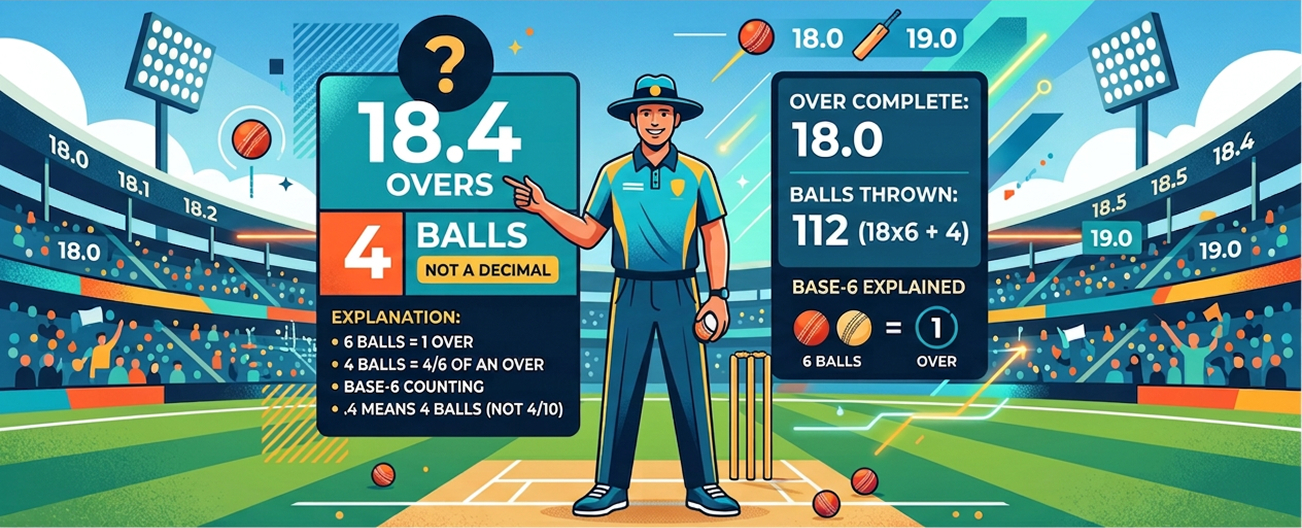
Because the figure after the point counts balls. Cricket uses six-ball overs, with wides and no-balls excluded from those six valid deliveries.
For an innings lasting 18.4 overs:
Legal balls = (18 × 6) + 4 = 112.
Overs for division = 112 ÷ 6 = 18.666666…
Dividing by 18.4 would use the wrong denominator.
| Scorecard notation | Legal balls | Decimal overs for calculation |
|---|---|---|
| 18.1 | 109 | 18.166666… |
| 18.4 | 112 | 18.666666… |
| 19.5 | 119 | 19.833333… |
Here is a quick check. A successful chase of 161 in 18.4 overs has a scoring rate of 161 × 6 ÷ 112 = 8.625.
Store balls as whole numbers rather than repeatedly rounding fractional overs. Preserve the original innings record separately from any NRR adjustment.
We would make this a mandatory demonstration when reviewing a tournament reporting dashboard. It is a small test with an unambiguous answer.
What Changes When a Team Is All Out?
Use its full allotted quota, not the shorter innings duration. That is the ICC rule for dismissal before the allocation expires.
Start our illustrative campaign with this result: Falcons score 180 in 20 overs, then dismiss Rangers for 100 in 16.4 overs.
Rangers’ NRR denominator is still 20 overs. Their 100 runs count at 5.00 per over, not 6.00.
Falcons therefore begin with:
180 ÷ 20 − 100 ÷ 20 = +4.000.
Use the actual allocation for that innings. If an event is reduced to 12 overs per side, an all-out innings uses twelve, not an automatic twenty. A successful chase normally uses the balls actually faced instead.
That distinction explains why an innings’ scorecard duration and its NRR allowance may differ.
How Do You Calculate NRR Across Multiple Matches?
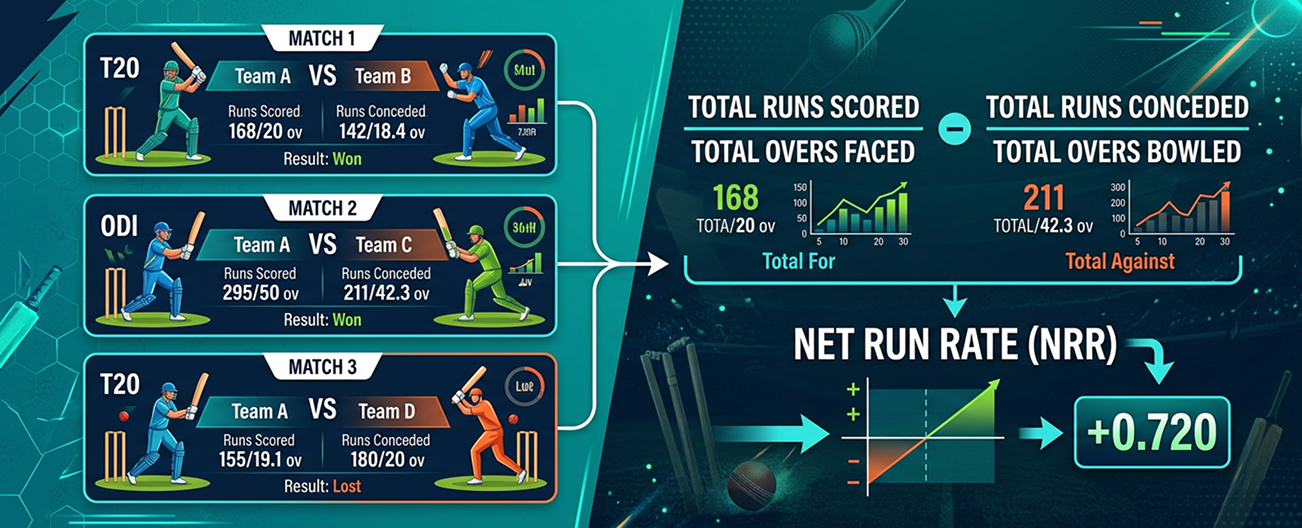
Now Falcons win again. This time they concede 160 in 20 overs and chase 161 in 18.4.
Keep the campaign totals in balls, including the all-out allowance from the first fixture:
| Match | Runs scored | NRR balls faced | Runs conceded | NRR balls bowled |
|---|---|---|---|---|
| Win against Rangers | 180 | 120 | 100 | 120 |
| Second victory | 161 | 112 | 160 | 120 |
| Combined | 341 | 232 | 260 | 240 |
Calculate from those totals:
Scoring rate = 341 × 6 ÷ 232 = 8.818965…
Conceding rate = 260 × 6 ÷ 240 = 6.500000.
Tournament NRR = +2.318965…, displayed as +2.319.
There is the answer to our captain.
Two wins. Yet the figure falls from +4.000 to +2.319. The second match added a smaller scoring advantage than the first, changing the aggregate rates.
Averaging the two match figures, +4.000 and +0.625, would instead produce +2.3125. Close, but wrong. In a tight group, close is not a satisfactory explanation.
Recalculate from the underlying totals and round only for display.
A Real Example: Australia’s 2022 Opening Defeat
On October 22, 2022, New Zealand scored 200/3 against Australia at the Men’s T20 World Cup. Australia were dismissed for 111 with seventeen deliveries unused. ICC reported Australia’s resulting NRR as −4.450.
Reproduce it using the full twenty overs for both sides:
Australia: 111 ÷ 20 − 200 ÷ 20 = −4.450.
The calculation matches the published figure. Australia’s early dismissal did not reduce its denominator.
This is a useful test case for a scoring system because directors can compare the output with a documented international result.
How Quickly Must a Team Chase to Reach a Target NRR?
Work from the existing totals, not just the next match’s margin.
Suppose Falcons carry the figures above into another twenty-over fixture. Their opponent scores 150 in twenty overs, and a rival has already finished on exactly +2.500.
Assume Falcons finish their chase on exactly 151. Their new totals would be 492 runs scored and 410 conceded. Let b be the legal balls used in this chase:
Projected NRR = (492 × 6 ÷ (232 + b)) − (410 × 6 ÷ 360).
Finishing in 84 balls, or 14 overs, produces approximately +2.508. Taking 85 balls produces approximately +2.479.
Under those assumptions, they must finish by 14.0 overs to beat +2.500.
A winning boundary could change the final run total and the deadline. Publish the assumptions with any qualification scenario; otherwise a precise-looking message can answer the wrong question.
How Do Rain and DLS Affect Net Run Rate?

First establish whether the match has an official result. A no-result fixture contributes neither runs nor overs to NRR; a rain-affected match decided by Duckworth-Lewis-Stern can count with adjustments.
When a revised target is set and the match concludes, ICC rules credit the first innings with the final target minus one, over the allocation given to the chasing side.
Suppose the official revised target is 121 from 15 overs. For NRR, the first innings becomes 120 from 15 overs, regardless of its original score. Apply the usual actual-overs or all-out treatment to the chase.
When play stops permanently but a DLS result is declared, the first innings is credited with the chasing team’s par score at abandonment, over the same number of overs the chasing side faced.
Use the official target sheet. Do not guess an adjusted total from the winning margin. A shortened match is not automatically a no result, and a DLS result is not permission to use unadjusted scorecard totals.
The research behind rain adjustments explains why. Frank Duckworth and Tony Lewis’s 1998 paper modeled remaining scoring resources using both overs and wickets. It provided a method for resetting interrupted-match targets, not a replacement for tournament NRR.
Keep those two calculations separate: one determines the revised match target; the other contributes to the standings.
What Should Directors Check Before Publishing Standings?
We would ask for a calculation report, not just a green number beside the leading team.
A useful tournament reporting dashboard should expose these checks:
| Check | Evidence to retain |
|---|---|
| Innings totals | Official scorecard totals, including extras |
| Overs allowances | Actual legal balls and any substituted quota |
| Match eligibility | Result status and applicable competition stage |
| Rain adjustments | Revised target, par score, and allotted overs |
| Corrections | Who approved the change and when totals were rebuilt |
Under the 2026 ICC conditions, Super Over runs and deliveries are excluded. Forfeited matches have separate provisions, so do not treat every awarded result as an ordinary win.
Test one complete match, one early dismissal, one partial-over chase, and both rain scenarios before the tournament begins. Ask a second official to reproduce the answers independently.
Keep provisional live figures separate from approved standings, and rank using unrounded values where your rules require that precision.
After a correction, review every affected team’s position before confirming qualification. Publish the changed input and revised calculation, not an unexplained replacement table.
The 12th Men cricket platform describes ball-by-ball scoring and statistics. Ask for a demonstration of your NRR rules and exceptions rather than assuming any automated table applies them correctly.
For wider planning, see our cricket tournament management guide.
Does NRR Explain Overall Cricket Performance?

Not by itself. An ordinary chase completed at the same score in the same number of balls produces the same NRR contribution whether the team loses two wickets or nine.
That is a consequence of the formula, not a verdict on either batting performance.
A 2025 systematic review by A.K.D.K. Chathurangi and colleagues examined batting, bowling, and fielding measures. It emphasized that conventional totals can miss contributions shaped by opposition, playing conditions, and match situations.
Our reading for directors: keep standings calculations distinct from broader sports performance insights. Present phase scoring, wickets, and other relevant match records alongside NRR rather than turning one number into an all-purpose assessment.
Make the Number Explainable Before It Becomes Disputed
The captain’s original question now has a reproducible answer, not an instruction to trust the software.
That should be the standard.
Understanding how net run rate is calculated means checking the inputs, applying the right exceptions, and keeping the final table open to verification.
Explore The 12th Men’s analytics and insights offering and request a demonstration using your tournament’s scoring rules. Bring an all-out innings, an unfinished over, and a rain-adjusted result. Ask to see how each number reaches the standings.
FAQ
Got Questions? We've Got Answers.
Yes. In the worked campaign above, Falcons’ second victory lowers their aggregate NRR from +4.000 to +2.319. Winning does not guarantee that the new scoring and conceding rates improve the existing difference.
No. Wickets matter through the all-out rule and can affect DLS adjustments, but ordinary NRR does not contain a separate wickets term.
Their runs belong in the innings total, but those deliveries do not count as legal balls toward the over. Use the official total and correctly recorded valid deliveries.
Yes, but use its existing aggregate totals, the opposition’s score, and the exact target NRR. Calculate ball by ball, retain full precision, and label any projection provisional until the official result is confirmed.
Related Articles

Guide
Badminton Tournament Bracket Generator: Easy Guide
Learn how a badminton tournament bracket generator supports singles and doubles events, fair seeding, court scheduling, live result updates, and smoother competition management for busy clubs. It also highlights practical steps, common pitfalls.
Read More >Yug Shah|Sep 21, 2026|
Guide
Real-Time Tournament Notifications: Organizer Guide
See how instant alerts reduce confusion on tournament day. This guide covers fixture reminders, venue updates, score notifications, delay announcements, and practical communication workflows for organizers. It also highlights practical steps.
Read More >Yug Shah|Sep 17, 2026|