Cricket Auction Day Run Sheet: Roles, Timing and Checks
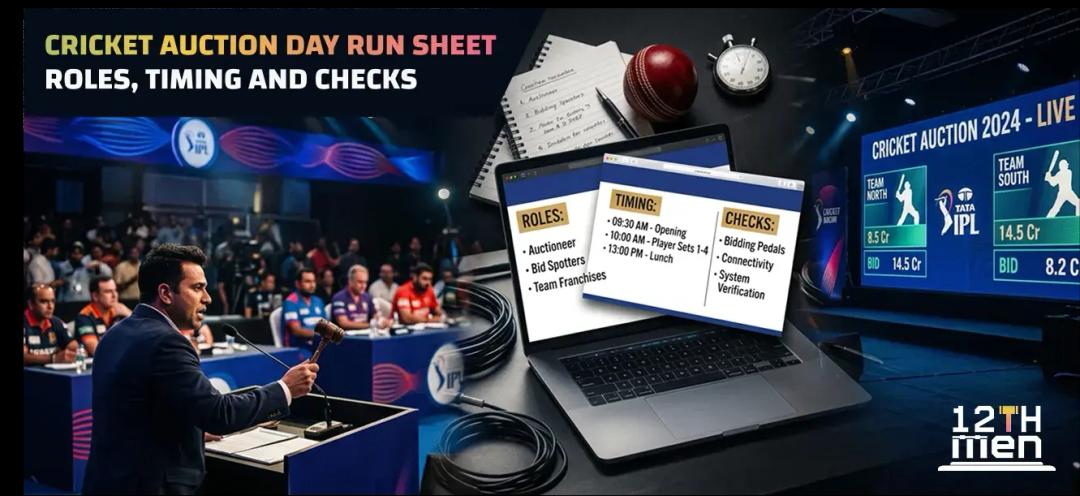
Table of contents
The hall is full. Owners are seated, the screen is on and the first player is about to go under the hammer. Does everyone on your team know what they do next?
A cricket auction day run sheet is one page that tells every person on the organizing team what happens, when, and who owns it, from the first device check to the final squad sign-off. Build it from your rules and a timed mock auction, then hand the same copy to everyone.
Quick Summary: Key Takeaways
- Give each job one named owner: host, operator, rules checker, screen, help desk and recorder.
- Time the auction from your own mock run, then add breaks and a buffer.
- Plan the bidding order on purpose, because the order of sale can affect prices.
- Write the backup action for each likely failure before the day, not during it.
- End with a squad sign-off that every owner agrees to before anyone leaves.
What Is a Run Sheet and How Is It Different From Your Rules?
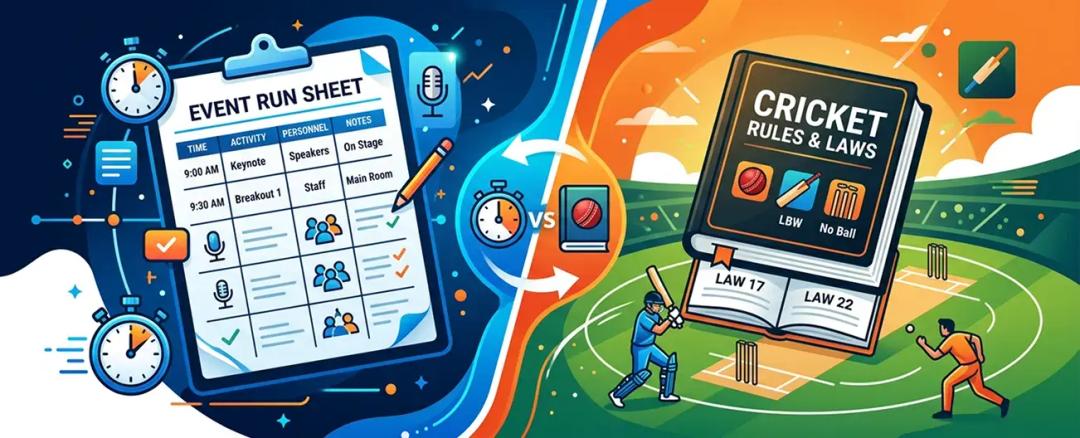
Your auction rules say what is allowed. Base prices, purse limits, squad sizes, what happens to unsold players. The run sheet says who does what, at what time, in what order.
You need both. Rules without a run sheet leave the host improvising. A run sheet without settled rules leaves the team arguing on stage. If your sold and unsold rules are not written yet, start with Sold, Unsold and Re-Auction Rules for Cricket Leagues and come back.
Who Does What on Auction Day?
In a small auction, one person may hold two jobs. That works, as long as every job below has a name next to it.
| Role | Owns | Should never also be |
|---|---|---|
| Host | Announcing players, calling bids, keeping pace | The person entering bids |
| Platform operator | Entering or confirming bids and sold or unsold calls | The person settling disputes |
| Rules checker | Purse limits, squad limits, category limits, disputes | A team owner |
| Screen and stream operator | Display, projector, any live stream | The only person with the venue Wi-Fi password |
| Owner help desk | Logins, remote bidders, device problems | The host |
| Recorder | Notes on disputes, corrections and final sign-off | Anyone with a stake in a team |
Clear auction day roles prevent two obvious jams. The host stops to fix a login, and the room stalls. Or the operator settles a dispute, and nobody is entering bids.
If you would rather not staff every role yourself, The 12th Men says on its scheduling and scoring page that it can help with running your auction on the day when you want hands-on support.
How Long Will the Auction Take?
Longer than the invitation says. The honest way to estimate it is to time a mock auction with your own host and operator.
Here is a hypothetical planning example. Imagine 8 teams and 120 players, with a mock run that averaged 90 seconds per player.
- Bidding time: 120 players × 1.5 minutes = 180 minutes, or 3 hours
- Two 15 minute breaks: 30 minutes
- Opening briefing and rules recap: 15 minutes
- Unsold round: 20 minutes
- Squad sign-off: 15 minutes
That adds up to 180 + 30 + 15 + 20 + 15 = 260 minutes, or 4 hours 20 minutes. A buffer of about 10 percent, roughly 25 minutes, takes the plan to about 4 hours 45 minutes.
Your numbers will differ. The working is the useful part. The quickest way to get real figures is a mock auction on the same platform you will use on the day.

What Should the Run Sheet Timeline Look Like?
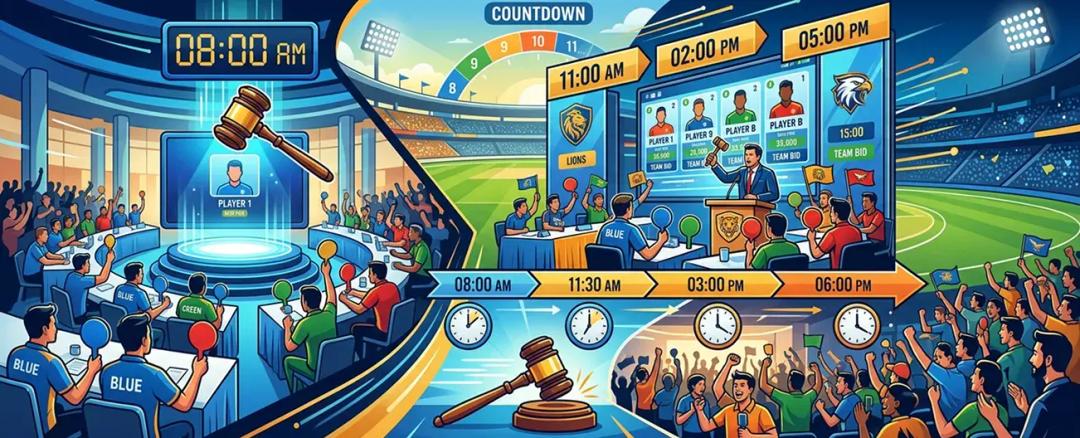
A player bidding schedule works best in blocks, with a check at the end of each one. This sample uses the timings above and a 10 AM opening.
| Time | Stage | Owner | Check before moving on |
|---|---|---|---|
| 8:30 AM | Device, power, network and screen test | Screen operator | Display shows a test player correctly |
| 9:15 AM | Owner logins and remote bidder test | Help desk | Every team can see its purse |
| 9:45 AM | Opening briefing and rules recap | Host and rules checker | Owners confirm they have the rules |
| 10:00 AM | Bidding block 1 | Host and operator | Purses and squad counts look right |
| 11:15 AM | Break | Recorder | Disputes logged and resolved |
| 11:30 AM | Bidding block 2 | Host and operator | Category limits still possible for every team |
| 12:45 PM | Break | Rules checker | Unsold list confirmed |
| 1:00 PM | Bidding block 3 | Host and operator | All listed players called once |
| 1:30 PM | Unsold round | Host and rules checker | Squad minimums can be met |
| 1:50 PM | Squad sign-off | Recorder | Every owner agrees their list |
The three bidding blocks add up to 75 + 75 + 30 = 180 minutes, matching the estimate. The plan finishes around 2:05 PM, with the buffer used for overruns.
What Goes on the Printed Run Sheet Itself?
Keep it to one page if you can. A run sheet that needs scrolling will not be read on the day.
- The auction day timeline from the table above, with real clock times
- Each role, the person holding it and their phone number
- The venue Wi-Fi details and the backup hotspot name
- The contingency table
- The sign-off steps at the end
Print one copy per person, plus two spares at the operator desk. Mark it with a version number, so nobody works from an old draft.

How Should You Brief Owners Before Bidding Starts?
The opening briefing is the last chance to settle questions before money is on the line. Keep it short and cover the same points every time.
- The purse, squad size and category limits for every team
- How a bid is placed, in the room and from a phone
- How the host will call sold and unsold
- What happens if an owner disputes a bid
- When the breaks are and when the sign-off will happen
Ask owners to raise questions now. A question answered at 9:50 AM is far cheaper than one answered in the middle of a bidding war.
Does the Order of Players Matter?
It may. In a well known paper, Orley Ashenfelter's 1989 study of wine and art auctions compared identical lots of wine sold in the same sale. Prices most often stayed the same, but they were at least twice as likely to fall as to rise for later lots.
Cricket players are not identical lots of wine. Still, it suggests that the order of sale is not neutral, and that owners may hold back early or run low on purse late.
Research on the IPL points the same way. Lenten, Geerling and Kónya's 2012 study in Sport Management Review found evidence of a superstar effect in the IPL auction, with overbidding for star players and underbidding for lesser ones.
For a local run sheet, that seems to support a few simple choices:
- Publish the order or the category sequence in advance, so nobody feels ambushed.
- Mix categories across blocks instead of saving all the strong players for the end.
- Expect star players to take longer and plan your block lengths with that in mind.
Whatever order you pick, every purse and category limit has to update after each sale, or owners will bid on numbers that are already out of date.

What Is Your Cricket Auction Contingency Plan?
Things go wrong on the day. The fix is deciding the response in advance and writing it on the run sheet.
| If this happens | First action | Owner |
|---|---|---|
| Venue internet drops | Switch to a mobile hotspot tested that morning | Screen operator |
| A remote owner loses connection | Pause that lot and phone the owner | Help desk |
| An owner disputes a bid | Pause, check the bid record, rule from the written rules | Rules checker |
| The display or projector fails | Keep bidding on the operator screen and read bids aloud | Host |
| A player is sold to the wrong team | Stop, correct before the next lot, log it | Operator and recorder |
| A player withdraws on the day | Remove from the list and tell owners before their block | Rules checker |
Keep a printed copy of the run sheet, the player list and the rules. If every screen fails, paper still works.
Which Platform Checks Belong on the Run Sheet?
The run sheet should match the tool you are using, so test the parts you rely on.
The 12th Men's player auction platform describes a live bidding dashboard, automated budget rules, player categories and remote bidding from phones when it is turned on. It also lists YouTube streaming with bid and team spend overlays, and sold or unsold alerts for players and owners.
Use those to set your checks. Confirm the budget rules and categories match your written rules. Test remote bidding with one real owner. If you stream, check the overlay on a second screen before the doors open.

How Do You Close the Auction Cleanly?
The last lot is not the end. The squad sign-off is.
Read out or display each team's final squad and remaining purse. Ask each owner to confirm. Note any correction and who agreed to it.
According to the feature page, The 12th Men can download team sheets in Excel or PDF, with sold and unsold lists and rosters, and move finalized rosters into the scoring module with one click. Share the confirmed sheets the same day, so there is one agreed version.
For the stages before and after the event, How to Run an Online Cricket Auction Successfully covers the wider process.
Hand Out the Run Sheet Before the First Bid
Go back to that full hall. When every person knows their job and the next step, the host can focus on the room.
Bring your rules and player count to a walkthrough. Book a demo to plan your auction day, or Start free and run a mock auction with your team. You can also see how auctions connect to fixtures on The 12th Men.

Sources

Sports Enthusiast
Sports enthusiast and writer passionate about sports technology, tournament management, player auctions, and scoring solutions. Sharing insights, trends, and ideas that help organizers, players, and fans enhance their sporting experience.
FAQ
Got Questions? We've Got Answers.
It should list each stage with a start time, an owner and a check before moving on. Add the roles, the contingency actions and the final squad sign-off.
Plan for six roles: host, platform operator, rules checker, screen operator, owner help desk and recorder. In a small auction, three or four people can cover them, as long as the host does not also enter bids and the rules checker is not a team owner.
Time a mock auction and multiply your average time per player by the number of players, then add breaks, an unsold round, the sign-off and a 10 percent buffer. For example, 120 players at 90 seconds each comes to about 4 hours 45 minutes in total.
Pause bidding, switch to a backup connection you tested that morning and tell remote owners by phone. Keep a printed player list and rules as a last resort.
Related Articles
Cricket
Digital Cricket Scorebook: Ball Entry to Shareable Scorecard
A digital cricket scorebook guide for scorers: match setup, ball entry, extras, wickets, corrections and closing the innings into a shareable scorecard.
Read More >Yug Shah|Nov 13, 2026|
Cricket
Quotient vs Net Run Rate in Cricket Standings Explained
Quotient vs net run rate in cricket explained with formulas and a worked example, plus why your rules must name one ranking method before the first ball.
Read More >Yug Shah|Nov 11, 2026|