Sold, Unsold and Re-Auction Rules for Cricket Leagues

By Yug Shah
|
Oct 5, 2026
|
|

The auctioneer says, “Sold.”
Someone at the desk assigns the player to Team Blue. The purse drops. Applause follows.
Thirty seconds later, another admin looks up.
“Wasn’t that player already marked unsold and requested for the re-auction round?”
Silence.
This is why cricket re-auction rules need to be settled before the first paddle goes up. A league should define exactly when a player becomes sold, what unsold actually means, who can return in a later round, and what happens when the auction record is wrong.
There is another reason scorers should care.
The auction result eventually becomes the squad list used for fixtures and scoring. A wrong status at the auction desk can become the wrong player on a match scorecard days later.
Quick Summary: Key Takeaways
- A player should become sold only after the final valid bid has been confirmed and the team purse and squad record have been updated.
- Unsold does not mean removed from the tournament. Your rules may allow selected unsold players to return in a re-auction or accelerated round.
- Re-auction eligibility, base prices, nomination limits, and bidding rules should be published before the event.
- A sold player should not quietly return to the auction because another owner changes their mind.
- Auction corrections and scoring corrections are different jobs. Do not edit a cricket scorecard to compensate for a wrong squad record.
- A good ball-by-ball scoring app should preserve player identity from auction to squad to match while giving authorized scorers a controlled way to correct genuine scoring errors.
What Does Sold, Unsold and Re-Auction Actually Mean?
These three labels should describe clear states, not informal comments made during the event.
| Status | Meaning | What should happen next |
|---|---|---|
| Available | Player has not yet completed bidding | Player remains in auction pool |
| Bidding | At least one valid bid is active | Auction remains open |
| Sold | Highest valid bid is confirmed | Player joins winning team and purse is reduced |
| Unsold | No valid bid is received under the published rule | Player moves to unsold pool |
| Re-auction eligible | Rules allow the unsold player to return | Player may appear in the later round |
| Re-auction complete | Player is sold or remains unsold again | Final status is recorded |
The distinction becomes especially useful when several admins are working simultaneously.
One person may control the bidding screen. Another tracks purses. Someone else prepares rosters for the scoring team.
If one screen says “unsold,” another says “Team C,” and a spreadsheet still says “available,” the argument is not really about cricket.
It is about records.
The 12th Men describes connected auction, squad, fixture, and scoring workflows rather than treating bidding as an isolated activity.
When Should a Player Be Marked Sold?

A player should be marked sold when the highest valid bid has been accepted under the league’s auction rules and no further valid bid is being taken.
For a local league, define what makes that moment final.
It may be:
“Going once. Going twice. Sold.”
Or it may be a digital countdown.
Either can work. The important part is consistency.
Imagine Player 24 opens at 2,000 auction points.
Team A bids 2,000.
Team B raises to 2,500.
Team A reaches 3,000.
Nobody responds.
The auctioneer confirms Team A at 3,000.
At that moment, the system should update all connected records:
- Player status changes to sold.
- Team A gains the player.
- Team A’s purse drops by 3,000.
- The squad count increases by one.
- The player is removed from the active auction pool.
The 12th Men’s published real-time bidding guide describes a similar flow where player status, squad information, and team budgets are updated as auction activity progresses.
We would also record who confirmed the sale and when.
That one detail can settle a surprising number of disputes.
When Is a Player Unsold?
A player is normally unsold when no team submits the minimum valid opening bid while that player is under auction.
Do not turn “unsold” into a judgment about ability.
Auction demand depends on timing, team requirements, purse balances, category restrictions, and which roles franchises have already filled.
A wicketkeeper may receive no bid early because every team already has one.
Twenty minutes later, one keeper withdraws and the same player suddenly becomes highly relevant.
Research into IPL auction pricing supports the broader point that player valuation is not a simple measure of cricketing quality. Vaseekaran Chittibabu and Malolan Sundararaman studied performance-based base prices for IPL mega auctions and showed how auction design and starting valuations affect the process. Their work focused on historical IPL data, not local league re-auction policy, but it is a useful reminder that the price attached to a player is partly a product of the market mechanism around that player.
That is why we would use “unsold” as a transaction status.
Nothing more.
Should Unsold Players Be Allowed Back Into the Auction?

They can be, if your published cricket re-auction rules allow it.
This is where a local league needs to make a choice before auction day.
One practical model is an accelerated round after the main player sets. Teams submit names from the unsold pool that they want to see again.
Another approach is simpler: every unsold player gets one second opportunity.
Both systems can work.
What does not work well is deciding case by case once owners know which players are still available.
Professional cricket auctions also use later auction phases. During the 2026 IPL auction cycle, the official auction list contained 350 shortlisted players competing for 77 available squad slots, so a large number would inevitably remain without a sale. Reporting from the auction showed examples of players who were initially unsold and later purchased during accelerated bidding, including Lungi Ngidi.
Local leagues do not need to copy the IPL.
They do need the same basic clarity.
What Should Your Cricket Re-Auction Rules Cover?
Before registrations close, answer these questions in writing.
| Rule area | Example local policy |
|---|---|
| Re-auction eligibility | Only players declared unsold in the main round may return |
| Nomination | Each team may request up to 3 unsold players |
| Base price | Original base price remains unchanged |
| Bid increments | Same increments as the main auction |
| Purse rules | Normal remaining-purse rules continue |
| Squad limits | Teams cannot exceed category or roster limits |
| Auction order | Re-auction follows the main player sets |
| Final unsold status | A second unsold result closes that player’s auction |
| Corrections | Only an authorized admin may reopen an incorrect status |
These are sample rules rather than universal cricket regulations.
Your competition may choose something different.
The key is that every team sees the same rules before strategic decisions begin.
For organizers still designing opening prices and purse limits, the related guide on base prices, purses, and bidding rules is a natural next read. You can also use the current real-time cricket bidding guide when planning how auction states should be recorded digitally.
Should the Base Price Change During Re-Auction?
Our preference for a local league would be simple: keep the original base price unless the rulebook explicitly says otherwise.
Why?
Because dropping it informally after the first round changes the conditions after teams have already made decisions.
Suppose a player opens at 5,000 points and receives no bid.
If the organizer suddenly brings that player back at 2,000, an owner who skipped the first round may have been rewarded for waiting.
That does not automatically make price reduction unfair. It just means it should be known beforehand.
You could publish a system such as:
First round: 5,000.
Second round: same 5,000.
Final open pool: reduced base price where allowed.
If that is the structure, everybody can plan around it.
Never invent the discount at the microphone.
Can a Sold Player Be Re-Auctioned?
Normally, no.
A confirmed sale should be treated as final unless the league discovers a defined reason to void it.
Good examples include:
- The accepted bid exceeded the team’s legal purse.
- The team had already reached a squad limit.
- The wrong player record was displayed.
- A technical problem caused the wrong bidder to be recorded.
- The auctioneer accepted a bid that did not meet the published increment.
- The player was later found ineligible before rosters were finalized.
Buyer’s regret is different.
If Team A spends too much on its first three players and later wants its purse back, that should not turn a sold player into an unsold one.
We would give one tournament administrator authority to void a sale, document the reason, restore the purse, return the roster slot, and decide whether the player goes back into the current round or a later re-auction pool.
Do all four updates together.
Partial corrections create bigger problems later.
What Happens When Auction Data Moves Into Scoring?

This is where the audience for this guide, scorers and admins, becomes especially important.
The auction finishes on Sunday.
The first match is Friday.
Between those days, sold-player records become team rosters.
The intended flow looks something like:
Registration → Auction → Sold Player → Team Squad → Fixture → Playing XI → Ball-by-Ball Scorecard
The 12th Men positions its platform around this connection between auctions and match scoring.
You can explore its Auction and Scoring Integration feature when planning this handoff.
The benefit is not just convenience.
It reduces opportunities to recreate player identities manually.
If “Rohit Patel” is purchased at the auction, the scorer should ideally select that same approved player record rather than create “R. Patel” again on match morning.
Duplicate records are how one person ends up with two sets of statistics.
What If the Wrong Player Appears on the Scorecard?
First determine whether you have a roster mistake or a scoring mistake.
They are not the same thing.
If Player A was correctly sold to Team Red but accidentally added to Team Blue’s roster, repair the team assignment through the administrative record.
If Player A genuinely played for Team Red but the scorer selected Player B for one over, that is a scorecard correction.
Do not change the auction result simply to make the scorecard look right.
When you edit a cricket scorecard, preserve the match event as accurately as possible. Correct the affected delivery, batter, bowler, dismissal, or run entry through an authorized scoring process.
Then check the dependent statistics.
A single wrong ball can affect:
- Batter runs and balls faced
- Bowler figures
- Extras
- Wickets
- Partnerships
- Strike rate
- Economy rate
- Match total
- Player statistics
This is why cricket scoring mistakes deserve an audit trail rather than a quiet overwrite.
Why Does Ball-by-Ball Accuracy Matter So Much?
Because later reports depend on the delivery record underneath them.
Researchers Leo Roberts, Daniel Little, Mervyn Jackson, and Matthew J. Spittal used ball-by-ball data from 712 Test matches for a 2023 PLOS ONE study. As part of their data validation, they independently rebuilt player innings totals and compared them with another cricket database. Across 25,825 individual innings, they found only one one-run discrepancy.
Their research was about batting behavior near centuries, not tournament administration.
The validation process is the useful lesson for scorers.
When statistics matter, verify the underlying event data rather than assuming a polished total must be right.
For a local competition, you do not need a research pipeline.
You do need basic checks.
Does the innings total reconcile?
Do legal balls match the displayed overs?
Does the fall of wicket belong to the correct batter?
Did a corrected no-ball update the bowler and team total?
A trustworthy ball-by-ball scoring app should make corrections controlled but possible.
A Practical Correction Workflow for Scorers
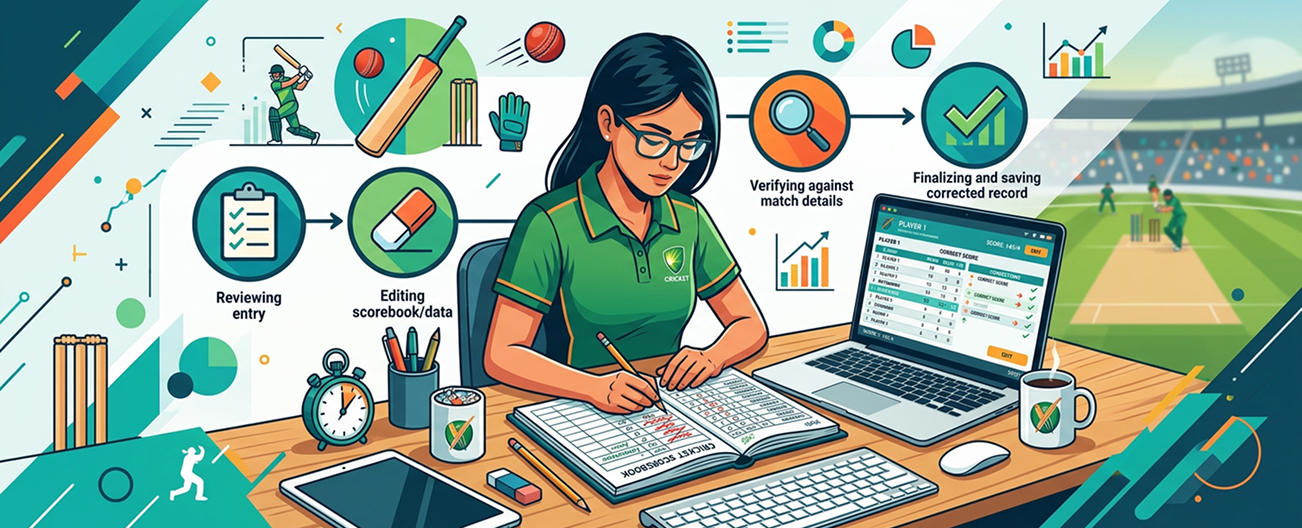
Use one process every time rather than improvising according to who complains.
| Problem | Correct action | Avoid |
|---|---|---|
| Wrong team assignment before match | Correct roster record | Creating a duplicate player |
| Wrong batter selected | Edit affected scoring entry | Changing player statistics manually |
| Wrong bowler selected for an over | Correct the relevant deliveries | Leaving figures under the wrong bowler |
| Wrong sold status | Correct auction record with admin approval | Editing the scorecard |
| Re-auction sale changed team | Update roster before scoring begins | Keeping the old team assignment |
| Historical score correction | Record reason and recalculate dependent stats | Silent overwrite |
In our experience, the most useful question during a correction is not “Can I edit this?”
It is:
“What else changes if I edit this?”
That is the question a scorer should ask before touching a completed scorecard.
Do Not Let “Sold” Become a Guess
Return to the auction desk.
The disputed player was not the real problem.
The real problem was that nobody knew which record was final.
Good cricket re-auction rules remove that ambiguity before it reaches the microphone, the squad list, or the scorecard.
A player is available.
Then bidding starts.
Then the player is sold or unsold.
If your rules allow it, the unsold player may return.
Once the final auction status is confirmed, that record should follow the player into the team and eventually into the scorecard.
Simple sequence.
Much less cleanup.
If your league runs auctions and ball-by-ball scoring, explore The 12th Men’s Auction and Scoring Integration and test the difficult scenarios, not just the happy path.
Bring an unsold player back. Void one incorrect sale. Move the corrected squad into a fixture. Then deliberately enter one wrong ball and see how the correction behaves.
That demonstration will tell you far more than a perfect sample auction.
FAQ
Got Questions? We've Got Answers.
Yes, if the competition’s published cricket re-auction rules allow it. Define who can nominate the player, whether the base price changes, and how many re-auction rounds are available before bidding begins.
Not necessarily. Unsold only describes the auction outcome at that stage. Your tournament may allow another auction round, replacement selection, or another published process.
A confirmed sold player would normally remain with the winning team. Reopening the sale should require a documented rule violation, eligibility issue, or recording error rather than a team simply changing its mind.
Use the scoring platform’s authorized correction workflow and update the exact event that was entered incorrectly. Then verify totals, wickets, batter statistics, bowler figures, and any other figures affected by the correction.
Because auction results determine squads. A connected system can carry the approved player identity and team assignment into fixtures and scoring, reducing repeated data entry and duplicate player records.
Related Articles

Cricket
Player Categories in Cricket Auctions: Rules That Work
Create player categories that produce balanced squads instead of auction-day confusion. This guide covers minimum and maximum players, category points caps and reserve calculations that protect each team's remaining purse.
Read More >Yug Shah|Oct 1, 2026|
Cricket
Cricket Auction Rules: How to Set Base Price, Purse and Bids
Build an auction rulebook every owner can follow. Learn how base prices, team purses, bid increments, maximum bids and minimum or maximum squad sizes work together before the first player goes on the block.
Read More >Yug Shah|Sep 28, 2026|