Digital Cricket Scorebook: Ball Entry to Shareable Scorecard
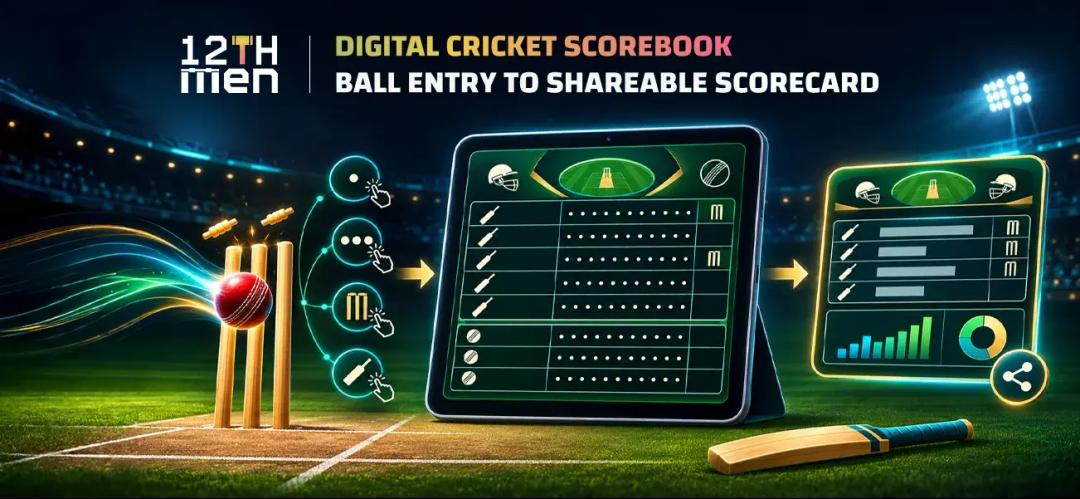
Table of contents
The last ball is bowled. Within a minute, both captains want the scorecard on their phones. Will yours be right?
A digital cricket scorebook records every delivery as it happens and turns those entries into a scorecard you can share the moment the match ends. Its accuracy depends on three things: a careful setup, the right entry for every extra and wicket, and a check with the umpires before you publish.
Quick Summary: Key Takeaways
- Set up teams, playing XIs, overs and match rules before the first ball, not during it.
- Wides and no balls do not count as balls of the over, so enter them as extras, not dot balls.
- Record how each batter was out, because some dismissals are not credited to the bowler.
- Agree the score with the umpires at intervals and at the end, then share the scorecard.
What Does a Digital Cricket Scorebook Actually Record?
A paper book and a digital one record the same facts. The MCC Laws on the scorers say scorers record all runs scored, all wickets taken and, where appropriate, the overs bowled.
The difference is what happens next. On paper, the scorer adds up columns at the end of each over and again at the end of the innings. In an electronic cricket scorebook, each entry updates the batting card, the bowling figures, the extras and the total at once.
That speed has a cost. A wrong tap spreads into every figure straight away, so the workflow matters more than the screen.
How Should You Set Up a Match Before the First Ball?
Setup is the easiest part of the match to get right, so do it while things are calm.
| Setup item | What to enter | Why it matters later |
|---|---|---|
| Teams and playing XIs | The 11 players per side, spelled as on the team sheet | Batting and bowling cards pull names from this list |
| Toss | Who won and what they chose | Sets which side bats first |
| Overs per innings | The agreed limit for this match | Drives the over count and the end of the innings |
| Match rules | Any local playing conditions, such as overs per bowler | Stops arguments partway through |
| Scorer access | Who is allowed to enter balls | Keeps two people from scoring one match |
If your squads come from an auction, check that the playing XI matches the final team list. In The 12th Men, the scoring app says squads picked at an auction run on the website carry straight through to scoring, so there is less retyping to go wrong.
What Should You Enter for Every Ball?
Every delivery needs the same small set of facts: the bowler, the striker, the runs, any extra and any wicket. A ball by ball scorebook is only as good as the least careful of those entries.
Most balls are simple. A dot, a single, a boundary. The ones that cause trouble are extras.
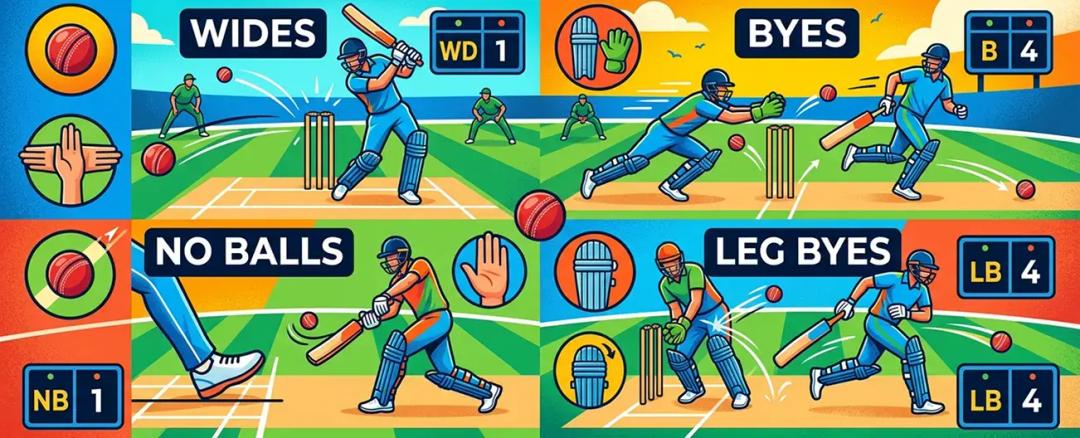
How Do You Record Wides, No Balls, Byes and Leg Byes?
The Laws set out exactly how each one is scored. Here is the short version for a scorer.
| Delivery | Penalty run | Counts as a ball of the over? | How other runs are recorded |
|---|---|---|---|
| Wide | 1 | No | All runs, including the penalty, are scored as wides |
| No ball | 1 | No | Runs off the bat go to the striker; otherwise they are byes or leg byes |
| Bye | None | Yes | Runs go to the batting side as byes |
| Leg bye | None | Yes | Runs go to the batting side as leg byes, if the umpire allows them |
The detail is in Law 22 on the wide ball and Law 21 on the no ball. Two points matter for bowling figures. Runs from a wide are debited against the bowler, apart from any 5 penalty runs. The one run no ball penalty is debited against the bowler too.
Here is a quick check. If a bowler sends down one wide in an over, the over will contain seven deliveries, because the wide is not one of the six. If your scorebook ends the over after six taps, something was entered as a legal ball when it was not.
How Do You Record Wickets Correctly?
Enter the dismissal type every time, not just "out." It changes the bowling figures.
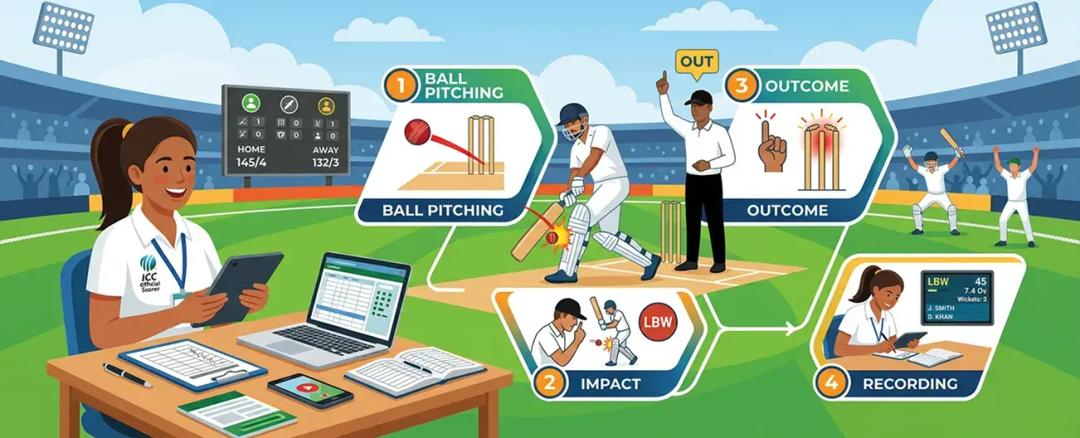
Some dismissals are not credited to the bowler at all. A run out is the common one, and the Law on run outs says plainly that the bowler does not get credit for the wicket. Hit the ball twice, obstructing the field and timed out work the same way.
After each wicket, confirm three things before the next ball:
- Which batter is out, striker or non-striker
- How they were out, and the fielder involved if any
- Who the incoming batter is and which end they take
That last point is easy to miss. A wrong striker means every run that follows lands on the wrong batter's card.
What If You Make a Mistake Mid Over?
You will. Every scorer does. The question is whether you catch it before it spreads.
The Laws already build in a check. They expect two scorers, who must frequently check that their records agree, and who must agree the runs, wickets and overs with the umpires at every interval other than drinks and at the end of the match.
There is research behind the habit of checking twice. In a 2011 study by Barchard and Pace in Computers in Human Behavior, 195 participants entered the same data sheets using one of three methods. Visual checking produced 2,958% more errors than double entry, and was not significantly better than entering the data once. The study used research data, not cricket, but it suggests that glancing back at your own entries is a weak check. A second scorer keeping an independent record seems to be the stronger one.
How Should Two Scorers Split the Work?
If you have two scorers, give them separate records. One scores in the app and the other keeps a paper sheet or a second device. Sharing one screen defeats the purpose, because both people end up checking the same entries.
Agree a signal for "check" at the end of each over. Compare the total, wickets and balls. If they differ, settle it at once, while both scorers still remember the over.
If you only have one scorer, the umpires' totals at each interval become the second record. Ask for them.
A Practical Correction Routine
- Pause at the end of each over and compare the total, wickets and over count with the scoreboard or second scorer.
- Fix errors in the over where they happened, not by adjusting a later ball.
- Note what changed and why, in case a captain asks.
- Check how your scoring app handles corrections before match day, so you are not learning it under pressure.
How Do You Close an Innings and Share the Scorecard?
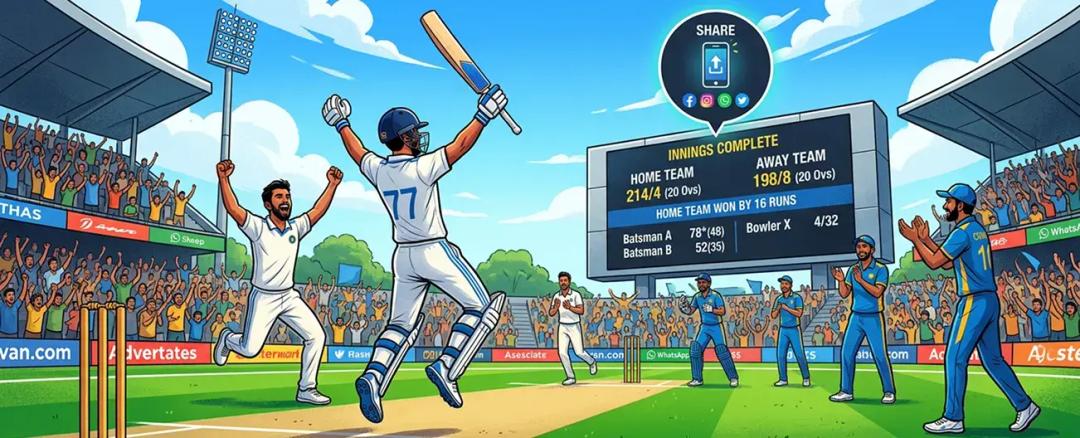
An innings ends when the overs run out, the side is all out, the target is reached or the captain declares, depending on the format. Close it in the scorebook only when the umpires agree.
Before you publish, run a final check:
| Check | What should match |
|---|---|
| Total | Batting runs plus all extras |
| Wickets | Dismissals listed on the batting card |
| Overs | Legal balls bowled, with wides and no balls excluded |
| Bowling figures | Each bowler's overs and runs match the entries for their overs |
| Result | Agreed with the umpires |
That last row has teeth. Once the umpires have agreed the scores with the scorers at the end of the match, the Laws say the result cannot be changed.
Then share. In The 12th Men, anyone with the match link can follow the live scorecard in a browser without installing anything, according to the app page. That makes it easy to share a cricket scorecard in a team group the moment the match is signed off.
Why Keep Ball Level Records at All?
Because the scorecard is a summary, and summaries hide things. Ball level records let you rebuild a partnership, check a bowler's spell or answer a dispute about the 14th over.
They are also the raw material for analysis. Swartz, Gill and Muthukumarana's 2009 study in the Canadian Journal of Statistics built a simulator for one day matches from ball by ball outcome probabilities, which depended on the batter, the bowler, wickets lost and balls bowled. A local club will not need that. It does show what careful ball entry makes possible later.
For the bigger picture of moving from paper, our post on Manual vs Digital Scoring covers the switch. If you are training a new scorer, Cricket Scoring Rules Explained for Beginners is a good first read.
Where Does a Digital Cricket Scorebook App Fit in a Tournament?
A single match scorecard is useful. A tournament needs those scorecards to feed the points table.
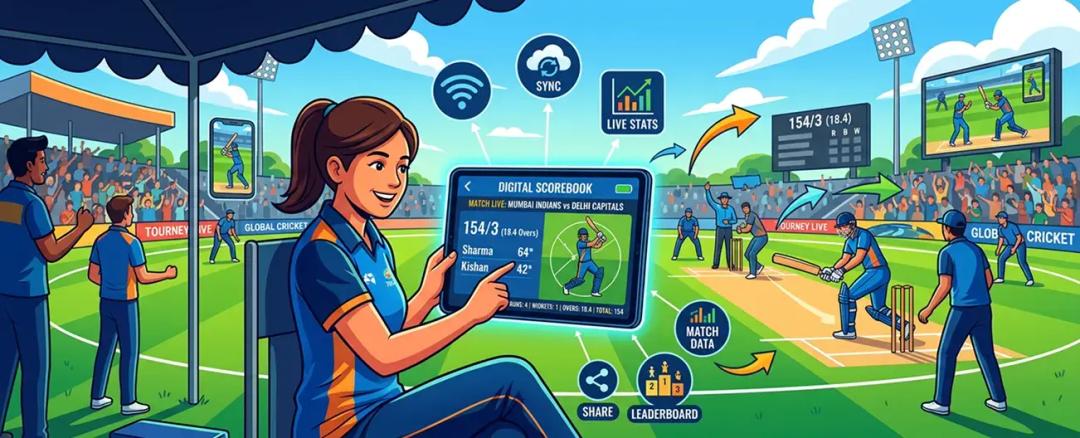
The 12th Men's scheduling and scoring tools describe scores that update live and standings that refresh automatically as results come in. Scoring matches and publishing live scorecards in the app is free, with no limit on the number of matches, according to the app page.
Whether you score on The 12th Men or another app, the scorer's habits are what make the scorecard right.
Score the Next Match Ball by Ball
Back to that final ball. A scorecard that is ready in a minute is only worth sharing if it is right, and that comes from setup, careful extras and a check with the umpires.
Start free and score your next match live, or Book a demo to walk through scoring and standings for a full tournament.
Sources
- MCC Laws of Cricket, Law 3: The Scorers
- MCC Laws of Cricket, Law 21: No Ball
- MCC Laws of Cricket, Law 22: Wide Ball
- MCC Laws of Cricket, Law 38: Run Out
- MCC Laws of Cricket, Law 16: The Result
- Barchard and Pace 2011, Preventing Human Error: The Impact of Data Entry Methods on Data Accuracy and Statistical Results, Computers in Human Behavior
- Swartz, Gill and Muthukumarana 2009, Modelling and Simulation for One-Day Cricket, Canadian Journal of Statistics

Sports Enthusiast
Sports enthusiast and writer passionate about sports technology, tournament management, player auctions, and scoring solutions. Sharing insights, trends, and ideas that help organizers, players, and fans enhance their sporting experience.
FAQ
Got Questions? We've Got Answers.
It is an app or program that records each delivery as it happens and builds the batting card, bowling figures, extras and total automatically. It replaces the columns a scorer would add up by hand in a paper book.
No. Under the Laws, a wide or a no ball does not count as one of the six balls of the over, so the bowler must bowl another delivery.
No. The Laws say the bowler does not get credit for a run out. Record the fielder involved and the batter who was out.
Not with The 12th Men. Anyone with the match link can follow the live scorecard in a browser.
Related Articles
Cricket
Cricket Auction Day Run Sheet: Roles, Timing and Checks
A practical cricket auction day run sheet covering roles, timed bidding blocks, device and purse checks, contingency planning and final squad sign-off.
Read More >Yug Shah|Nov 20, 2026|
Cricket
Quotient vs Net Run Rate in Cricket Standings Explained
Quotient vs net run rate in cricket explained with formulas and a worked example, plus why your rules must name one ranking method before the first ball.
Read More >Yug Shah|Nov 11, 2026|