Quotient vs Net Run Rate in Cricket Standings Explained

Table of contents
Two teams finish level on points. One has the better net run rate. The other has the better quotient. Which one goes through?
Quotient vs net run rate in cricket comes down to what each one divides by. Net run rate compares runs per over, while quotient compares runs per wicket, so the same results can rank two teams in opposite order. Your rules have to name one before play starts.
Quick Summary: Key Takeaways
- Net run rate measures scoring speed. Quotient measures how many runs each wicket is worth.
- The two methods can put tied teams in different order from the same scorecards.
- The ICC uses net run rate in ODIs, and the first World Test Championship (2019–21) used a runs per wicket ratio.
- Write the ranking method, the all-out rule and the zero wicket case into your playing conditions.
What Is Net Run Rate?
Net run rate is a team's average runs per over scored, minus the average runs per over scored against it, across the whole competition. The ICC's ODI playing conditions, clause 16 sets it out this way.
Two details catch people out. If a team is all out early, its innings counts as if it had used its full quota of overs. And only matches with a result count toward net run rate.
A positive figure means a team scores faster than its opponents. A figure of zero means it scores and concedes at the same rate. We cover the full working, including partial overs, in How Net Run Rate Is Calculated in Cricket Tournaments.
What Is the Quotient in Cricket?
The quotient, often called the runs per wicket ratio, divides runs scored per wicket lost by runs conceded per wicket taken. The cricket quotient formula looks like this:
Quotient = (runs scored ÷ wickets lost) ÷ (runs conceded ÷ wickets taken)
A quotient above 1 means each of your wickets is worth more runs than each of your opponents' wickets. Exactly 1 means the two are equal.
Quotient is most familiar in multi-day cricket standings, where overs matter less because there is no fixed innings length. The first ICC World Test Championship's playing conditions separated teams level in the standings by series wins first and then by runs per wicket ratio. Later editions use different tie-breakers, so always check the conditions for the cycle you are reading about.
How Do Quotient and Net Run Rate Compare Side by Side?
The cleanest way to see the difference is to line up what goes in and what comes out.

| Net run rate | Quotient (runs per wicket ratio) | |
|---|---|---|
| Inputs | Runs and overs | Runs and wickets |
| Formula | Runs per over scored minus runs per over conceded | Runs per wicket scored divided by runs per wicket conceded |
| Neutral value | 0 | 1 |
| Team all out early | Counted as the full quota of overs | Counted as the wickets that fell |
| What it rewards | Fast scoring and tight bowling | Keeping wickets and taking them |
| ICC example | ODI standings, clause 16 | First World Test Championship (2019–21) |
So run quotient vs NRR is really wickets against overs. Neither is wrong. They just answer different questions about the same matches.
Worked Example: Same Points, Opposite Order
This example is hypothetical. Imagine a 20-over league where a win is worth 2 points. Team A and Team B each play two matches, win one and lose one, so both finish on 2 points. Every innings below lasted the full 20 overs.
| Match | Team score | Opponent score | Result |
|---|---|---|---|
| Team A v Team P | 165 for 7 | 140 for 5 | Team A won by 25 runs |
| Team A v Team Q | 135 for 8 | 140 for 5 | Team A lost by 5 runs |
| Team B v Team R | 150 for 2 | 145 for 9 | Team B won by 5 runs |
| Team B v Team S | 120 for 4 | 135 for 5 | Team B lost by 15 runs |
Now add up each team's totals.
- Team A scored 300 runs for 15 wickets in 40 overs and conceded 280 runs for 10 wickets in 40 overs.
- Team B scored 270 runs for 6 wickets in 40 overs and conceded 280 runs for 14 wickets in 40 overs.
Net Run Rate Puts Team A First
Team A scored 300 ÷ 40 = 7.50 runs per over and conceded 280 ÷ 40 = 7.00. Its net run rate is 7.50 minus 7.00, or +0.500.
Team B scored 270 ÷ 40 = 6.75 runs per over and conceded 7.00. Its net run rate is 6.75 minus 7.00, or -0.250. Team A goes through.
If your team is the one chasing a spot before the last round, our guide to what you need to qualify on net run rate shows how to work out the margin that would change the order.
Quotient Puts Team B First
Team A scored 300 ÷ 15 = 20 runs per wicket and conceded 280 ÷ 10 = 28. Its quotient is 20 ÷ 28 = 0.714.
Team B scored 270 ÷ 6 = 45 runs per wicket and conceded 280 ÷ 14 = 20. Its quotient is 45 ÷ 20 = 2.250. Team B goes through.
Same four scorecards. Different qualifier. Team A batted aggressively and lost wickets. Team B batted cautiously and took more wickets, and only the quotient gives it credit for that.
Working this out by hand after every round is where mistakes creep in. A scoring app keeps the points table and net run rate current as each ball is scored.

Which Matches Move Each Number the Most?
Once you see the inputs, you can predict which results will swing each method. To trace which past result dragged your own figure down, see Which Match Hurt Our Net Run Rate?.
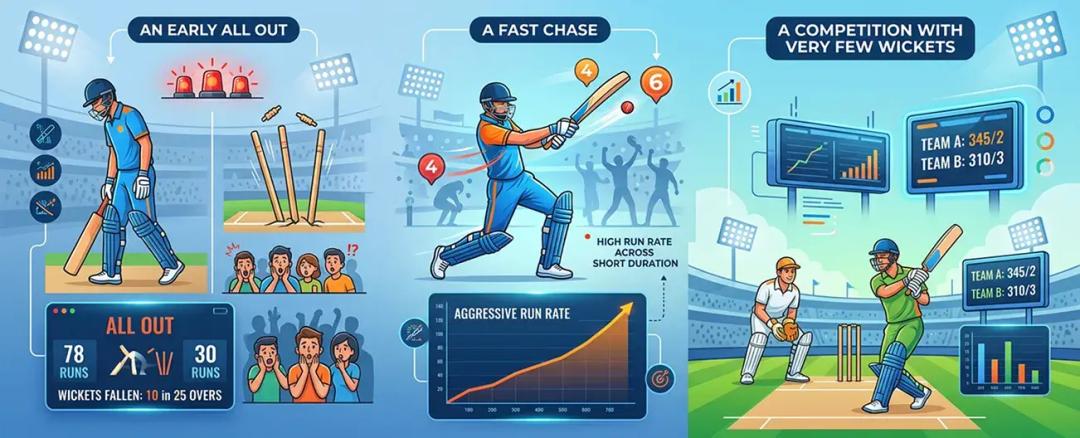
An Early All Out
Suppose a team is bowled out for 90 in 12 overs. Net run rate counts that innings as 90 runs from 20 overs, or 4.5 runs per over. The quotient counts it as 90 runs for 10 wickets, or 9 runs per wicket.
Both numbers are poor. But the net run rate rule removes any benefit from the eight overs the team never batted.
A Fast Chase
Now suppose a team chases 120 in 10 overs for the loss of 2 wickets. Its run rate for that match is 12 per over, which lifts net run rate sharply.
Its quotient credit is 60 runs per wicket. That is exactly what it would earn if the same chase took 19.5 overs. The quotient does not reward speed at all.
A Competition With Very Few Wickets
The quotient has one more weak spot. If a team loses no wickets across the competition, runs per wicket cannot be calculated, because you cannot divide by zero. It seems unlikely in a long season, but in a three-match group it can happen. Your rules should say what happens if it does.
Is There a Fairer Measure Than Either?
Net run rate looks only at overs. Quotient looks only at wickets. In limited-overs cricket, a team's remaining scoring potential depends on both.

That idea sits behind the target-resetting method that Duckworth and Lewis published in 1998 in the Journal of the Operational Research Society. It treats overs left and wickets in hand together as a team's resources. A few years later, de Silva, Pond and Swartz showed in 2001 that a modified version of that resource table could measure the size of a victory in one-day matches, and suggested it was particularly useful for breaking ties in tournament standings.
Neither study is a rulebook. They do suggest that any single ratio leaves something out, which is one more reason to publish your choice early and explain it.
Which Ranking Method Should Your League Use?
There is no universal answer, but the format tends to point one way.
| Format | Method that usually fits | Why |
|---|---|---|
| T20 or one-day league with fixed overs | Net run rate | Overs are fixed, so scoring rate compares like with like |
| Multi-day or timed matches with declarations | Quotient | Innings length varies, so overs say less than wickets |
| Short group with many washouts | Head-to-head before either | Small samples make both ratios swing widely |
Whatever you pick, put it in one place with the rest of your tie-break order. Our guide to Cricket Points Table Tie-Break Rules covers the full chain, and Cricket Qualification Scenarios Explained shows how to map out who needs what when the final round decides several places at once. Cricket league ranking methods only feel fair when every captain has read them before the first fixture.
What to Write Into Your Playing Conditions
- The method used after points and wins: net run rate, quotient or something else
- How an all-out innings counts
- Which matches count, for example only those with a result
- What happens if a team has lost no wickets
- How many decimal places you publish and how you round
Once the rules are written, keep them with your fixtures, scores and standings in one place instead of a shared spreadsheet.

How Do You Round and Publish the Numbers?
Rounding sounds minor until two teams match to two decimal places. Work out both ratios from the full totals, not from rounded match figures, and round only the final number.
Publish the totals behind the ratio too. For net run rate, that means runs and overs for and against. For quotient, it means runs and wickets for and against. When a captain can rebuild the number from the table, most arguments end quickly.
If your rules need a deciding step after the ratio, say what it is. Head-to-head results, a bowl-out or drawing lots are all used in different competitions, but only the one written in your playing conditions counts.
How Should Standings Show the Method?
Label the column. A table headed "NRR" that is really a quotient will start an argument the first time two teams finish level.

The 12th Men's scheduling and scoring tools give you live scoring with standings that refresh automatically, and the analytics and insights dashboard adds team performance trends and downloadable standings reports. Net run rate is built into the points table. If your league ranks on quotient instead, walk through that setup with our team on a demo before the season.
Whether you run standings on The 12th Men or by hand, recalculate any tie by hand before you announce a qualifier.
Pick Your Ranking Method Before Teams Finish Level
Back to the two teams level on points. Neither method is right in general. The only wrong answer is choosing one after the table is known.
Bring your playing conditions and a sample tied table to a walkthrough. Book a demo to see how your standings handle the tie, or Start free and set up your next league.

Sources
- ICC Men's ODI Playing Conditions, Clause 16: The Result
- ICC World Test Championship 2019–21 Playing Conditions: What's Different
- Duckworth and Lewis 1998, A Fair Method for Resetting the Target in Interrupted One-Day Cricket Matches, Journal of the Operational Research Society
- de Silva, Pond and Swartz 2001, Estimation of the Magnitude of Victory in One-Day Cricket, Australian and New Zealand Journal of Statistics

Sports Enthusiast
Sports enthusiast and writer passionate about sports technology, tournament management, player auctions, and scoring solutions. Sharing insights, trends, and ideas that help organizers, players, and fans enhance their sporting experience.
FAQ
Got Questions? We've Got Answers.
Net run rate compares runs per over scored with runs per over conceded. Quotient compares runs per wicket scored with runs per wicket conceded. The first rewards fast scoring and tight bowling, while the second rewards keeping wickets and taking them, so the same results can rank teams differently.
Yes. A team that scores quickly but loses many wickets can lead on net run rate and trail on quotient, while a cautious team that keeps wickets can do the opposite. That is why your playing conditions must name one method before the first match, not after teams finish level.
The first ICC World Test Championship (2019–21) used the runs per wicket ratio to separate teams level in the standings after series wins. Later editions use different tie-breakers, so a competition using quotient today will say so in its own playing conditions. Always check them before assuming which ratio applies.
Any quotient above 1 means each of your wickets is worth more runs than each of your opponents' wickets, and below 1 means the reverse. There is no fixed good number, because it depends on the format, the pitches and the strength of the other teams in your competition.
Related Articles

Cricket
Cricket Auction Day Run Sheet: Roles, Timing and Checks
A practical cricket auction day run sheet covering roles, timed bidding blocks, device and purse checks, contingency planning and final squad sign-off.
Read More >Yug Shah|Nov 20, 2026|
Cricket
Digital Cricket Scorebook: Ball Entry to Shareable Scorecard
A digital cricket scorebook guide for scorers: match setup, ball entry, extras, wickets, corrections and closing the innings into a shareable scorecard.
Read More >Yug Shah|Nov 13, 2026|