Remote Cricket Auctions: Online Bidding for Team Owners

By Yug Shah
|
Oct 15, 2026
|
|

The player is on screen.
Base price: 5,000 points.
Three owners are sitting inside the auction hall. The fourth is 600 kilometers away, watching from a hotel room with headphones on.
The auctioneer asks for the opening bid.
The remote owner clicks.
Nothing appears.
For perhaps a second.
Then the bid lands.
That tiny pause is where a remote cricket auction either feels organized or starts producing arguments.
Online bidding lets authorized team owners participate from different locations, but the rules need to answer questions an in-person auction can sometimes avoid: Which screen decides whether a bid was received? What happens when a connection drops? Is the livestream the official bidding clock? Who can pause the sale?
A good remote auction is not simply a normal cricket auction placed on the internet. It needs bidding rules, connectivity procedures, team permissions, and a clear source of truth.
Quick Summary: Key Takeaways
- Use the bidding system as the official auction record, not a public livestream.
- Give every remote owner access before auction day and run a rehearsal.
- Publish what happens when a bidder loses connectivity.
- Show current player, bid, bidding team, purse, and squad position clearly.
- Avoid last-second rules unless the platform and auction format are designed for them.
- Keep the audience stream separate from the owner bidding workflow.
- After the auction, carry approved squads into scoring instead of rebuilding team lists.
- When matches begin, use official scorecard and scoring links for sharing rather than screenshots that become outdated.
What Is a Remote Cricket Auction?
A remote cricket auction is a player auction in which one or more authorized team owners place bids digitally instead of needing to sit beside the auctioneer.
The bidding may still happen in real time.
The difference is location.
One franchise owner could be at the venue. Another could be at home. A third might join from another city.
The 12th Men currently documents a Team-Page Bidding option that lets owners bid from their own team page when the feature is enabled. Its live-auction guide also states that the current bid and team purse update as bidding progresses.
That kind of setup can remove the need to put every owner in the same room.
It does not remove the need for rules.
Why Is Remote Bidding Different From Watching an Auction Online?
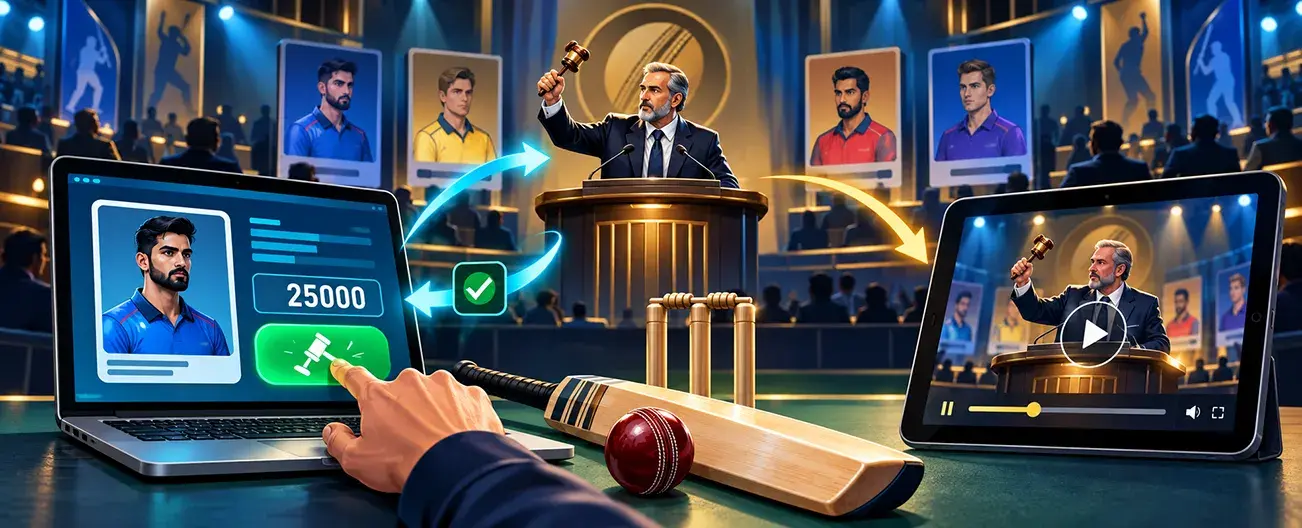
Because watching and bidding are two different actions.
Imagine our remote owner again.
He has:
- The official bidding page open on his laptop.
- A YouTube livestream playing on another screen.
- His team strategy sheet beside him.
The public stream may be useful for commentary, player introductions, interviews, sponsor graphics, and atmosphere.
It should not automatically become the official timing reference for bids.
Live video has to travel through cameras, encoders, networks, distribution platforms, and the viewer’s device. That path can introduce delay.
Research published in October 2026 by Mary Grace Burkett, Miguel Angel Martinez Lopez, Nuria Recuero Virto, and Aruna Prem Bianzino studied low-latency immersive sports streaming during a professional basketball event in Madrid. Their work specifically relied on low-latency, high-bandwidth network capabilities for the real-time viewing experience.
The study did not examine cricket auctions.
The practical broadcast lesson still matters: a video feed and an interactive bidding interface should not be assumed to arrive at exactly the same moment.
For that reason, tell owners which interface governs the auction.
What Should Team Owners See While Bidding?
Strip the screen down to information they need to make the next decision.
| Information | Why the owner needs it |
|---|---|
| Current player | Confirms who is being auctioned |
| Player category | Helps with squad planning |
| Base price | Shows where bidding begins |
| Current accepted bid | Prevents bidding from an outdated number |
| Current bidding team | Shows who holds the leading position |
| Required next bid | Removes increment confusion |
| Remaining purse | Helps control spending |
| Squad count | Shows how many places are filled |
| Player status | Makes sold or unsold outcome clear |
The 12th Men’s current documentation says player details can appear to bidders, bid increments follow configured rules, and current bid and purse information update during the auction. It also documents sold, unsold, retention, and owner-bidding controls.
The goal should be boring clarity.
When four people are bidding quickly, nobody should need to ask the auctioneer:
“What is the current price?”
How Should You Prepare Owners Before a Remote Auction?
Do not make auction night their first login.
Run a rehearsal.
Use fake players and fake points if necessary.
Have every owner:
- Log in from the device they intend to use.
- Find their team page.
- Place a sample bid.
- Check the updated purse.
- Pass on a player.
- Lose a test bid.
- Reconnect after temporarily disabling internet access.
- Confirm who to contact when something looks wrong.
The 12th Men’s current how-to documentation says its auction interface supports owner bidding when enabled and displays a reconnect banner when connectivity is lost, after which live state re-syncs.
That is useful functionality.
Your league still needs an operational rule for the period between disconnect and recovery.
Software can reconnect.
It cannot decide your competition policy for you.
What Happens If a Team Owner Loses Internet?
Write the answer before the auction.
Here is one possible local policy.
| Situation | Example organizer rule |
|---|---|
| Short owner disconnect | Auctioneer pauses before opening a new player |
| Disconnect during active bidding | Existing accepted bid remains valid |
| Bid not received by official system | Bid is not treated as accepted |
| Repeated connectivity failure | Approved backup representative takes control |
| Platform-wide issue | Auction pauses for every team |
| Public stream fails | Bidding continues if the official auction system remains available |
These are sample rules, not universal cricket auction regulations.
Your policy can be different.
What matters is that owners know it before a valuable player reaches the block.
We would also collect a backup phone number for one authorized representative per team.
Not so they can shout bids down the phone whenever they feel like it.
So the organizer has a defined escalation route.
Why Should You Be Careful With Last-Second Bidding?

Because online auction design affects bidder behavior.
Axel Ockenfels and Alvin Roth studied late bidding in internet auctions and found that fixed-end auctions can encourage bids very close to the deadline. Their model also recognized something technically mundane but important: a very late bid has some probability of failing to arrive successfully. They found that auction designs with automatic extensions reduced some of the strategic attraction of extremely late bidding.
Their research examined commercial internet auctions, not cricket.
Still, it gives organizers a useful question:
Do you actually want owners competing against the clock?
A cricket player auction usually works better when the auctioneer controls the close and gives teams a clear opportunity to respond.
If you use a timer, document:
- how long it runs,
- whether a new bid resets or extends it,
- what timestamp decides acceptance,
- and what happens when a bid reaches the server after expiry.
Do not discover those rules while two owners are arguing about the same player.
Should Owners Bid Through the Livestream?
No.
The livestream is for watching.
The authorized bidding interface is for bidding.
That distinction becomes even more important when an auction is being produced as a show.
The 12th Men says its player auction management can be streamed through YouTube Live, while its live-streaming feature supports event data, names, status information, branding, and sponsor elements.
That creates two experiences:
Owner experience: player, bid, purse, squad, bid controls.
Viewer experience: video, commentator, auction graphics, sponsor visibility, sold-player moments.
Do not sacrifice the first simply to make the second more dramatic.
A flashing animation can wait.
An accepted bid cannot.
How Should Broadcasters Cover a Remote Cricket Auction?
The broadcaster has a different job from the auctioneer.
The auctioneer decides the sale.
The production team explains it.
We would build the broadcast around five recurring states:
- Player introduced
- Bidding open
- Current bid changes
- Sold or unsold
- Updated team purse and squad
The graphic operator should take the result from the confirmed auction state, not from what a commentator thinks they heard.
If the owner interface says 18,000 and the presenter says 19,000, stop the graphic from becoming a second source of truth.
The broadcast can correct itself.
The database should not need to.
What Makes a Good Remote Auction Broadcast?
Viewers need enough context to follow the decision.
Not every database field belongs on screen.
A player card could show:
- Player name
- Photograph
- Playing role
- Category
- Base price
- Current bid
- Current leading team
After the sale:
- Sold price
- Winning team
- Updated purse, where useful
The The 12th Men live-streaming feature can display event information such as scores, player or team names, match status, branding, and sponsors, with the feed connected to event data.
For a cricket auction, confirm exactly which bidding graphics and auction states are available in the broadcast configuration you plan to use.
Do not treat marketing copy as a substitute for a technical rehearsal.
What Should Happen When the Auction Ends?
The remote owner closes the laptop.
The tournament database should not start over.
The 12th Men documents a post-auction workflow where public view pages can show auction results and the auction view link can be copied and shared without requiring viewers to log in. Its guide also says teams can be carried into a linked tournament for fixtures and live scoring.
This is where the value of connected records becomes easier to see.
A player bought by Team Blue should already be Team Blue’s player when the scorer prepares the first match.
No second spreadsheet.
No retyping twelve names.
No “Which Rahul is this?” on match morning.
For the auction side, the guide to real-time cricket bidding explains how digital bid records, purses, and squad information fit together.
For purse planning, link naturally to the guide on base prices, team purses, and bids.
And when players remain unsold, the sold, unsold, and re-auction rules guide is the better next step.
How Do You Share Cricket Scores After the Auction?
This is where the auction story becomes the tournament story.
Once teams move into fixtures, organizers may want to share cricket scorecard access with owners, players, families, and sponsors.
The 12th Men’s current how-to guide documents ball-by-ball cricket scoring with a live scorecard and commentary. Its scheduling system also says scoring links, schedules, leaderboards, and player updates can be shared with participants.
For WhatsApp specifically, the same scheduling documentation says match alerts, schedule changes, and tournament links can be sent through WhatsApp, email, or app notifications.
So if your workflow needs a live score WhatsApp link, verify in your tournament setup whether the direct scoring link, tournament link, or both are distributed through your chosen notification flow.
That wording matters.
Do not promise a specific automation until you test it.
What About Cricket Result Graphics?
A final score screenshot and a broadcast graphic are not quite the same thing.
A useful cricket result graphic might show:
- Final score
- Winning team
- Margin
- Player of the match
- Team logos
- Tournament branding
- Sponsor branding
The 12th Men documents live-stream score overlays, player and team names, match status, event branding, and sponsor elements.
Whether your tournament needs automated post-match result cards, manually designed social graphics, or frames captured from the broadcast is a separate production decision.
We would keep the source data connected to the official scorecard either way.
That avoids a familiar problem:
The graphic says 157/6.
The corrected scorecard says 158/6.
WhatsApp still has the old image.
Links age better than screenshots when numbers can still change.
Remote Auction Checklist Before Going Live
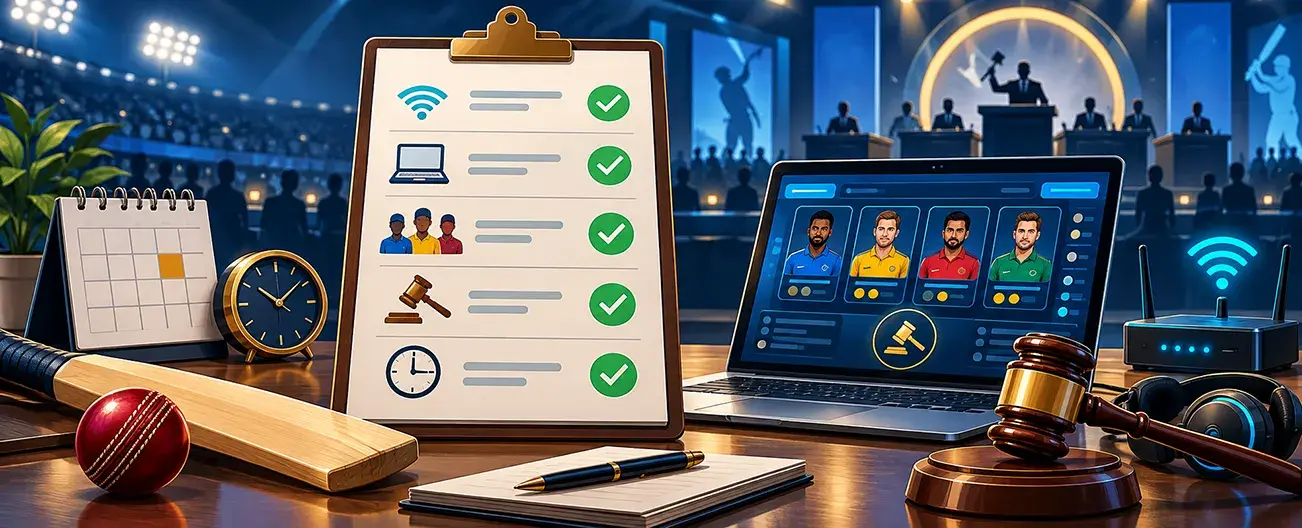
A day before the auction, run one full simulation.
| Test | What you want to prove |
|---|---|
| Remote owner login | Every franchise can access the correct team |
| Sample bid | Bid reaches the official auction state |
| Purse deduction | Winning amount is reflected correctly |
| Squad limit | Invalid purchases are handled under your rules |
| Network loss | Owner and admin know the fallback process |
| Livestream delay | Owners understand the stream is not the bidding clock |
| Sold graphic | Broadcast matches confirmed auction result |
| Public sharing | Final auction view opens correctly |
| Tournament handoff | Sold players appear in the correct squads |
Use your slowest realistic connection during the test.
The best office Wi-Fi proves very little about an owner joining from a hotel or mobile hotspot.
The Owner Does Not Need to Be in the Room
Back to our owner in the hotel.
Another player reaches the auction.
His connection is stable again.
The player card appears on the official bidding page.
He sees the base price.
He sees his remaining purse.
He bids.
The auction system records it.
A moment later, viewers watching the production see the new amount on screen.
That order matters.
The auction should create the truth. The broadcast should tell the story.
A well-run remote cricket auction allows owners to participate from different locations without turning distance into a rules dispute. Give every owner the same bidding procedure, establish what happens during a connection problem, separate the livestream from the bid clock, and rehearse everything before a real player is on the line.
Explore The 12th Men cricket event management platform and its live-streaming integration. For your demo, do not test only a perfect sale. Put one owner on a slower connection, disconnect another briefly, run simultaneous bids, and confirm that the winning player flows into the correct squad afterward.
That is the demo that tells you whether your remote auction is ready.
FAQ
Got Questions? We've Got Answers.
Yes, when the auction platform supports remote owner access. The 12th Men currently documents Team-Page Bidding, which lets owners place bids from their team page when the feature is enabled.
We would not recommend that. Streaming can introduce delay, while the bidding system records interactive auction activity. Define the official source and bid-closing rule before the auction begins.
Follow the tournament’s published connectivity policy. Decide whether bidding pauses, whether the current accepted bid remains valid, and when an approved backup representative may take over.
Yes. The 12th Men currently advertises YouTube Live support around its player auction and sports-event workflow. Confirm the exact auction graphics and streaming configuration required for your event.
Once squads move into the tournament, a connected scoring platform can provide live scorecards and scoring links. The 12th Men documents ball-by-ball cricket scoring, live scorecards, and participant sharing of scoring and tournament information.
Related Articles
Guide
What Do We Need to Qualify? NRR Calculator Guide for Teams
Turn a crowded points table into clear qualification targets. Use remaining fixtures, current points and net run rate to estimate the winning margin, chase speed or defensive result your team may need to advance.
Read More >Yug Shah|Oct 8, 2026|
Guide
How Net Run Rate Is Calculated in Cricket Tournaments
Understand the exact net run rate formula and the scoring inputs behind it. This guide works through runs scored, overs faced, all-out innings, shortened matches and how each result changes a tournament points table.
Read More >Yug Shah|Sep 23, 2026|