Cricket Auction Rules: How to Set Base Price, Purse and Bids

By Yug Shah
|
Sep 28, 2026
|
|

A captain can afford the next bid and still be unable to afford a complete team.
Good cricket auction rules prevent that: define starting prices, set team budgets, establish bidding increments, and reserve enough funds for every required squad place before accepting another purchase.
For this guide, we will follow a fictional eight-team community league. Each franchise receives 100,000 auction credits and must finish with fourteen players. These credits are bidding units, not salaries.
The problem arrives when one captain wants another all-rounder.
His balance says yes. His unfinished squad says otherwise.
Quick Summary: Key Takeaways
- Price the squad before the stars. Check that team budgets can support the required roster.
- Separate balance from bidding power. Some remaining credits must cover unfilled places.
- Publish the procedure. Set increments, retention deductions, unsold rounds, and dispute rules beforehand.
- Rehearse the exceptions. Test an unaffordable bid and an incorrect sale before going live.
What Do Base Price, Purse and Bid Mean?
Base price is the opening minimum for a player’s auction entry. Purse is the team’s spending allowance. Bid is an offer made within the published rules; sold price is the accepted winning amount.
Keep them separate. A player opening at 2,000 credits might sell for 15,000. Deduct 15,000, not the base price.
For cash auctions, state what the sold amount represents, who pays whom, and when. Registration charges should appear separately from team spending.
Have captains and auction staff review the same rule sheet before bidding.
Whether you organize through The 12th Men or another platform, write these definitions where owners and players can find them.
How Do You Set a Purse for a Local Cricket League?

Work backward from squad size and entry prices. Avoid choosing a large number simply because it sounds impressive when announced.
Our sample league could use this fourteen-player budget plan:
| Pricing category | Example base price | Planned players | Cost at base |
|---|---|---|---|
| A | 10,000 credits | 2 | 20,000 |
| B | 5,000 credits | 4 | 20,000 |
| C | 2,000 credits | 8 | 16,000 |
| Total | 14 | 56,000 |
These are invented planning figures, not official categories or a prescribed squad mix.
A 100,000-credit purse leaves 44,000 above that starting cost for competitive bidding. That is room to compete, not a guarantee that every desired combination remains affordable.
Check the player pool too. Requiring this exact mix across eight teams would need at least sixteen Category A, thirty-two Category B, and sixty-four Category C entrants.
If those players do not exist, changing the purse will not solve the shortage.
For professional context, IPL announced a purse of INR 120 crore for its 2025 season. That was a season-specific regulation, not a budget recommendation for community cricket.
How Should You Set Player Base Prices?
Use a published assessment method, then place comparable entrants into clearly defined bands.
Consider recent performances in similar playing conditions, relevant roles, verified availability, and trial assessments. An opening batter’s record should not be judged using exactly the same checklist as a specialist bowler’s.
Give newcomers a route through trials instead of treating missing statistics as proof of low ability.
Research offers a useful starting point. In 2023, Vaseekaran Chittibabu and Malolan Sundararaman studied performance-based base prices using IPL auction data from 2014 and 2018. Their retrospective analysis estimated roughly 17.6% fewer auction calls for Indian players and 31.1% fewer for overseas players under their proposed method. These were modeled call reductions, not measured time savings at a local event. The method also did not cover newcomers without IPL experience.
Our takeaway is modest: compare evidence before assigning prices, but do not let a spreadsheet pretend it knows every player.
Publish categories early, allow a correction window, and freeze the approved list before bidding. A base price should not change because a particular owner asks quietly.
How Much Can a Team Actually Bid?

Remaining purse is not automatically the maximum permitted bid. A useful local safeguard reserves the minimum amount needed for the rest of the squad.
Under that proposed rule:
Squad-completion ceiling = remaining purse − minimum cost of completing the squad after this purchase.
Return to our captain. He has nine players, 24,000 credits, and five places left to fill.
Buying the current all-rounder would leave four vacancies. Assume four suitable players remain available at a minimum of 2,000 credits each, with no higher-priced category requirement.
Completion reserve: 4 × 2,000 = 8,000 credits.
Bid ceiling: 24,000 − 8,000 = 16,000 credits.
An offer of 17,000 leaves only 7,000 for four places costing at least 8,000. Reject it before announcing the sale.
The uncomfortable conversation has disappeared because the answer was agreed beforehand.
Change one assumption and the ceiling changes. If one remaining place needs a Category B wicketkeeper at 5,000, while the other three start at 2,000, reserve 11,000. The ceiling becomes 13,000. Never price every empty slot at the cheapest rate when your rules require higher categories.
One qualification matters: minimum prices do not guarantee future purchases. Rivals may bid higher or take the remaining eligible players. Recheck role availability and allow a practical spending cushion beyond the mathematical minimum.
Researcher Gaurav Malhotra’s 2022 study modeled IPL player valuations alongside role requirements and budget constraints. It treated squad composition as part of the valuation problem, rather than pricing every cricketer in isolation.
For organizers, that suggests a useful principle: protect the complete team, not merely the next transaction.
What Bid Increments Should Your Auction Use?
Choose either one fixed step or a short, published ladder. For our fictional league, this ladder keeps the arithmetic easy to follow:
| Current accepted bid | Required next increase | Example next bid |
|---|---|---|
| Below 10,000 credits | 500 | 9,500 becomes 10,000 |
| 10,000 to below 20,000 | 1,000 | 10,000 becomes 11,000 |
| 20,000 or more | 2,000 | 20,000 becomes 22,000 |
The first offer opens at base price. After that, the current accepted amount determines the next step.
Under this sample policy, jump bids and smaller final raises are not allowed. A team whose ceiling falls between valid steps must stop at the previous valid amount.
Check the purse reserve and any individual-player cap before accepting each raise.
Where a league also sets a single-player price cap, use the lower of that cap and the squad-completion ceiling, then round down to a valid bid step.
We would rather hear one consistent bidding rhythm than pause repeatedly to negotiate what the next number should be.
Which Cricket Auction Rules Must Be Settled Beforehand?

Retained players and captain allocations
Count every retained or preassigned player toward squad limits and charge the published deduction.
For example, retaining two players for 12,000 and 8,000 credits leaves 80,000 from our starting purse and twelve squad vacancies.
If you allow a matching right, explain exactly when it applies, who qualifies, and how the final amount is decided. Do not announce a surprise privilege halfway through bidding.
Unsold players and auction order
Publish the player sequence or the method used to randomize it.
For this sample league, unsold entrants return in one announced second round at the same base price. A different event may permit reduced prices, but that policy should be agreed with participants before opening bids.
Avoid automatic allocation to the weakest team unless everyone accepted that process.
Disputed bids and connectivity problems
Nominate an authorized bidder for each franchise. Define whether the auctioneer’s acknowledgment or the system’s accepted-bid record determines priority.
When two offers appear simultaneous, pause and follow that rule. Do not award a player to whichever owner shouts louder.
Specify the closing countdown, when a sale becomes final, and the correction authority. For remote participation, rehearse a lost connection and do not use a viewer’s livestream as the official bidding clock.
Withdrawals after the auction
Set a replacement deadline, eligibility requirements, and the treatment of spent credits. Explain whether any replacement must come from the unsold pool.
A withdrawal should trigger the same documented process for every franchise, not a private negotiation with its owner.
How Should You Compare a Cricket Scoring and Auction App?
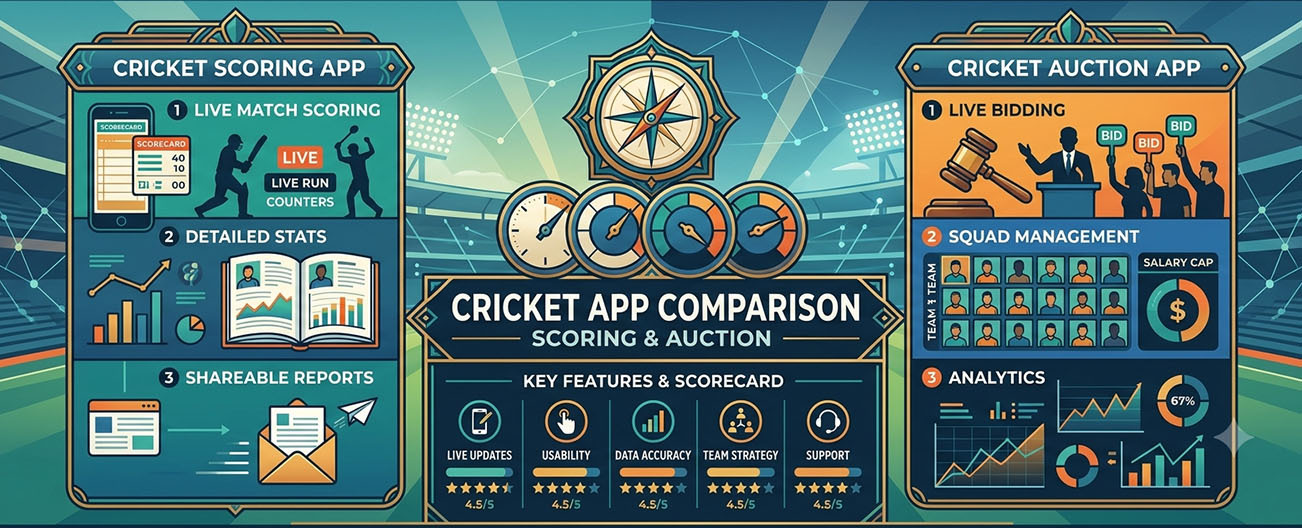
Searching for a CricHeroes alternative or a CricClubs alternative? Start with the rules your event needs rather than assuming a brand name answers the question.
Ask each shortlisted cricket scoring and auction app to demonstrate the same scenario: nine players, 24,000 credits, five vacancies, and a proposed bid of 17,000.
Can the operator see the completion reserve? Does the system reject the offer, or must an official intervene? Can an authorized correction restore both purse balance and player status?
Then move an approved squad into scoring and check names, roles, and duplicate records.
The 12th Men’s player auction software describes live bidding, automated budget controls, bid histories, and roster transfer into scoring. Confirm that its available settings match your specific reserve policy, increments, and exceptions.
Its cricket page also describes ball-by-ball scoring and statistics, so include that handover in the rehearsal.
For related selection questions, see our guide to choosing a cricket bidding platform.
Make the Loudest Bid a Valid One
Our captain stops at 16,000. Someone else may win the all-rounder, but his remaining squad is still possible at the assumed minimum prices.
That is a better outcome than celebrating a purchase and discovering four empty places afterward.
Bring your purse, categories, squad requirements, and bidding ladder to The 12th Men’s cricket platform. Request an auction demonstration built around your league’s rules, including the bid that must be rejected.
Settle the arithmetic before the room gets noisy.
FAQ
Got Questions? We've Got Answers.
For a local league, choose and publish an organizer-led assessment method or a player-nomination process with defined bands. Tell participants who approves disputed categories and when the final list becomes fixed.
Not under the sample rules above. A lower starting price would require a previously announced unsold-round policy. Do not quietly accept a below-base offer during the original bidding round.
An equal starting allowance is a straightforward option for a new competition. Retention deductions may produce different opening balances. Publish those deductions alongside each team’s existing players and remaining vacancies.
Prevent that outcome with squad-completion checks. If an administrative error occurs, pause and apply the published correction procedure. Do not create an unannounced purse top-up for one owner.
No. In the proposed system, it records the accepted bid for that event. Review cricket performances separately rather than treating a high price as proof that a player must outperform everyone else.
Related Articles
Guide
How Net Run Rate Is Calculated in Cricket Tournaments
Understand the exact net run rate formula and the scoring inputs behind it. This guide works through runs scored, overs faced, all-out innings, shortened matches and how each result changes a tournament points table.
Read More >Yug Shah|Sep 23, 2026|
Guide
Badminton Tournament Bracket Generator: Easy Guide
Learn how a badminton tournament bracket generator supports singles and doubles events, fair seeding, court scheduling, live result updates, and smoother competition management for busy clubs. It also highlights practical steps, common pitfalls.
Read More >Yug Shah|Sep 21, 2026|