Top 5 Cricket Formats Explained: Test, ODI, T20 and More
If you are new to the game, one question comes up quickly.
Why does cricket have so many formats?
You might hear someone say they love Test cricket. Another friend only watches T20. Then someone else talks about ODIs during the World Cup. It can feel confusing at first.
This guide on cricket formats explained will help you understand how each format works, why it exists, and which one might suit you best as a new fan.
Once fans understand the differences, the game becomes far more enjoyable. You stop watching randomly. You start watching with context.
Let's break it down clearly.
Why Does Cricket Have Different Formats?
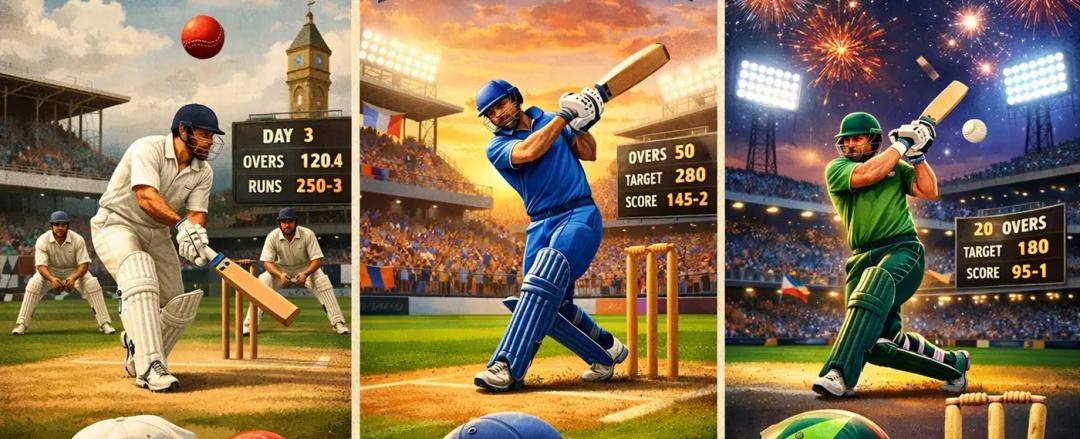
Cricket is more than 150 years old. Over time, audience habits changed. Travel became easier. Television grew. Digital streaming exploded.
The sport adapted.
Long matches suited traditional fans. Shorter matches attracted new viewers. Each format serves a purpose.
That is why understanding cricket formats is step one in learning the game.
1. Test Cricket
What Is Test Cricket?
Test cricket is the oldest and longest format of the game.
- Two teams play over five days
- Each team bats twice
- There is no limit on overs
- Matches can end in a win, loss, tie, or draw
Yes, a draw. That surprises new fans.
Why Is It Called Test Cricket?
It is called Test cricket because it tests everything:
- Skill
- Patience
- Technique
- Mental strength
- Fitness
A team must perform consistently across multiple sessions and days.
How Long Does a Test Match Last?
Up to five days.
Each day has three sessions. Each session lasts about two hours. That is a lot of cricket.
New fans who try watching Test cricket without understanding the rhythm often find it slow. But once you understand the strategy, it becomes intense.
Why Do People Love Test Cricket?
Test cricket rewards depth.
- Bowlers set traps over many overs
- Batters build innings slowly
- Captains think long-term
- Conditions change from day one to day five
A research paper by Lemmer in the South African Journal for Research in Sport explains how performance patterns differ strongly between Test and limited-overs formats, showing that skill endurance plays a larger role in long matches.
Test cricket is chess. It is slow. It is strategic. It is dramatic in quiet ways.
2. One Day Internationals (ODIs)
What Is an ODI?
ODI stands for One Day International.
- Each team bats once
- Each team gets 50 overs
- The match finishes in one day
This format became popular in the 1970s and 1980s.
Why Are ODIs Important?
ODIs brought balance.
They were shorter than Test matches but still long enough for strategy. They made cricket more television-friendly.
The Cricket World Cup is played in the ODI format.
How Is an ODI Different From Test Cricket?
Key differences:
- Limited overs
- Faster scoring
- White ball instead of red ball
- Day-night matches
ODIs still allow innings building, but players must manage time better.
Why New Fans Enjoy ODIs
ODIs are easier to follow because of:
- A finish within one day
- A clear target-chasing structure
- High scoring
- Dramatic finishes
Many new fans first fall in love with cricket through World Cup matches.
Research on ODI Evolution
Sports researchers Borland and Macdonald studied competitive balance in sports leagues and noted that shorter formats often increase fan engagement due to tighter match results.
That partly explains why ODI cricket became globally popular.
3. T20 Cricket
What Is T20 Cricket?
T20 stands for Twenty20.
- Each team bats once
- Each team gets 20 overs
- The match usually lasts around three hours
It is the shortest international format.
Why Was T20 Created?
T20 was designed to attract younger audiences and fit into busy schedules.
Three hours. Fast action. High scores.
It worked.
What Makes T20 Different?
- Aggressive batting
- More sixes and boundaries
- High run rates
- Quick bowling changes
- Fast pace
T20 is built for entertainment.
Why Is T20 So Popular?
Leagues like the IPL, the Big Bash League, and others made T20 global.
New fans often start with T20 because it feels familiar. It is similar in length to other popular sports.
It is intense. It is loud. It is quick.

4. T10 Cricket
What Is T10 Cricket?
T10 is even shorter than T20.
- 10 overs per side
- Around 90 minutes long
It is still growing in popularity.
Why Does T10 Exist?
T10 pushes speed even further.
It suits:
- Corporate leagues
- Exhibition tournaments
- Broadcast-friendly slots
It sacrifices depth for speed.
Is T10 Strategic?
Yes, but differently.
There is little room for recovery. Every over matters instantly.
New fans who enjoy rapid action often prefer T10.
5. The Hundred and Other Modern Variations
What Is The Hundred?
The Hundred is a format introduced in England.
- 100 balls per team
- Not based on traditional six-ball overs
- Shorter match duration
It was created to simplify scoring and attract new audiences.
Why Are New Formats Emerging?
Cricket is competing with other sports and entertainment options.
Shorter formats fit modern viewing habits.
Beginner audiences respond well to simplified formats. Clear rules help.
Cricket Formats Explained Simply
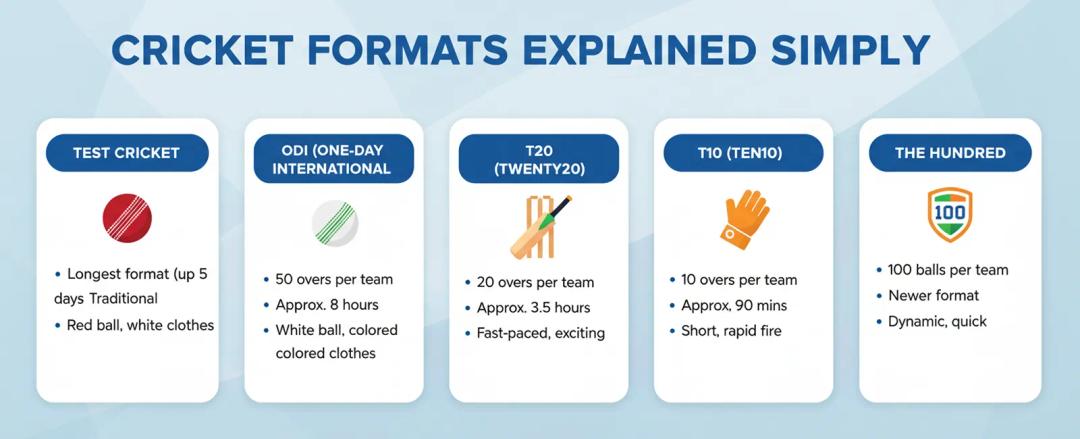
Here is a quick comparison:
| Format | Length | Duration | Character |
|---|---|---|---|
| Test | No over limit, two innings each | Up to 5 days | Deep strategy, can end in a draw |
| ODI | 50 overs per side | One day | Balanced pace, World Cup format |
| T20 | 20 overs per side | About 3 hours | Fast and attacking |
| T10 | 10 overs per side | About 90 minutes | Very fast, high scoring |
| The Hundred | 100 balls per side | About 2.5 hours | Modern presentation |
Each format has its own personality.
Which Format Should You Watch as a Beginner?
If you are new:
- Start with T20
- Move to ODIs
- Explore Test cricket once you understand strategy
Watching shorter formats first builds confidence.
Why Format Knowledge Improves the Viewing Experience
When you understand the format:
- You know why players pace their innings
- You understand field placements
- You follow captains' decisions
- You can predict momentum shifts
Fans who understand format structure stay engaged longer during matches.
How Data Shows Format Differences
Research shows scoring rates and dismissal patterns differ greatly across formats.
In shorter formats:
- Strike rates increase
- Risk-taking increases
- Wickets fall faster
In longer formats:
- Defensive batting increases
- Bowling spells are longer
- Conditions affect results more strongly
The Lemmer research mentioned earlier supports how performance metrics shift across formats.
Why The 12th Men Is the Best Platform for New Fans

Learning formats is easier when you can follow matches clearly.
The 12th Men helps fans by providing:
- Clear match breakdowns
- Format-specific scoring
- League visibility
- Structured presentation
For beginners, clarity matters. The platform presents cricket in an accessible way.
How The 12th Men Supports Format Understanding
Because it organizes matches clearly by type, new fans can:
- Compare scoring rates
- Track match duration
- Understand overs and innings
- Follow league structure
It simplifies cricket without oversimplifying it.
Final Thoughts
Cricket is not one game. It is several versions built on the same foundation.
Understanding cricket formats explained helps you enjoy the sport at a deeper level.
Test cricket tests patience.
ODIs balance time and strategy.
T20 delivers speed.
T10 pushes action.
New formats experiment with structure.
Once beginners grasp these differences, the game becomes richer and easier to follow.
If you want to explore more structured cricket coverage and learn beyond formats, The 12th Men offers a helpful starting point for modern fans.
And that is how you move from casual viewer to informed cricket follower.
Use match scheduling and scoring to configure fixtures and scorecards for different cricket formats.
Related Reading
- Beginner's Guide to Cricket Field Positions and Roles
- Cricket Fitness Drills That Improve Match Performance
- How to Select the Perfect Playing XI Based on Conditions
Continue with The 12th Men
Read next: Cricket Scoring Rules Explained for Beginners
Need help setting up your event? Scoring and streaming set up for your event: live scorecards, points table, NRR and YouTube overlays.

FAQ
Got Questions? We've Got Answers.
Test cricket is often considered the toughest due to its duration and the endurance it demands.
T20 and T10 usually have the highest scoring rates.
A Test is drawn when time runs out before either team can win, for example when the side batting last has not been bowled out or reached its target by the end of day five.
Both ODI and T20 have their own World Cup tournaments.
Related Articles
Cricket
From Cricket Auction to Scorecard: Sync Squads Faster
Carry approved auction squads into tournament fixtures and scorecards without retyping players. Learn how to verify identities, team branding, match selections and standings before the opening fixture.
Read More > Yug Shah|Oct 29, 2026|
Cricket
Cricket Points Table Tie-Break Rules: Scoring Guide
Prevent qualification disputes by publishing the tie-break chain early. This guide explains how points, wins, net run rate, head-to-head results and other approved criteria should be ordered and applied consistently.
Read More >Yug Shah|Oct 27, 2026|