Player Categories in Cricket Auctions: Rules That Work

By Yug Shah
|
Oct 1, 2026
|
|
A wicketkeeper who opens the batting has two skills. Does that make him an all-rounder for your auction?
Not necessarily.
Cricket auction player categories should separate playing role, assessed level, and eligibility. Publish the evidence, squad limits, and review process behind each label before teams start bidding.
Consider a fictional registration card marked “Category B, all-rounder.” The applicant bats and keeps wicket but does not bowl in matches. If an owner buys him to satisfy a bowling requirement, the problem began before the auction.
With a dropdown menu.
Quick Summary: Key Takeaways
- Keep role and grade separate. A wicketkeeper can belong to any approved ability tier.
- Assess comparable evidence. Give newcomers a trial route instead of assuming they belong at the bottom.
- Check squad feasibility. Category quotas must match the available player pool.
- Freeze approved records. Handle appeals and replacements through a published process.
What Should Cricket Auction Player Categories Describe?
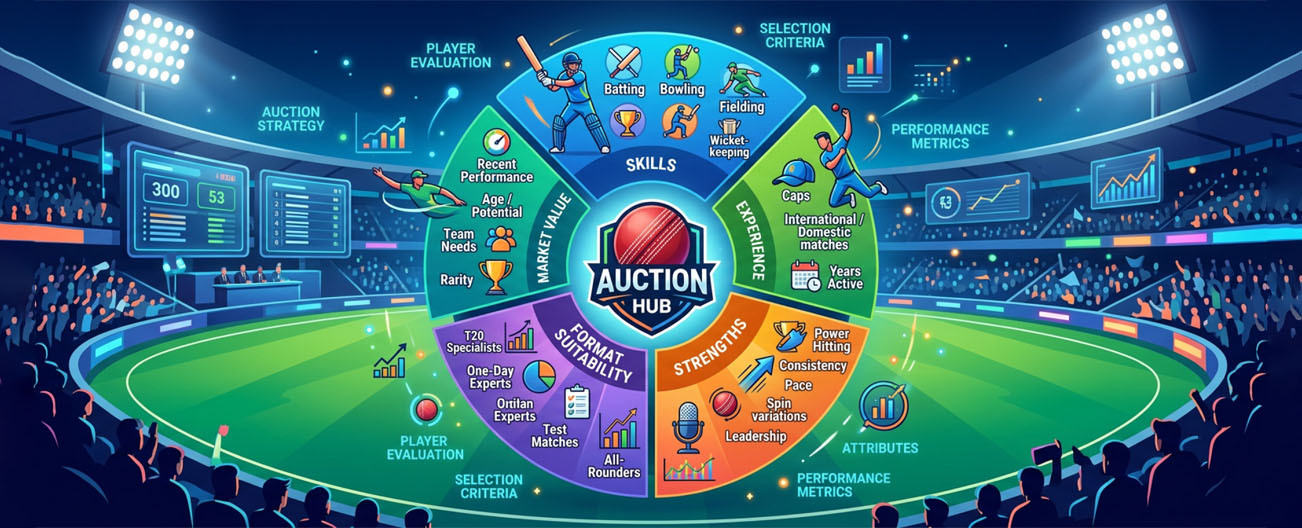
Use separate fields for separate decisions. In the sample policy below, an entrant receives one grading tier but may have several verified skill tags.
| Classification | Example | What it controls |
|---|---|---|
| Grading tier | A, B, or C | Your published ability bands and tier quotas |
| Playing role | Wicketkeeper-batter, pace bowler | Role requirements and captain selection |
| Eligibility | Registered club member | Whether the entrant qualifies for this event |
| Availability | Available except on finals day | Selection decisions, not an automatic downgrade |
Before uploading records to The 12th Men, decide what each field means.
Professional auctions make distinctions too. The IPL’s December 9, 2025 announcement for its 2026 auction separately listed capped and uncapped entrants, Indian and overseas players, and reserve-price bands. Those were different classifications, not one interchangeable grading system. IPL
The local lesson is simple: avoid making “Gold,” “bowler,” and “guest player” competing options in the same box.
How Do You Assign Tiers Without Playing Favorites?
Define the evidence before reviewing the names. Set a common assessment period, identify acceptable competitions, and explain how trial performances will be considered.
For batters, review scoring alongside balls faced, dismissals, batting position, and opposition. For bowlers, examine wickets alongside overs, runs conceded, and the phases they bowl. Assess wicketkeeping directly rather than relying on batting totals.
We would also separate tennis-ball and leather-ball evidence unless the panel explains how it compares them. A familiar name should not receive an unexplained advantage.
Researchers Gholam R. Amin and Sujeet Kumar Sharma used IPL 2011 data to evaluate players across different cricketing capabilities through multiple performance measures. Their paper appeared online in 2012 and in the European Journal of Sport Science in 2014. It proposed a selection method, not ready-made grades for community leagues. tandfonline.com
Our practical reading: compare people against the requirements of their role rather than treating runs, wickets, and auction reputation as equivalent evidence.
Publish observable tier criteria. Then have reviewers record why each entrant meets them.
For a local rubric, define what strong, adequate, and developing performance looks like within each role. Bowling control might be assessed through a specified target drill; keeping through agreed catching and stumping exercises. These are suggested assessment choices, not validated universal thresholds. Give assessors the same instructions, retain their notes, and review disagreements before turning observations into a final grade.
Avoid describing Category C as “poor players.” It is an event classification, not a judgment about someone’s future.
Who Should Count as an All-Rounder?

For this sample policy, require evidence of usable batting and bowling ability. Record whether the stronger contribution is with bat or ball.
That distinction has research behind it. Ananda B. W. Manage, Ram C. Kafle, and Danush K. Wijekularathna tested methods for distinguishing batting all-rounders from bowling all-rounders using performance statistics in a 2020 study. Their work examined role classification, not local auction fairness or guaranteed team success. Sage Journals
The player on our fictional card remains a wicketkeeper-batter unless further evidence supports a bowling role.
He can still be valuable.
Define how overlapping skills count toward squad requirements. One person can satisfy a keeping requirement and occupy a Category B slot, but cannot become two people in a twelve-player squad.
Where separate specialist places are mandatory, state whether an all-rounder may fill one of them.
How Many Players From Each Category Should Teams Buy?
Start with the available pool, then test the quotas together. Here is a proposed structure for six teams with exactly twelve members each.
These are illustrative local rules, not IPL requirements.
| Tier | Minimum per squad | Maximum per squad | Minimum needed across six teams |
|---|---|---|---|
| A | 1 | 2 | 6 |
| B | 3 | 5 | 18 |
| C | 5 | 8 | 30 |
The minimums add up to nine, leaving three flexible places per squad. One compliant combination is two A, four B, and six C entrants. Another is one A, four B, and seven C entrants.
State whether limits govern the full squad, the playing eleven, or both. Our example governs the twelve registered members. A developmental quota in registration does not guarantee match appearances. If participation is part of the event’s purpose, publish a separate playing-team requirement and check that it remains feasible on each match date.
The league needs 72 selected players overall. Meeting the tier minimums alone accounts for only 54 places, so check the remaining eighteen too.
Now examine the awkward cases.
If only five approved Category A entrants are available, six teams cannot each recruit one. Reopen recruitment or revise the proposed rule before bidding. Do not promote somebody on paper simply to repair the count.
Role shortages need another check. If exactly six eligible wicketkeepers must serve six teams, allowing one franchise to buy two can leave another without any.
One possible published safeguard is to restrict second-keeper purchases until every squad has its first. Test category, role, availability, and budget requirements together.
A valid purchase should not make the remaining squads impossible to complete.
Should Categories Determine Base Prices and Auction Order?

They can, but the relationship needs to be explicit.
You might assign one opening-price band to each tier while allowing bidding to determine the sold price. In that setup, an expensive Category B purchase stays in Category B. Demand does not rewrite the approved classification.
Decide how sets are called too. Publish whether you auction by tier, role, or a disclosed mixed sequence. Owners should know when specialist opportunities are likely to appear.
Retained players and preassigned captains must count toward the same published category limits. Otherwise, an owner could recruit the permitted maximum and quietly add another through retention.
Keep unsold status separate from ability. A second-round price reduction, where your announced policy permits it, should not silently lower the entrant’s grade.
For broader preparation, see our article on mistakes to avoid while running sports auctions.
What Happens When a Player Disagrees With a Category?
Publish provisional classifications and allow a defined appeal window, such as 48 hours. That timing is a suggested local choice, not a governing-body requirement.
Ask for missing scorecards, mistaken identities, or trial evidence rather than a captain’s promise that someone deserves a different label.
Use reviewers without an interest in the affected franchise. Record the decision and explanation, then circulate the finalized list to all owners simultaneously.
We would separate three situations: correcting a spelling error, correcting evidence, and changing an assessment. They should not all be treated as harmless profile edits.
Once bidding starts, freeze grading decisions. For a material error discovered later, pause the affected sale and apply the published correction procedure. Do not quietly edit the database after an owner has paid.
A replacement also needs approval. Check the resulting squad against every tier, role, eligibility, and budget rule, not just the departing player’s label.
What Should a Cricket Auction App Actually Enforce?
Ask a cricket auction app to show approved categories, roster counts, remaining places, and the effect of each proposed purchase.
Give the operator a team already holding two Category A players under our sample rules. Try to add a third. Then attempt to acquire the final available keeper while another franchise still needs one.
These are demonstration requirements, not assumptions about every product.
The 12th Men’s published auction features include player-category tracking, budget controls, bid histories, team-composition reports, and transfer of finalized rosters into scoring. Confirm which custom quota checks are automatic and which require an official’s approval. the12thmen.com
For related buying questions, see our guide to choosing a cricket bidding platform.
Ask about permissions too. An owner may suggest a correction, but should not be able to change an approved tier while bidding against other teams.
What Happens to Categories After the Auction?

Preserve the approved auction record when squads enter your cricket scoring app. Keep player identity stable even if a captain uses someone in a different match role.
The 12th Men’s cricket page describes ball-by-ball scoring, player statistics, and auction management. Test that connection with an actual sample roster rather than assuming every historical field transfers. The 12th Men
After the season, compare the evidence behind grades with subsequent performances. Review unexpected gaps, limited appearances, and players who changed roles.
Do not automatically promote someone after one spectacular innings or demote another after two failures. Set the next review window and use the declared assessment method.
Your cricket tournament software should help preserve that history. It should not turn last season’s label into a permanent identity.
Give Every Label an Explanation
The fictional registration card now reads “Category B, wicketkeeper-batter.” Its owner understands the role, the team sheet counts one person, and the organizer can explain the grade.
Nobody needed a louder argument. They needed clearer fields and rules.
Bring your proposed categories, player pool, and squad limits to The 12th Men’s cricket platform. Request a demonstration that tests legal and blocked purchases, appeals, and the handover to scoring.
Good cricket auction player categories do more than divide a list. They give everyone the same understanding of the competition they are entering.
FAQ
Got Questions? We've Got Answers.
Treat them as local labels unless your governing competition defines them. Publish the criteria and quota attached to each name. This article’s A, B, and C structure is an illustrative organizer policy.
Under the proposed model, each entrant has one grading tier and may hold several verified skill tags. Explain which requirements can overlap and count that person only once toward squad size.
Offer a documented trial and the same assessment criteria used for comparable entrants. Mark the evidence as limited during review instead of assuming that no recorded history means low ability.
Not merely because nobody bid. Review genuine classification errors through the agreed process. Keep an approved change to the starting price separate from a change in assessed level.
Related Articles

Cricket
Cricket Auction Rules: How to Set Base Price, Purse and Bids
Build an auction rulebook every owner can follow. Learn how base prices, team purses, bid increments, maximum bids and minimum or maximum squad sizes work together before the first player goes on the block.
Read More >Yug Shah|Sep 28, 2026|
Cricket
Best Cricket Tournament Management Software for 2026
Manage teams, fixtures, live scores, registrations, and results with cricket tournament management software in 2026.
Read More >Yug Shah|Aug 31, 2026|