Sports Auction Budget Planning: A Guide for Team Owners

By Yug Shah
|
Aug 19, 2026
|
|
Quick Summary / Key Takeaways
- Set your total auction budget before bidding starts.
- Divide the budget by player roles, not just by the number of players.
- Keep a reserve amount for late-auction opportunities.
- Avoid spending too much on one star player unless the squad plan supports it.
- Track every bid and remaining budget during the auction.
- A Sports Auction Platform can help teams monitor budgets, player purchases, squad balance, and auction activity in one place.
- For cricket leagues, combine auction planning with tools such as a Cricket Scoring App, Live Scoring Software, and tournament management features.
Planning a sports auction sounds simple until the bidding begins. A Sports Auction Platform helps team owners keep budgets visible, but a few aggressive bids can still change the entire squad plan within minutes. The real challenge is not only getting good players but making sure enough money remains to build a complete, balanced team.
The right auction tool can make this process easier by giving owners a clear view of spending, player purchases, and remaining budget while the auction is happening. Still, software cannot replace a sensible budget plan. That part starts before the first player enters the auction.
Why Sports Auction Budget Planning Matters
A team can lose an auction without losing a single bidding battle.
This usually happens when an owner spends too much early in the event and has very little money left for the players needed to complete the squad.
We've noticed that new team owners often focus on individual players instead of looking at the full squad. A player who looks like a great deal at ₹10,000 may become an expensive purchase if the same owner has to fill five more positions with only ₹15,000 left.
Good budget planning gives you a spending limit for the whole squad and a rough idea of how much each player category deserves.
The goal is simple: build the strongest squad possible without running out of money at the wrong time.
Start With Your Total Auction Budget
Before thinking about individual players, establish the total amount available to your team.
For example, suppose a local cricket league gives every team ₹100,000 to build a squad of 15 players.
That ₹100,000 is your starting point. Your next step is deciding how much can realistically be spent on different player types.
| Budget Area | Suggested Allocation | Example on ₹100,000 |
|---|---|---|
| Core/star players | 35-40% | ₹35,000-₹40,000 |
| Strong supporting players | 30-35% | ₹30,000-₹35,000 |
| Role players | 15-20% | ₹15,000-₹20,000 |
| Squad reserves | 10-15% | ₹10,000-₹15,000 |
These percentages are not fixed rules. A tournament with a strong pool of all-rounders may require a different approach from a league where specialist bowlers are harder to find.
The key is to decide your limits before the auction room gets noisy.
Divide the Budget by Player Roles

A common mistake we see is setting a single maximum bid for every player.
That rarely works.
A top-order batter, wicketkeeper, fast bowler, all-rounder, and developing player can have very different values depending on the squad you are building.
Create role-based spending ranges before the auction.
For example:
| Player Role | Target Players | Budget Range |
|---|---|---|
| Premium all-rounder | 1-2 | ₹12,000-₹16,000 |
| Lead batter | 2 | ₹8,000-₹11,000 each |
| Lead bowler | 2 | ₹7,000-₹10,000 each |
| Wicketkeeper | 1 | ₹5,000-₹8,000 |
| Supporting players | 4-5 | ₹3,000-₹6,000 each |
| Emerging/local players | 3-4 | ₹1,000-₹3,000 each |
This gives owners a reference point during bidding.
If a player crosses your planned limit, you have a reason to stop rather than making a decision based on the excitement of the moment.
Keep a Reserve Budget
Your entire auction budget should not be treated as available money from the first bid.
Keep some money aside.
For a ₹100,000 budget, you might start with a mental reserve of ₹10,000-₹15,000. This gives you room to react when an unexpected opportunity appears later.
Late-auction players can sometimes be overlooked because other teams have already spent heavily. A good player may become available at a reasonable price when several owners have very little money remaining.
That reserve can be the difference between finishing with an average squad and adding the final piece you actually needed.
Create a Maximum Bid for Every Priority Player
Before the auction, make a player shortlist with three numbers:
- Ideal bid
- Maximum acceptable bid
- Walk-away price
For example:
| Player | Ideal Bid | Maximum Bid | Walk Away Above |
|---|---|---|---|
| Player A | ₹9,000 | ₹12,000 | ₹12,000 |
| Player B | ₹7,000 | ₹9,000 | ₹9,000 |
| Player C | ₹5,000 | ₹7,000 | ₹7,000 |
This sounds basic, but it can prevent emotional bidding.
When two team owners start competing for the same player, the price can rise quickly. Having a pre-decided ceiling makes it easier to step away.
You do not need to win every bidding battle.
You need to build the best squad within your budget.
Watch the Budget of Other Teams
Your own budget is only one side of the auction.
Keep an eye on how much other teams have spent and which positions they still need to fill.
Imagine four teams are competing for top-order batters. One team has already spent 60% of its budget on three players. That team may not be able to compete aggressively for another expensive batter.
This creates useful opportunities for teams with more money remaining.
A central auction dashboard can help organizers and team owners track player purchases and auction activity, making it easier to understand how the event is progressing.
Use a Sports Auction Platform to Track Spending

Manual spreadsheets can work for small events, but they become difficult to manage when several teams are bidding at the same time.
A dedicated auction system can keep important auction information in one place.
Depending on the platform, team owners and organizers may be able to track:
- Total team budget
- Current balance
- Players purchased
- Player categories
- Bid amounts
- Remaining squad slots
- Auction history
- Player availability
- Team-wise spending
For an organizer, this also reduces the risk of calculation mistakes.
One wrong balance entry can create confusion during a live auction. Having the figures updated as purchases happen gives everyone a clearer picture.
Example: How a Team Can Manage ₹100,000
Let's look at a simple example.
Suppose Team Alpha has ₹100,000 and needs 15 players.
The owner decides to spend heavily on three core players but still wants enough money for the rest of the squad.
| Stage | Players Bought | Amount Spent | Balance |
|---|---|---|---|
| Opening phase | 2 | ₹23,000 | ₹77,000 |
| Middle phase | 4 | ₹28,000 | ₹49,000 |
| Squad-building phase | 5 | ₹27,000 | ₹22,000 |
| Final phase | 4 | ₹14,000 | ₹8,000 |
The team finishes with 15 players and ₹8,000 unused.
That leftover amount is not necessarily a problem. Spending every rupee is not the objective. The objective is getting the right players at sensible prices.
Avoid Spending Too Much on One Star

Every league has one or two players everyone wants.
It is tempting to keep bidding because you believe that player can change the team.
Sometimes that's true.
The problem starts when one player consumes 25-30% of the total budget and forces you to compromise everywhere else.
Suppose two teams have ₹100,000 each.
Team A spends ₹35,000 on one star player and has ₹65,000 for 14 players.
Team B spends ₹20,000 on two strong players and has ₹80,000 for 13 players.
Neither approach is automatically better. The right choice depends on the available player pool and the team's strategy.
The important part is knowing what you're giving up when you make a big purchase.
Budget for Squad Balance, Not Just Star Power
A cricket squad needs more than famous names.
You may need:
- Opening batters
- Middle-order batters
- Wicketkeepers
- All-rounders
- Fast bowlers
- Spin bowlers
- Backup players
- Young or emerging players
A strong auction strategy looks at the complete squad.
This is where a sports event management solution can be useful beyond the auction itself. Organizers can manage different parts of the tournament process instead of handling player information, fixtures, scoring, and communication separately.
Plan for Different Auction Scenarios
No two auctions follow the same script.
Create a few budget scenarios before the event.
| Scenario | Spending Approach | Suitable When |
|---|---|---|
| Star-heavy | Spend more on 2-3 players | Strong premium player pool |
| Balanced | Spread money across roles | Deep player pool |
| Value-focused | Smaller bids across many players | Tight budget |
| Reserve-heavy | Keep more money for later | Unpredictable auction |
This simple exercise helps owners stay calm when the actual bidding starts.
For example, if your first-choice all-rounder goes for twice your expected price, move to Plan B instead of changing your entire strategy.
Budget Planning Doesn't Stop After the Auction
Once the squad is finalized, the tournament still needs to be managed.
This is where auction software connects with wider tournament tools.
For cricket leagues, a Cricket Scoring App can help record match scores and player performances. Live Scoring Software can provide score updates during matches, while Cricket Tournament Live Scoring can keep players, team owners, and spectators informed.
Organizers can also use Real-Time Tournament Notifications to share match updates, fixture changes, results, and other important information.
When auction and tournament operations are handled as separate manual processes, teams often end up maintaining several spreadsheets, chat groups, and documents.
That creates extra work and leaves more room for errors.
Track Player Value After the Auction
There is another useful way to look at auction spending: compare the price paid with what the player actually contributes.
For example:
| Player | Auction Price | Matches | Performance | Initial Assessment |
|---|---|---|---|---|
| Player A | ₹12,000 | 8 | Strong | Good purchase |
| Player B | ₹9,000 | 7 | Average | Fair purchase |
| Player C | ₹5,000 | 8 | Strong | High-value purchase |
This information can help organizers understand future auction trends.
Team owners can also use past results when planning their next auction. A player who was inexpensive but performed consistently may be more valuable than a high-priced name who played only a few matches.
This is where tournament records and scoring history become useful.
Common Sports Auction Budget Mistakes
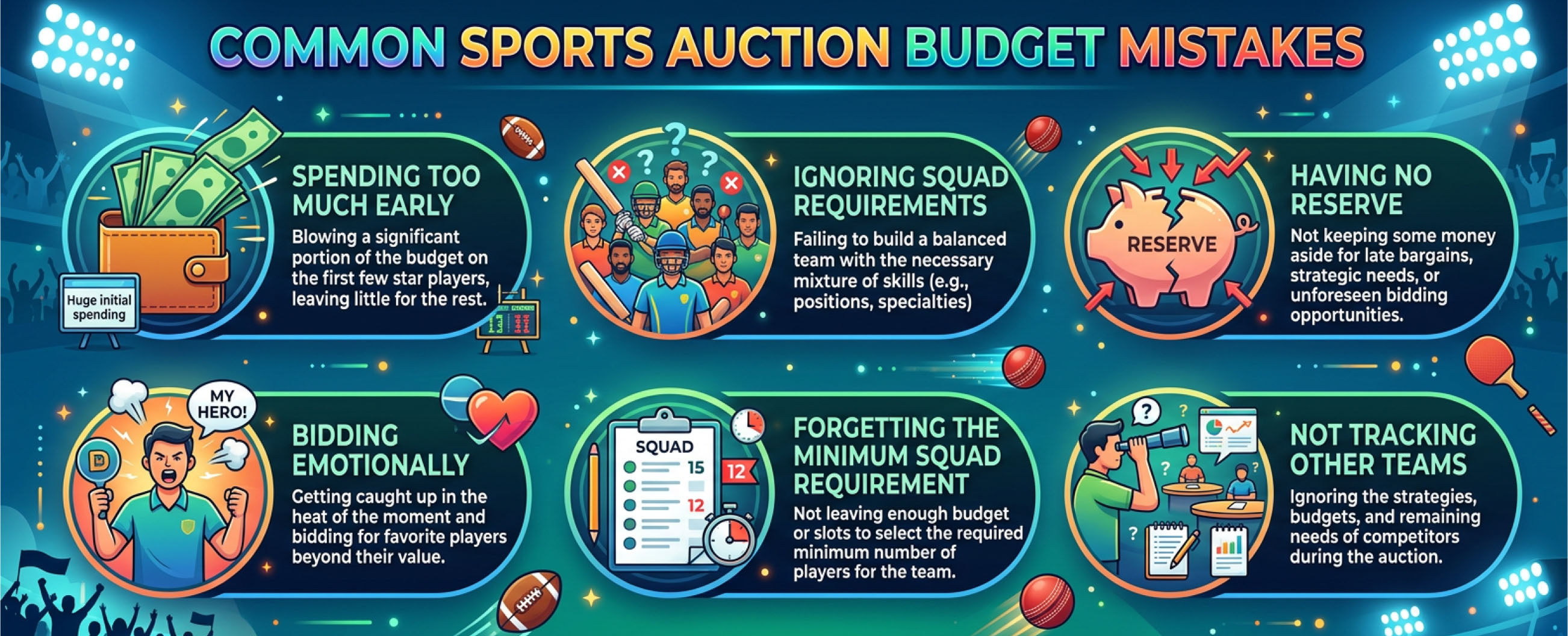
Here are some mistakes that can quickly damage an otherwise good auction plan:
1. Spending too much early
Early excitement can push prices above realistic levels.
2. Ignoring squad requirements
Buying three similar players while leaving another position empty creates an unbalanced squad.
3. Having no reserve
If all your money is spent early, you lose flexibility later.
4. Bidding emotionally
Trying to beat another owner can turn a ₹6,000 player into a ₹12,000 purchase.
5. Forgetting the minimum squad requirement
Always know how much money must remain to complete the required number of players.
6. Not tracking other teams
Other teams' remaining budgets can influence your bidding strategy.
A Simple Pre-Auction Budget Checklist
Before the auction begins, every team owner should know:
- Total auction budget
- Minimum squad size
- Maximum squad size
- Player categories
- Priority positions
- Target players
- Maximum bid for each priority player
- Minimum reserve amount
- Expected spending per player category
- Backup options
- Auction rules
- Bid increments
Keep this information in front of you during the auction.
A simple one-page plan can prevent several expensive mistakes.
How The 12th Men Fits Into Tournament Management
For organizers running cricket, badminton, pickleball, or other sports events, auction management is only one part of the work.
The 12th Men brings tournament activities into a single sports management setup, covering areas such as player management, auctions, scoring, fixtures, and tournament updates.
For cricket organizers, features such as a Cricket Scoring App, Live Scoring Software, and Cricket Tournament Live Scoring can help keep match information accessible during the event. Tournament communication can also be supported through Real-Time Tournament Notifications.
The bigger benefit is having fewer disconnected processes to manage.
Final Thoughts
A good auction is rarely won by the team that spends the most.
It is usually won by the team that knows where to spend, when to stop, and how much money to keep available.
Set your budget before the auction. Give every player category a spending range. Keep a reserve. Watch the budgets of competing teams and don't let one bidding battle decide the fate of your entire squad.
For organizers, the right platform can make budget tracking and auction administration much easier, especially when the auction is part of a larger tournament.
If you're planning a cricket, badminton, pickleball, or multi-sport event, The 12th Men can help you manage the auction and tournament journey from one place. Explore the platform and see how it can fit your next sports event.
FAQ
Got Questions? We've Got Answers.
The right budget depends on the tournament rules, squad size, player pool, and total amount allocated to each team.
Teams can consider keeping around 10-15% of their total budget for late-auction opportunities and unexpected player purchases.
Yes, it can help teams track bids, player purchases, remaining budgets, squad slots, and auction activity in real time.
A Cricket Scoring App or Live Scoring Software helps teams and organizers track match scores, player performances, and tournament results.
Overspending on one or two players can leave a team with too little money to build a balanced squad, so a Sports Auction Platform should support clear limits, reserve tracking, and disciplined bidding decisions.
Related Articles

Guide
Badminton Tournament Bracket Generator: Easy Guide
Learn how a badminton tournament bracket generator supports singles and doubles events, fair seeding, court scheduling, live result updates, and smoother competition management for busy clubs. It also highlights practical steps, common pitfalls.
Read More >Yug Shah|Sep 21, 2026|
Guide
Real-Time Tournament Notifications: Organizer Guide
See how instant alerts reduce confusion on tournament day. This guide covers fixture reminders, venue updates, score notifications, delay announcements, and practical communication workflows for organizers. It also highlights practical steps.
Read More >Yug Shah|Sep 17, 2026|