Football Tournament Management Software: 2026 Guide

By Yug Shah
|
Sep 10, 2026
|
5 min read
|
Football
It is 7:40 on tournament morning.
One team says its kickoff time is wrong. Another is asking which pitch it has been assigned. A referee has called to say he will arrive late. Someone changed a score from last night's match, which means the standings also need to change.
And the first whistle hasn't even blown.
This is the point where Football Tournament Management Software stops feeling like an optional organizer tool and starts making sense.
The basic idea is simple: keep registrations, teams, fixtures, scoring, standings, schedules, and tournament updates connected rather than spreading them across spreadsheets, WhatsApp groups, paper scorecards, and several unrelated apps.
That sounds like a small operational change.
Once a tournament grows, it isn't.
Quick Summary: What Should You Know?
If you only have two minutes, here is the useful part.
- Football Tournament Management Software gives organizers one place to manage teams, schedules, fixtures, match results, standings, and tournament records.
- A good football fixture generator should consider tournament format, available grounds, kickoff slots, rest periods, and schedule changes rather than simply pairing teams.
- A football scoring app lets results reach organizers, players, and followers faster while reducing repeated manual entry.
- The best system depends on your event. A six team corporate cup and a season long city league do not need the same setup.
- Current research suggests fixture design can affect fairness, travel, recovery, and even competition outcomes, so scheduling deserves more attention than it often gets.
What Is Football Tournament Management Software?
Football tournament management software is a digital system used to organize the operational side of a football competition, from team registration to the final standings.
Think about what an organizer normally has to keep track of.
Teams register. Squads change. Fixtures have to be created. Grounds and referees need assignments. Scores come in. Points tables move. Knockout teams qualify. A delayed match suddenly affects everything scheduled after it.
Doing each job separately is possible.
That is also where things start slipping through gaps.
| Tournament task | Manual approach | Software based approach |
|---|---|---|
| Team registration | Forms and spreadsheets | Central team records |
| Fixture planning | Manual tables | Automated fixture creation |
| Ground allocation | Calls and messages | Schedule based assignments |
| Match scoring | Paper or chat updates | Live score entry |
| League standings | Formula updates | Automatic recalculation |
| Schedule changes | Resend information manually | Update from one system |
| Tournament history | Separate documents | Stored event records |
The real benefit is not simply saving clicks. It is keeping one event record consistent when something changes.
That matters more than it first appears.
The Real Test Comes When the Schedule Breaks
Consider a fairly ordinary Saturday football tournament.
Sixteen teams. Four groups. Four pitches. Matches are planned back to back.
On paper, everything fits.
Then one pitch becomes unavailable for 45 minutes.
Now the organizer has choices. Move a match? Delay the group? Shorten the gap between games? Shift another fixture and risk making one team play twice with barely any recovery?
Suddenly, scheduling is no longer a tidy grid.
Researchers have been studying this problem for years, and recent work makes the point particularly well.
In March 2026, researchers Boldizsár Tűű-Szabó and László T. Kóczy examined procedural fixture fairness in league competitions. Their work suggests that differences built into fixture structures can influence outcome probabilities. In the football leagues they studied, balancing mechanisms helped reduce some of the distortion created by asymmetric schedules.
That is a useful reminder for grassroots football too.
A fixture isn't just a date and kickoff time.
Who plays whom, when they play, where they play, how much recovery they receive, and what happens after a disruption can all matter.
What Features Should Football Tournament Management Software Have in 2026?
There is a temptation to compare platforms by counting features.
Twenty features must be better than ten, right?
Not necessarily.
The better question is whether the software follows the actual movement of your tournament.
| Feature | What it should help you do | Why organizers care |
|---|---|---|
| Team registration | Capture teams and player details | Less duplicate entry |
| Tournament setup | Define format and competition rules | Faster event creation |
| Football fixture generator | Produce match schedules | Fewer manual clashes |
| Venue scheduling | Assign pitches and kickoff slots | Clearer match operations |
| Football scoring app | Record scores as games happen | Faster updates |
| Automatic standings | Calculate points and rankings | Fewer spreadsheet formulas |
| Knockout management | Move qualified teams forward | Easier progression |
| Notifications | Share fixture or timing changes | Fewer repeated messages |
| Live streaming support | Connect matches with viewers | Wider tournament reach |
| Reports and statistics | Preserve tournament information | Better post event review |
The The 12th Men football platform, for example, currently brings fixture creation, team registration, scoring, player auctions, referee support, streaming, and other football event functions into the same broader system.
That connected flow is the part worth paying attention to.
A long feature list means little when the organizer still has to copy the same team data between three screens.
How Should a Football Fixture Generator Actually Work?
A football fixture generator should do more than randomly match Team A with Team B.
At minimum, it needs to understand the competition format.
Is it round robin?
Group stage followed by knockout?
Straight knockout?
A league played over several weeks?
A one day 5v5 event with several pitches?
After that come the constraints: number of teams, ground availability, match duration, rest gaps, kickoff windows, repeat opponents, and potentially home and away rules.
For large competitions, those variables become surprisingly difficult to balance.
A 2026 study by Rogelio Gutierrez, Igor Cardoso, and Hamidreza Validi modeled scheduling for the FIFA World Cup 2026. Their model had to work around match dates, venues, stadium recovery, minimum team rest, and travel between locations. The researchers produced an alternative feasible schedule that cut modeled internal travel by roughly 50 percent and time zone crossings by about 83 percent compared with the official baseline. It was a research model, not the schedule FIFA adopted, but the result shows what better constraint aware scheduling can uncover.
Your local tournament will not have World Cup geography.
The principle still travels well.
Good scheduling software should understand constraints before it produces fixtures.
That is why tools connecting scheduling and scoring can be useful when matches move during an event. The The 12th Men match scheduling and scoring system is designed around fixture generation, rescheduling, scoring, and tournament updates rather than treating each task as a separate job.
Why Does a Football Scoring App Matter?

A final whistle creates another small rush of work.
What was the score?
Who updates the table?
Did both teams agree on the result?
Who tells the teams playing next?
Has the knockout bracket changed?
A football scoring app shortens that chain. The result can be recorded close to the pitch and used to update connected standings and tournament information.
For a four team event, you could do this manually without much trouble.
For 24 teams playing across several grounds, the difference becomes obvious.
And there is another audience that organizers sometimes forget: the people who are not standing beside the pitch.
Parents. Friends. Club members. Sponsors. Players waiting for their next game.
They increasingly expect to know what is happening without asking the organizer.
Live scores, current tables, match status, and streaming can turn the tournament from something visible only at the venue into something people can follow from anywhere. The12thMen also connects live streaming with event data such as scores and scheduling.
For a deeper look at that side of sports events, the guide to live sports streaming and tournament reach is useful supporting reading.
What Does a Connected Football Tournament Look Like?
The interesting change is not one feature. It is what happens when the pieces stop working independently.
A typical flow may look like this:
- Create the tournament. Set the format, dates, teams, grounds, match rules, and event information.
- Open registrations. Collect team or player details in a structured format.
- Build fixtures. Generate matches around your chosen competition structure and available playing slots.
- Run match day scoring. Record results from the pitch rather than waiting for spreadsheets to be updated later.
- Update standings automatically. Wins, draws, losses, goals, points, and qualification positions move as results are confirmed.
- Finish with tournament records. Keep results, statistics, rankings, and reports instead of losing the event inside old chat threads.
That last part tends to be underestimated.
A tournament creates data.
If you run the event again next season, historical results can help with seeding, player recognition, sponsor reports, event promotion, and planning.
Who Actually Needs Football League Management Software?
Not every organizer needs a large system.
That is fine.
The point is to match the software to the competition.
| Event type | Typical requirement | What matters most |
|---|---|---|
| School football cup | Simple groups and knockouts | Fixtures and results |
| Academy competition | Several squads or age groups | Scheduling and team records |
| Corporate tournament | Short event window | Registration and fast fixtures |
| Community 5v5 league | Frequent weekly games | Standings and live scores |
| City league | Larger team count | Full league administration |
| Multi venue competition | Several simultaneous matches | Ground scheduling and updates |
A football league management software becomes especially useful when the competition continues for weeks or months because every result affects a living table.
For one day tournaments, speed matters more.
Different problem. Different emphasis.
How Do You Choose the Right Football Tournament Software?
Start with your tournament, not the product demo.
Ask what happens on your busiest match day.
How many teams are involved? Can several matches happen at once? Who enters scores? How quickly must standings update? Can a fixture be changed after publishing? Are referees part of the workflow? Can players see schedules without contacting an administrator?
Then test the uncomfortable situations.
What happens if a match is postponed?
Can a wrong result be corrected safely?
Can the software handle group stages and knockouts together?
Can two pitches host matches at the same time without creating team clashes?
Does the football scoring app work comfortably from a phone beside the field?
That is usually where the difference between an attractive dashboard and useful tournament software appears.
In our view, organizers should also avoid buying for an imaginary future. If you currently run eight team local tournaments, choose something that makes those eight team events easier. Make sure there is room to grow, but do not turn a simple competition into an IT project.
Where Does The 12th Men Fit?
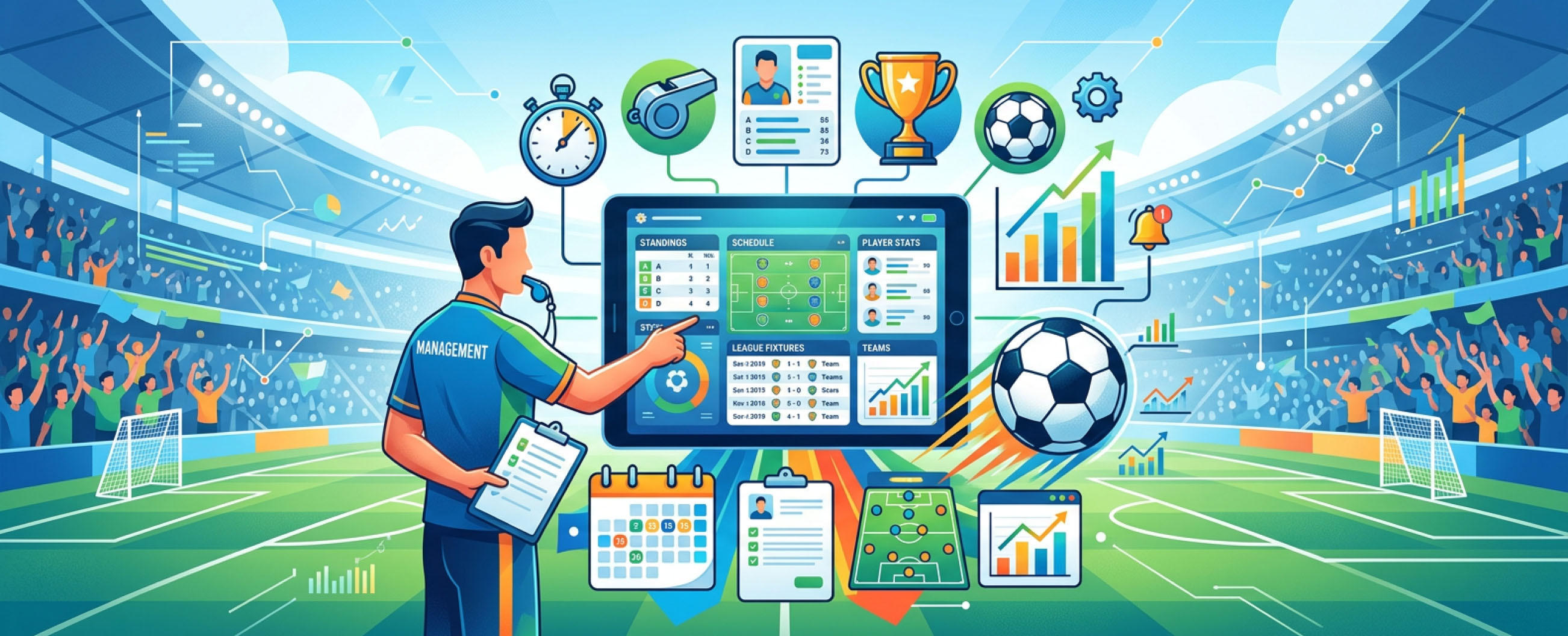
The 12th Men approaches tournament management as a connected sports event workflow. Its current platform covers registrations, tournament setup, fixtures, scoring, auctions, standings, and live event functions across multiple sports.
For football organizers specifically, its football league management software brings football scheduling, live scoring, team operations, streaming, player auctions, and referee related services into the same event environment.
That can be particularly useful if your tournament ambitions go beyond entering final scores.
Maybe you want an auction before the season.
Maybe families should follow results online.
Maybe the final deserves a live stream.
Or perhaps you simply want to stop rebuilding the tournament from five spreadsheets every weekend.
If you also organize other sports, our 2026 cricket tournament management software guide shows how many of the same scheduling and event principles carry across different competition formats.
What Will Matter Most After 2026?
The next improvement in tournament software probably will not be another crowded admin screen.
It appears more likely to be less organizer work between actions.
A team registers, so it becomes available for scheduling.
A fixture changes, so everyone affected receives the new information.
A score is confirmed, so the table changes.
A group finishes, so the correct teams move into the knockout stage.
One action creates the next.
That is where tournament software becomes genuinely useful. Not because it replaces the organizer, but because the organizer no longer has to act as the human connection between every part of the event.
Your Tournament Should Be Remembered for the Football
The best tournament organizer is often the person nobody notices during the event.
The fixtures make sense. Teams know where to go. Scores appear when they should. The table is right. The next match begins.
Behind that calm experience is a lot of work.
Football Tournament Management Software can take some of that work out of the organizer's hands without taking away their control.
If you are planning a school cup, corporate football event, academy tournament, community league, or larger football competition, explore The 12th Men football tournament platform and see how your tournament can move from registration to the final whistle in one connected system.
Ready to spend less time chasing fixtures and more time building a football event people want to return to? Start planning your next tournament with The 12th Men.
FAQ
Got Questions? We've Got Answers.
The best option depends on the tournament format, number of teams, venues, scoring needs, and whether you need extras such as registrations, streaming, auctions, or referee management. Look for software that connects the tasks you already perform rather than simply offering the longest feature list.
Yes. A suitable football fixture generator can create schedules based on teams and competition format. More capable systems can also consider venues, time slots, rest periods, and tournament progression.
Yes. Tournament platforms can work well for small sided competitions because organizers often have several short matches running across multiple pitches. Fixture scheduling, live scores, tables, and quick schedule changes become particularly useful in that setting.
Football league management software is usually focused on an ongoing season with recurring fixtures and standings. Tournament software may focus more on groups, brackets, qualification, and shorter competition windows. Some platforms support both structures.
A football scoring app allows results to be recorded closer to the action. When scoring connects with standings and fixtures, organizers can reduce repeated data entry and give teams and followers quicker access to current tournament information.