Tournament Payment Management Software: Key Features

By Yug Shah
|
Aug 26, 2026
|
|

Running a sports tournament involves much more than creating fixtures and managing matches. Tournament payment management software helps organizers keep registration fees, payment confirmations, refunds, pending dues, invoices, and participant records in one clear workflow instead of tracking everything through spreadsheets, bank screenshots, and chat messages.
This is where a connected payment system can make a real difference. It links registration and payment records in one place, giving clubs and organizers a clearer view of who has registered, who has paid, and what still needs attention.
For clubs running cricket, badminton, pickleball, or other sports events, the right payment setup can save hours of manual follow-up.
Quick Summary / Key Takeaways
- Tournament payment management software connects player registration with fee collection.
- Organizers can track paid, pending, failed, and refunded payments from one dashboard.
- Online payment options make registration easier for players and teams.
- Automated receipts reduce manual confirmation work.
- Payment reports help organizers understand tournament revenue and outstanding fees.
- Refund and cancellation records should be easy to access.
- The best systems connect payments with a broader Tournament Registration System.
- Clubs should look for clear reporting, payment security, mobile access, and simple participant management.
Why Payment Management Becomes a Problem for Tournament Organizers
Many small and mid-sized tournaments start with simple tools.
A Google Form collects player details. A spreadsheet stores registrations. Participants send payment screenshots on WhatsApp. The organizer checks the bank account manually and marks each player as paid.
That setup may work for a small event with 20 or 30 participants. Problems start when registrations reach 100, 200, or more.
A participant may register but forget to pay. Someone may transfer the wrong amount. Another player may send a screenshot without mentioning their registration name. During the tournament, organizers then spend time checking old messages instead of focusing on the event.
We've noticed that payment tracking is often treated as a separate task from registration. That is one of the main reasons records become messy.
A connected payment system keeps registration and payment information together.
What Is Tournament Payment Management Software?

Tournament payment management software is a digital system that helps sports clubs and organizers collect, track, verify, and manage payments related to tournaments.
Organizers may also describe this need as online tournament fee collection, sports payment tracking software, or a tournament registration payment system. Depending on the platform, it can handle:
- Player and team registration fees
- Online payment collection
- Payment status tracking
- Automated receipts
- Invoices
- Refund records
- Pending payment reminders
- Transaction reports
- Registration and payment history
- Multiple tournament categories
When payment data is connected to Sports Tournament Registration Software, an organizer can see a participant's registration details and payment status from the same record.
That small change can remove a lot of manual work.
Key Features to Look for in Tournament Payment Management Software
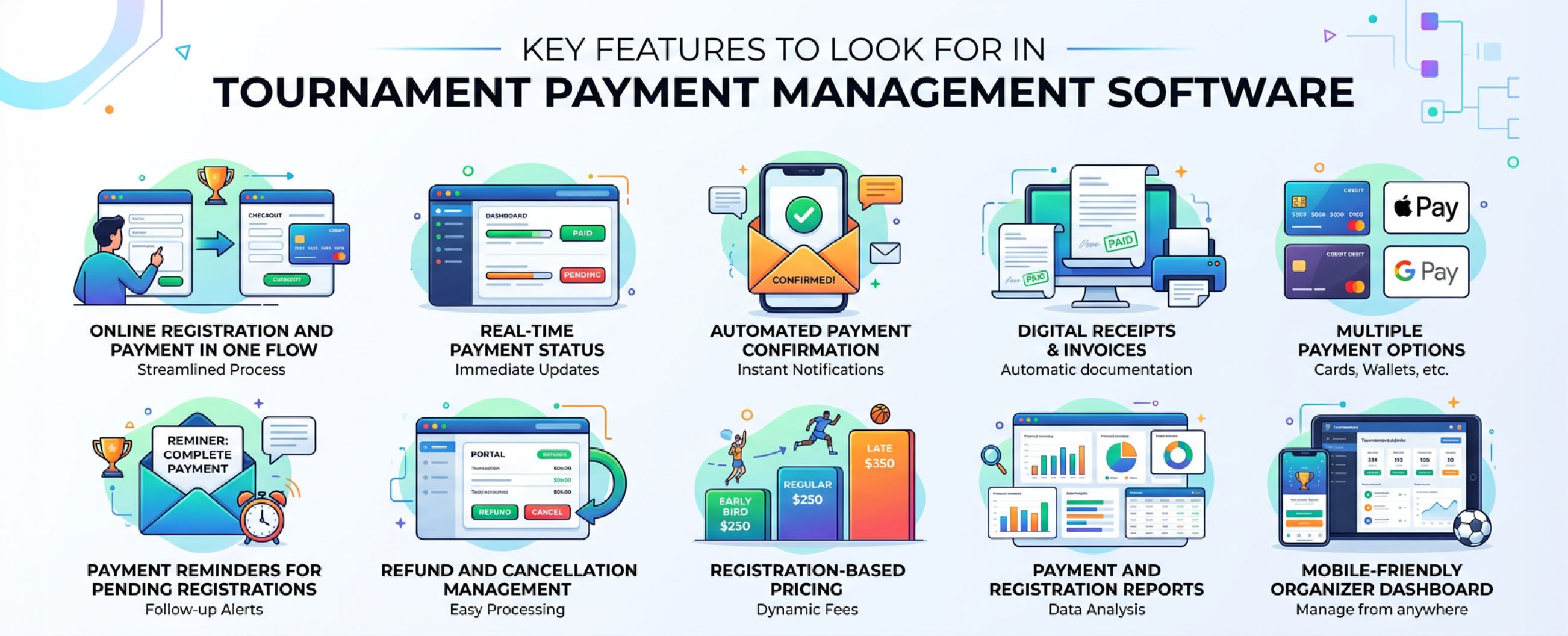
Not every payment tool is suitable for sports events. Tournament organizers have a few specific requirements that general payment platforms may not cover.
Here are the features worth checking before choosing a system.
1. Online Registration and Payment in One Flow
The registration process should not force players to jump between different platforms.
A player selects the tournament, chooses the category, enters their details, and pays the registration fee in the same flow.
This makes Online Tournament Registration and Payment much easier for participants.
For example, imagine a badminton club hosting singles and doubles categories. The system can show different fees for each category and collect the correct amount during registration.
| Registration Type | Example Fee | Payment Status |
|---|---|---|
| Men's Singles | ₹500 | Paid |
| Women's Singles | ₹500 | Pending |
| Men's Doubles | ₹800 | Paid |
| Mixed Doubles | ₹800 | Paid |
The organizer doesn't need to calculate these amounts manually for every participant.
2. Real-Time Payment Status
A registration system should clearly show whether a payment is:
- Paid
- Pending
- Failed
- Refunded
- Cancelled
This sounds basic, but it becomes extremely useful during a busy tournament.
If an organizer has 150 registrations, searching through bank statements to identify 15 pending payments can consume a surprising amount of time.
A dashboard gives the team a quick view of outstanding payments.
3. Automated Payment Confirmation
Players want confirmation after making a payment.
A proper system can send an automatic confirmation through email, SMS, or other supported communication channels. The message can include:
- Participant name
- Tournament name
- Registration number
- Amount paid
- Payment date
- Transaction reference
- Selected category
This removes the need for organizers to manually reply to every payment message.
One thing that often gets overlooked is the participant's peace of mind. A clear confirmation tells them that their registration has actually been recorded.
4. Digital Receipts and Invoices
Clubs may need receipts for participants, sponsors, companies, or internal accounting.
The software should make it possible to generate and store payment receipts without creating them manually in a document.
For example:
| Payment Detail | Example |
|---|---|
| Participant | Rahul Sharma |
| Tournament | City Badminton Open |
| Category | Men's Singles |
| Amount | ₹500 |
| Payment Status | Paid |
| Transaction ID | TXN458721 |
| Receipt | Available |
Keeping these records attached to the registration makes future reference much easier.
5. Multiple Payment Options
Players have different payment preferences. Depending on the market and payment provider, a tournament platform may support options such as:
- UPI
- Credit cards
- Debit cards
- Net banking
- Digital wallets
The goal is simple: give participants a convenient way to complete registration.
If someone reaches the final payment step and finds that their preferred option isn't available, they may leave the registration unfinished.
6. Payment Reminders for Pending Registrations
A common mistake we see is assuming that every registration automatically becomes a confirmed entry.
A participant can fill out the registration form and never complete the payment.
Payment management software can identify these records and help organizers send reminders.
For example:
"Your registration for the Weekend Pickleball League is incomplete. Please complete the payment to confirm your participation."
This is much easier than manually checking a spreadsheet and contacting players one by one.
7. Refund and Cancellation Management
Sports events sometimes get cancelled, postponed, or changed.
A player may also withdraw before the event. In such cases, organizers need a clear record of what was refunded and when.
The system should keep refund information linked to the original transaction.
Useful details include:
- Refund amount
- Refund date
- Original payment reference
- Refund status
- Reason for refund
This creates a clear record for both the participant and the organizer.
8. Registration-Based Pricing
Tournament fees aren't always the same for everyone.
A club may charge different amounts based on:
- Sport
- Category
- Age group
- Singles or doubles
- Early-bird registration
- Team size
- Membership status
A good Tournament Registration System should allow organizers to set these prices without building separate payment processes.
For example, a cricket tournament could have one fee for team registration and another fee for individual player registration.
9. Payment and Registration Reports
Reports are useful when the tournament grows.
Instead of manually adding numbers from different spreadsheets, organizers should be able to view figures such as:
- Total registrations
- Total amount collected
- Pending payments
- Refunds
- Failed transactions
- Category-wise revenue
- Date-wise collections
| Report | Why It Helps |
|---|---|
| Payment Summary | Shows total collection |
| Pending Payment Report | Helps follow up with unpaid participants |
| Refund Report | Tracks returned payments |
| Category Report | Shows registration by category |
| Transaction Report | Provides payment-level records |
These reports can also help with post-event accounting.
10. Mobile-Friendly Organizer Dashboard
Tournament work rarely happens from one desk.
Organizers may be at a venue, travelling to a match, or speaking with participants. A mobile-friendly dashboard lets them check payment records when they need them.
Imagine a player arriving at the venue and saying, "I paid last night, but my name is showing as pending."
The organizer can check the registration record from a phone instead of searching through dozens of messages.
That kind of quick access matters during live events.
How Payment Software Fits Into Sports Tournament Management
Payment collection is only one part of running a tournament.
A club may also need registration, scheduling, team management, live scoring, standings, and player communication.
This is where a broader sports event management solution becomes useful.
| Tournament Task | Manual Method | Software-Based Method |
|---|---|---|
| Registration | Forms and spreadsheets | Online registration |
| Payment | Bank checks/screenshots | Online payment tracking |
| Participant Records | Spreadsheet | Central database |
| Fixtures | Manual preparation | Digital scheduling |
| Scoring | Paper or separate tools | Live scoring features |
| Reports | Manual calculations | Automated reports |
When these areas work together, organizers don't have to maintain several unrelated systems.
Real-World Example: A Local Badminton Tournament

Consider a badminton club organizing a weekend tournament with 180 players.
The club offers singles and doubles categories. Registration is open for three weeks.
With a manual process, the organizer may have:
- One registration spreadsheet
- One payment spreadsheet
- Hundreds of payment screenshots
- WhatsApp conversations
- Bank transaction records
- A separate list of confirmed players
Even a small mismatch can create confusion.
With a connected payment platform, each registration can have its own payment record. The organizer can filter participants by paid or pending status and follow up only with those who haven't completed payment.
The result isn't just less paperwork. The club also gets a cleaner participant list before fixtures are prepared.
Security Should Be Part of the Selection Process
Payment data needs careful handling.
When choosing software, clubs should ask how payment information is processed and what security measures are provided by the payment provider and platform.
Organizers should avoid storing sensitive card information themselves. Payment processing should be handled through appropriate payment gateways and secure systems.
Before choosing a platform, ask:
- Which payment gateway does it support?
- Is transaction data securely handled?
- Can authorized staff access payment records?
- Are payment logs maintained?
- Can receipts be generated?
- What happens when a transaction fails?
- How are refunds recorded?
These questions are more useful than simply asking whether the platform "has online payments."
What Clubs Should Check Before Choosing a Payment System
Price matters, but it shouldn't be the only factor.
A cheap system can become expensive if organizers still have to maintain separate spreadsheets and manually verify payments.
Here's a practical checklist:
| Feature | Priority |
|---|---|
| Online payment collection | High |
| Registration + payment connection | High |
| Payment status tracking | High |
| Automated receipts | High |
| Refund tracking | High |
| Payment reports | High |
| Mobile access | High |
| Multiple payment options | Medium to High |
| Reminder support | Medium to High |
| Accounting exports | Medium |
Clubs should also test the registration process from a participant's point of view.
If it takes too many steps to register and pay, players may abandon the process.
Don't Forget the Bigger Tournament Workflow
Payment collection should not operate in isolation.
A tournament organizer may start with registrations, then move to team selection, fixtures, scoring, rankings, and final reports.
For leagues that also run player auctions, a Sports Auction Platform can be part of the wider sports management setup. This can be useful for cricket leagues where teams need player registration, auction management, squad tracking, and tournament operations in one workflow.
The exact features a club needs depend on its sport and event format. A small badminton event may need registration and payments first. A multi-team cricket league may need a much wider set of tools.
How The 12th Men Approaches Tournament Management
At The 12th Men, the focus is on helping sports organizers manage the different parts of an event from a more connected system.
For clubs, that can mean bringing registration, payment tracking, team management, tournament operations, scoring, and other event activities into a single workflow rather than depending on several disconnected tools.
The practical benefit is straightforward: organizers spend less time reconciling information and more time managing the actual tournament.
For a small club, that can mean fewer spreadsheets. For a growing league, it can mean having a better structure in place before registration numbers start climbing.
Common Mistakes When Managing Tournament Payments
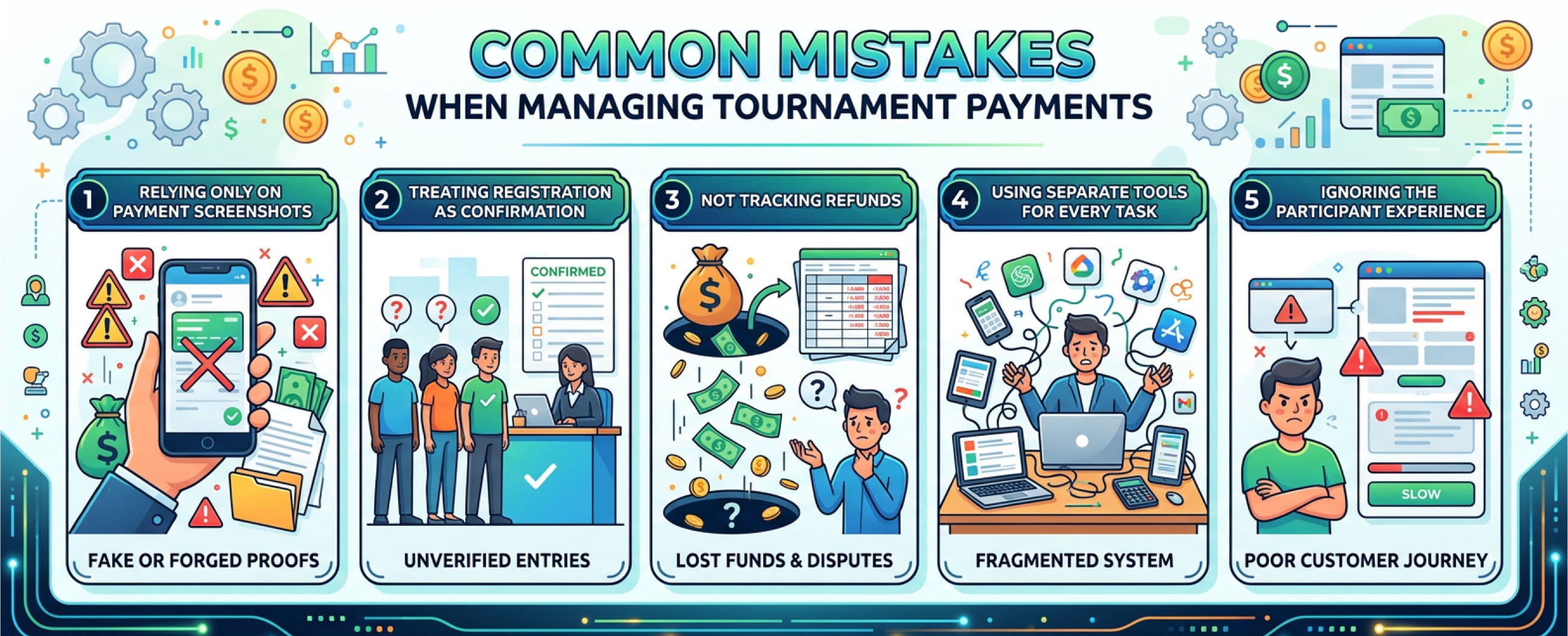
A few mistakes appear again and again.
Relying Only on Payment Screenshots
Screenshots can be edited, misplaced, or sent without enough information to identify the participant.
Use the actual transaction record as the main payment reference.
Treating Registration as Confirmation
Filling out a form doesn't always mean the participant has paid.
Keep registration status and payment status connected but clearly defined.
Not Tracking Refunds
Refunds should be recorded against the original payment. Otherwise, financial reports can become confusing later.
Using Separate Tools for Every Task
One tool for registration, another for payments, another for player records, and another for reporting can create duplicate data.
Look for a system that covers the core requirements of your tournament.
Ignoring the Participant Experience
Organizers often focus on their own dashboard and forget what the player sees.
Registration should be easy to understand, payment steps should be clear, and confirmation should arrive quickly.
Final Thoughts
A good payment system does more than collect registration fees. It gives clubs a reliable way to connect registrations, payments, receipts, refunds, and participant records.
In our experience, the biggest improvement comes when payment information stops living in separate spreadsheets and chat messages. Once the registration and payment records are connected, organizers have a much clearer picture of the event.
If your club is still checking payment screenshots manually or maintaining several sheets for tournament registrations, it may be time to rethink the process.
The 12th Men can help clubs and organizers build a more organized sports event workflow covering registration, payments, tournaments, scoring, and other event needs. Explore the platform at The 12th men and see which features fit your next tournament.
Related Articles

Guide
Badminton Tournament Bracket Generator: Easy Guide
Learn how a badminton tournament bracket generator supports singles and doubles events, fair seeding, court scheduling, live result updates, and smoother competition management for busy clubs. It also highlights practical steps, common pitfalls.
Read More >Yug Shah|Sep 21, 2026|
Guide
Real-Time Tournament Notifications: Organizer Guide
See how instant alerts reduce confusion on tournament day. This guide covers fixture reminders, venue updates, score notifications, delay announcements, and practical communication workflows for organizers. It also highlights practical steps.
Read More >Yug Shah|Sep 17, 2026|