Player Registration Features Every League Should Have

By Yug Shah
|
Aug 12, 2026
|
|

A Tournament Registration System becomes important when player sign-ups grow beyond manual tracking. A few teams can quickly become dozens, and registrations may arrive through email, WhatsApp messages, spreadsheets, and phone calls. Without a clear process, organizers spend more time sorting player details than preparing the tournament itself.
A good system solves these problems by bringing registrations, payments, team details, and player records into one place. Instead of chasing missing information or correcting duplicate entries, organizers can focus on delivering a better tournament experience.
Whether you're running a cricket league, badminton championship, football cup, or pickleball event, the right registration process sets the foundation for everything that follows.
Quick Summary / Key Takeaways
- The right registration setup reduces manual work and registration mistakes.
- Online player registration makes joining tournaments faster for participants.
- Built-in payment collection keeps registrations organized.
- Team and player management becomes easier as tournaments grow.
- Mobile-friendly registration improves participation.
- Automated confirmations save organizers hours of manual communication.
- Choosing software with flexible registration options prepares your league for future growth.
Why Registration Is More Important Than Most Organizers Think
Many leagues invest heavily in scheduling, scoring, and live streaming. Registration often receives the least attention, even though it's the first experience every player has with your tournament.
We've noticed that when registration feels confusing, players start asking questions before the event has even begun.
Questions like:
- Has my payment been received?
- Am I successfully registered?
- Can I edit my player details?
- Where do I upload my ID?
- How do I add teammates?
These questions create unnecessary work for organizers.
Modern sports tournament registration software removes much of this confusion by giving players a clear, guided registration process from start to finish.
What Every Tournament Registration System Should Include
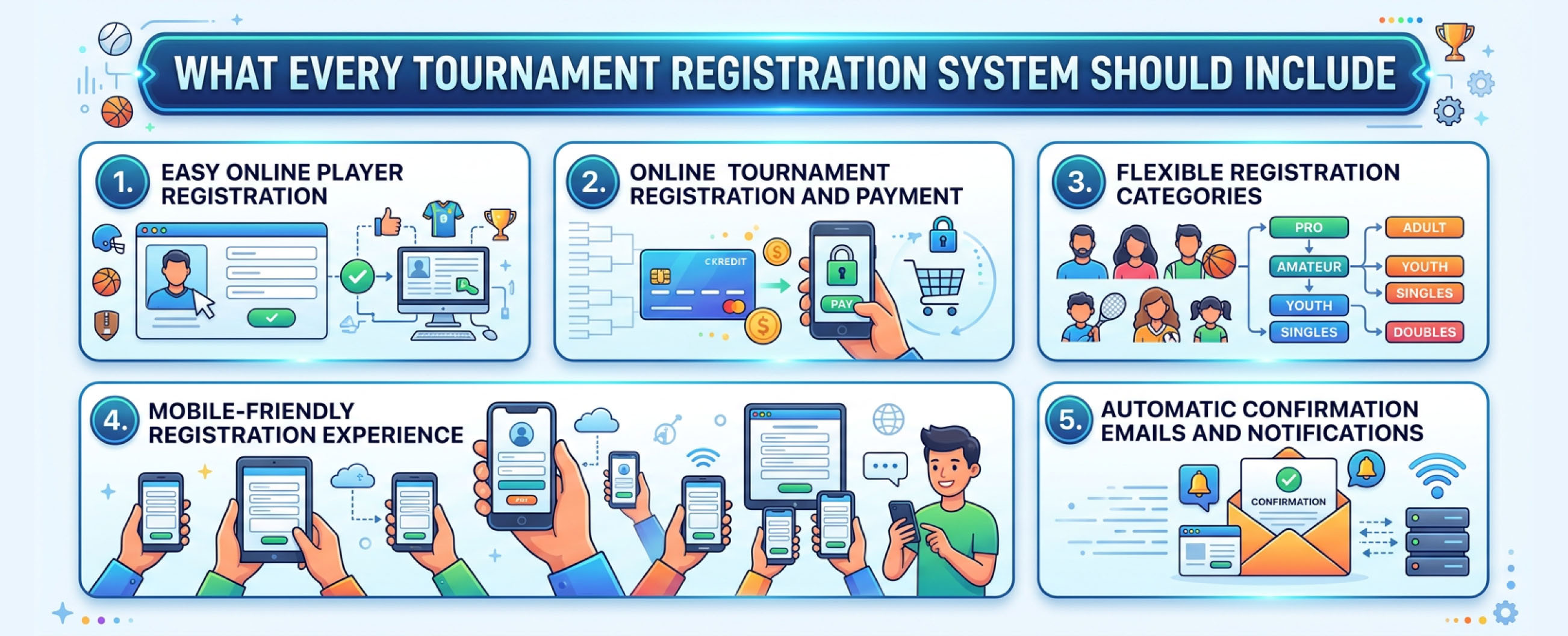
Not every registration platform is built the same. Some only collect player names, while others help manage the entire registration journey.
Below are the features every growing sports league should expect.
1. Easy Online Player Registration
The first priority should always be simplicity.
Players should be able to register in just a few minutes using their phone or computer without downloading additional applications.
A registration form should collect only the information organizers actually need.
Typical fields include:
- Player Name
- Email Address
- Mobile Number
- Date of Birth
- Team Name
- Emergency Contact
- Jersey Size (if required)
- Identity Proof (optional)
One thing that often gets overlooked is form length.
Long registration forms discourage players from completing the process. Keeping forms short usually increases successful registrations.
Manual Registration vs Digital Registration
| Feature | Manual Process | Tournament Registration System |
|---|---|---|
| Registration Forms | Paper or Excel | Online Form |
| Player Updates | Manual edits | Self-service updates |
| Confirmation | Phone or Email | Instant confirmation |
| Data Storage | Multiple files | Single dashboard |
| Error Rate | High | Much lower |
| Registration Tracking | Difficult | Real-time |
2. Online Tournament Registration and Payment
Registration and payments should never be treated as separate processes.
Many businesses run into this issue. Players register successfully but forget to pay. Others pay first without completing registration.
This creates unnecessary confusion.
A good platform combines online tournament registration and payment into one workflow.
Benefits include:
- Instant payment confirmation
- Reduced follow-up messages
- Better financial records
- Automatic receipt generation
- Easier refund management
Organizers also spend less time matching payment screenshots with player names.
3. Flexible Registration Categories
Every tournament has different participation rules.
Some events include:
- Individual players
- Teams
- Junior divisions
- Women's categories
- Mixed doubles
- Corporate leagues
- Veteran competitions
Your registration system should support multiple categories without creating separate forms for each event.
For example:
A cricket tournament may allow team registrations.
A badminton championship may accept both singles and doubles entries.
A pickleball event may include beginner, intermediate, and advanced divisions.
The software should manage all of these from one dashboard.
4. Mobile-Friendly Registration Experience
Most players register using their smartphones.
If forms are difficult to complete on mobile devices, registration numbers often drop.
We've seen organizers lose registrations simply because players couldn't upload documents or complete payment from their phones.
A mobile-friendly registration page should include:
- Responsive design
- Fast loading pages
- Simple payment flow
- Easy document uploads
- Large buttons
- Clear progress indicators
This small improvement often makes a noticeable difference during registration periods.
5. Automatic Confirmation Emails and Notifications
Players appreciate knowing their registration has been received.
Without confirmation, many contact organizers asking if their form was submitted successfully.
Automatic notifications should include:
- Registration confirmation
- Payment receipt
- Tournament details
- Venue information
- Reporting time
- Important instructions
This creates a smoother experience for both organizers and participants.
Why These Features Matter as Your Tournament Grows
Managing registrations for twenty players is very different from handling registrations for two hundred or even two thousand.
As participation grows, small manual tasks begin to consume a surprising amount of time. A missing payment, duplicate player entry, or incomplete registration can quickly turn into hours of extra work.
This is where a well-designed Tournament Registration System becomes more than just an online form. It helps organizers stay in control while giving players a smooth registration experience from the very beginning.
In our experience, leagues that switch from spreadsheets to dedicated sports registration software for tournaments often notice fewer registration errors, faster participant onboarding, and much less administrative workload.
6. Complete Player Profiles That Stay Updated
A registration form is only the beginning. Once players join your tournament, organizers often need much more information.
A good Tournament Registration System should create a profile for every participant instead of storing information in a single spreadsheet.
Player profiles can include:
- Personal details
- Team information
- Previous tournaments
- Registration history
- Emergency contacts
- Uploaded documents
- Payment status
- Match statistics (if available)
This becomes especially useful for leagues held every season. Returning players don't need to fill out the same information again, and organizers can quickly verify existing records.
We've noticed that clubs running annual competitions save a significant amount of time when player data carries over from previous events.
7. Team Registration with Easy Player Management

Many tournaments involve teams rather than individual players.
In cricket, football, hockey, and volleyball competitions, team captains usually handle registration for the entire squad. A system that forces each player to register separately often creates unnecessary delays.
Instead, team registration should allow captains to:
- Create a team
- Add players
- Invite teammates
- Edit player details before the deadline
- Replace unavailable players (within tournament rules)
- Upload team logos
- Assign jersey numbers
For organizers using cricket tournament software, these features reduce last-minute roster changes and make match preparation much easier.
8. Built-In Document Upload and Verification
Many sports events require participants to submit supporting documents before approval.
These might include:
- Government ID
- Student ID
- Age proof
- Medical certificate
- Club membership
- Player photograph
Collecting these over email or messaging apps quickly becomes difficult to manage.
The platform should allow players to upload documents during registration and let organizers review them from a single dashboard.
One thing that often gets overlooked is document quality. If uploads are blurry or incomplete, organizers spend extra time requesting replacements. Allowing common file formats and setting clear upload guidelines can prevent many of these issues.
9. Payment Tracking Without Manual Follow-Ups
Collecting entry fees is only one part of the process. Tracking who has paid, and who has not, is where many organizers struggle.
A good tournament payment management software should display payment status alongside each registration.
Typical payment labels include:
- Paid
- Pending
- Failed
- Refunded
- Partially Paid
This makes it much easier to answer questions from players and prepare final participant lists.
Instead of searching through bank statements or payment screenshots, organizers can see payment status instantly.
Manual Payment Tracking vs Automated Payment Tracking

| Task | Manual Process | Tournament Payment Management Software |
|---|---|---|
| Payment Confirmation | Check bank records manually | Instant status update |
| Receipt Generation | Created individually | Automatic |
| Pending Payments | Manual reminders | System alerts |
| Refund Tracking | Spreadsheet updates | Recorded automatically |
| Registration Approval | Manual verification | Linked to payment status |
| Financial Reports | Time-consuming | Available anytime |
10. Early Bird Offers and Discount Codes
Many tournaments encourage early registrations by offering reduced entry fees.
Without software, managing these discounts usually means checking dates manually and adjusting payments one by one.
A modern Tournament Registration System should allow organizers to:
- Set early bird pricing
- Create promotional codes
- Offer club discounts
- Apply group registration offers
- Limit discounts by date or quantity
This not only helps attract early registrations but also reduces manual work for organizers.
For example, a local pickleball club might offer a 15% discount to the first 50 participants. Once the limit is reached, the system automatically switches back to the regular fee.
11. Registration Limits and Waiting Lists
Popular tournaments often reach full capacity before registration closes.
Without proper controls, organizers may accidentally accept more participants than they can accommodate.
The registration system should allow organizers to:
- Set player limits
- Set team limits
- Close registrations automatically
- Create waiting lists
- Notify players if a spot becomes available
We've seen this feature become especially useful during community cricket tournaments where registrations fill up within a few days.
12. Real-Time Registration Dashboard
One of the biggest advantages of modern sports registration software for tournaments is visibility.
Instead of checking multiple spreadsheets, organizers should have a dashboard showing everything in one place.
Useful dashboard information includes:
- Total registrations
- Teams registered
- Individual players
- Payment collection
- Pending approvals
- Category-wise registrations
- Remaining slots
- Registration trends
This helps organizers make quicker decisions without searching through multiple files.
A Real Example from Community Sports
Imagine a district-level cricket tournament with 32 teams.
Using email forms and spreadsheets, organizers may spend several evenings:
- Sorting registrations
- Matching payment screenshots
- Correcting spelling mistakes
- Calling team captains
- Updating player lists
Now imagine the same event using cricket tournament software with built-in registration and payment management.
Team captains register online, upload player details, complete payment, and receive instant confirmation. Organizers can review everything from a single dashboard.
The result isn't just time saved. It also reduces registration errors and creates a better experience for everyone involved.
The same approach works well for pickleball tournament software, where players often register across multiple skill divisions and doubles categories.
Common Registration Mistakes Organizers Should Avoid
Even experienced organizers can run into problems when registration isn't planned carefully.
Some of the most common mistakes include:
- Asking for too much information during registration
- Accepting payments outside the registration process
- Using different forms for different categories
- Allowing unlimited edits after registration closes
- Not sending confirmation emails
- Forgetting document verification
- Keeping registration records in multiple spreadsheets
Many businesses run into this issue as tournaments become more popular. Small administrative tasks begin to pile up, making registration much harder to manage than it needs to be.
Helpful Resources for Organizers
If you're planning larger sports events, these resources are worth exploring for best practices:
| Resource | Why It's Useful |
|---|---|
| Sports governing body guidelines | Registration rules and player eligibility |
| Digital payment provider documentation | Secure online payment practices |
| Local association tournament regulations | Age verification and participation rules |
| Data privacy guidelines | Handling player information responsibly |
These references can help you create a registration process that is easier for players while keeping organizer responsibilities clear.
How to Choose the Right Tournament Registration System

With so many platforms available, choosing the right software isn't always easy. Every league has different requirements, so the best choice depends on your event size, sport, and future plans.
Instead of looking for software with the longest feature list, focus on the tools you'll actually use throughout the season.
When comparing options, ask these questions:
- Can players register from any device?
- Does it support online tournament registration and payment?
- Can I manage both individual and team registrations?
- Does it allow document uploads?
- Are confirmation emails sent automatically?
- Can I track payments in one dashboard?
- Does it work for multiple tournaments each year?
- Is customer support available if issues arise?
A common mistake we see is choosing a platform based only on price. A lower-cost tool may seem attractive at first, but it can create extra manual work if it lacks the features your league needs.
Checklist for Selecting Registration Software
| Feature | Why It Matters |
|---|---|
| Online Registration | Makes it easy for players to sign up from anywhere |
| Payment Collection | Keeps registrations and payments connected |
| Team Management | Simplifies squad registration and updates |
| Document Upload | Verifies player eligibility before the event |
| Mobile-Friendly Design | Supports registrations from smartphones and tablets |
| Automated Notifications | Reduces questions from participants |
| Registration Dashboard | Gives organizers a clear view of entries and payments |
| Reporting Tools | Helps track registrations, revenue, and participation |
Use this checklist when comparing different platforms. It helps you focus on features that improve day-to-day tournament management rather than extras you may never use.
Looking Ahead: What Players Expect Today
Player expectations have changed over the past few years.
Most participants now expect to:
- Register online in a few minutes
- Pay securely during registration
- Receive instant confirmation
- Access tournament details from their phone
- Update information before registration closes
- Get timely event notifications
If a registration process feels slow or confusing, players often lose interest or contact organizers for help. That creates more work for everyone involved.
In our experience, leagues that make registration simple often see higher completion rates and fewer support requests. Players appreciate clear communication, while organizers spend less time handling routine questions.
Why Registration Is the First Step Toward a Better Tournament
Registration is more than collecting names and entry fees. It sets the tone for the entire event.
When player details are accurate, payments are confirmed, and communication is clear, everything that follows becomes easier, from scheduling matches to preparing scorecards and checking in participants on event day.
Whether you're organizing a local cricket league, a school championship, or a regional pickleball competition, using the right Tournament Registration System gives you a solid foundation for running a well-organized event.
Many organizers start with spreadsheets because they work for smaller tournaments. As participation grows, though, those spreadsheets become harder to manage. Moving to dedicated sports tournament registration software helps reduce manual work while giving players a smoother registration experience.
If you're already using Sports Event Management Software, choosing a platform with built-in registration, payments, scheduling, and communication keeps everything connected in one place.
Ready to Simplify Your Tournament Registration?
Managing registrations doesn't have to involve spreadsheets, endless phone calls, or chasing payment confirmations.
The 12th Men offers an all-in-one Sports Event Management Software that helps leagues manage player registrations, team entries, online payments, scheduling, live scoring, and communication from a single platform.
Whether you're planning a local cricket tournament, a growing pickleball league, or a multi-sport championship, the platform is built to support events of every size while giving players a smooth registration experience.
Looking for an easier way to manage your next tournament? Explore The 12th Men and see how the right Tournament Registration System can help you save time, reduce registration errors, and deliver a better experience for every participant.
FAQ
Got Questions? We've Got Answers.
A Tournament Registration System is software that allows players or teams to register online, submit required details, upload documents, and complete payments. It helps organizers manage registrations from a single dashboard.
Online registration saves time, reduces data entry mistakes, sends instant confirmations, and keeps player information organized. It also makes registration easier for participants using mobile devices.
Yes. Most modern sports tournament registration software includes online tournament registration and payment features, allowing players to pay during registration while organizers can track payment status in real time.
Yes. Many platforms support cricket, badminton, football, basketball, tennis, and pickleball tournament software requirements. They can also handle both individual and team-based competitions.
A Tournament Registration System should include online registration, payment collection, team management, document verification, automated notifications, mobile compatibility, reporting, and easy administration. Together, these features make day-to-day tournament management simpler for organizers and easier for participants.
Related Articles

Guide
Badminton Tournament Bracket Generator: Easy Guide
Learn how a badminton tournament bracket generator supports singles and doubles events, fair seeding, court scheduling, live result updates, and smoother competition management for busy clubs. It also highlights practical steps, common pitfalls.
Read More >Yug Shah|Sep 21, 2026|
Guide
Real-Time Tournament Notifications: Organizer Guide
See how instant alerts reduce confusion on tournament day. This guide covers fixture reminders, venue updates, score notifications, delay announcements, and practical communication workflows for organizers. It also highlights practical steps.
Read More >Yug Shah|Sep 17, 2026|