Cricket Player Registration Software: Complete Guide

By Yug Shah
|
Sep 11, 2026
|
|
The spreadsheet says 126 players have registered.
The payment sheet says 119.
Then someone notices something stranger. One player appears twice, once as "R. Patel" and again under his full name. His payment is attached to one entry. His preferred playing role is attached to the other.
The auction is tomorrow.
This is the kind of problem Cricket Player Registration Software is meant to prevent. Instead of treating registration as a form people fill out and forget, it creates a usable player record that can move into payments, verification, auctions, teams, fixtures, scoring, and tournament reports.
In simple terms, online registration should be the beginning of your cricket tournament data, not another list somebody has to clean later.
Quick Summary: Key Takeaways
If you are comparing registration systems for a cricket league, start here:
- Cricket Player Registration Software collects player information in one organized place.
- Good online cricket registration should connect the player's form, payment status, category, contact details, and tournament eligibility.
- Registration becomes far more useful when the same player record can later move into auctions, team rosters, fixtures, and scoring.
- Tournament payment software can help organizers distinguish between someone who filled out a form and someone whose entry is actually confirmed.
- A broader cricket league software platform makes more sense when registrations need to feed several stages of the competition.
- Research using sports registration records suggests that well maintained player data can eventually tell organizers much more than simply how many people signed up.
What Is Cricket Player Registration Software?
Cricket Player Registration Software is a system that lets organizers collect, verify, organize, and manage player entries digitally before and during a cricket tournament or league.
A player opens the registration link, enters the required details, completes the payment when applicable, and submits the entry.
That sounds almost too ordinary to need dedicated software.
The difference appears later.
With a basic form, the organizer receives information.
With a connected registration system, that information can become part of the tournament.
A player's name does not have to be typed again for an auction. Their profile does not need to be rebuilt after team selection. Payment status does not sit in somebody else's spreadsheet.
That continuity is where the value starts.
The The 12th Men sports management platform currently connects player registration with tournament setup, payments, auctions, scheduling, scoring, and other event functions.
The Registration Problem Usually Looks Harmless at First
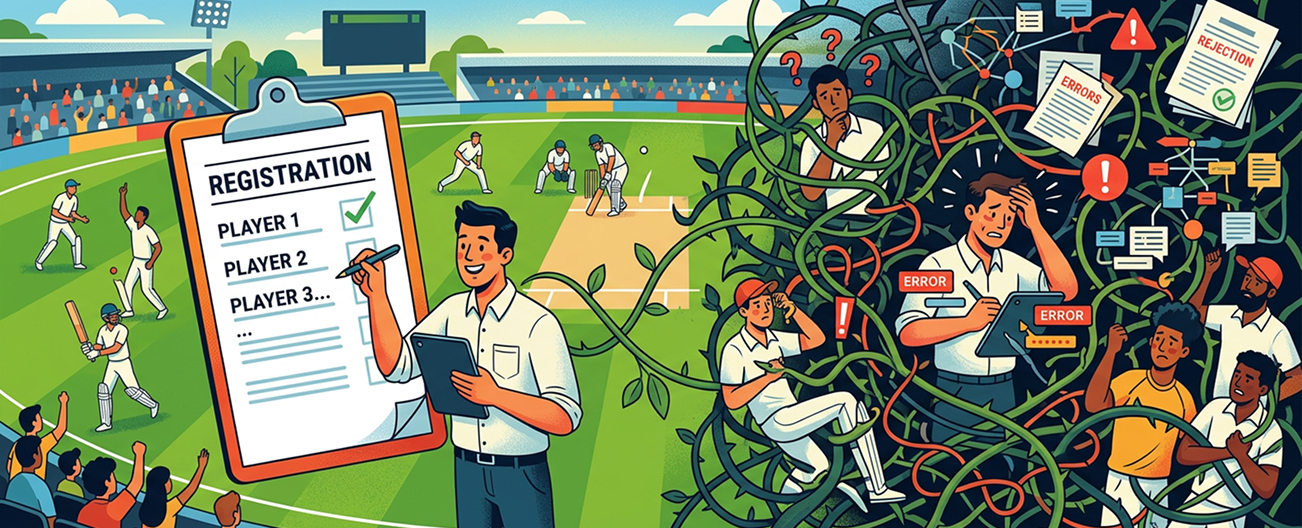
Imagine a local cricket league preparing for its next season.
The organizer shares a Google Form in several WhatsApp groups.
Registrations arrive quickly.
Good start.
Then the messages begin.
"Can I change my category?"
"My payment went through, but my name isn't confirmed."
"I entered the wrong phone number."
"My friend registered me. Can you update my photo?"
"Which team am I in?"
"Has my registration been accepted?"
None of these requests is especially difficult.
Put 150 players behind them and the situation changes.
One volunteer checks payments. Another edits the spreadsheet. Someone else prepares the auction list. A fourth person creates the teams after bidding.
Every handoff creates another chance for a mismatch.
The real registration problem is rarely collecting names. It is keeping those names correct as the tournament moves forward.
How Does Online Cricket Registration Work?
A good online cricket registration journey should be short for the player and structured for the organizer.
The player should not have to understand your back office process.
They should see a clear form, provide the requested information, understand any fee involved, submit the entry, and know what happens next.
Behind the screen, there is more going on.
| Registration stage | What the player does | What the organizer needs |
|---|---|---|
| Opens registration | Visits the tournament link | Correct event and category |
| Creates profile | Enters personal details | Clean player record |
| Selects playing details | Adds role or category | Consistent classifications |
| Uploads required information | Adds photo or documents | Verification-ready data |
| Makes payment | Completes registration fee | Payment status linked to player |
| Receives confirmation | Knows entry was received | Confirmed participant list |
| Gets selected or auctioned | Waits for team assignment | Player moved into correct squad |
There is a small design lesson hiding here.
Every field should have a reason to exist.
If organizers never use a piece of information, asking every player to enter it only makes registration slower.
What Player Details Should a Cricket Registration System Collect?
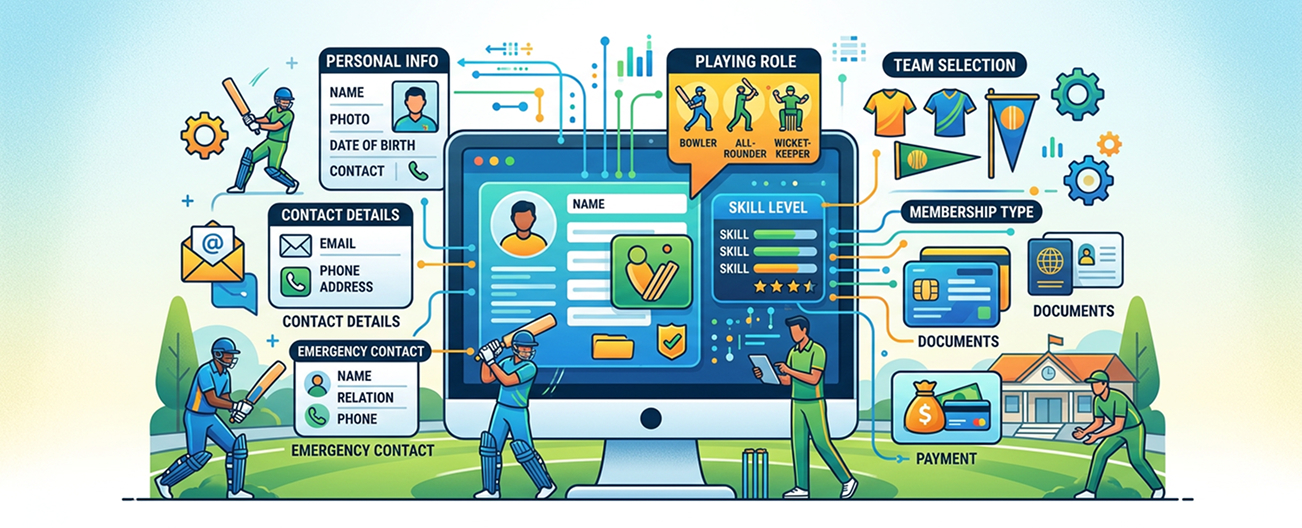
There is no universal form because a weekend box cricket competition and a franchise style league operate differently.
Most competitions will need some combination of:
- Player name
- Phone number
- Email address
- Profile photo
- Date of birth or age category
- Batting preference
- Bowling preference
- Wicketkeeping status
- Player category
- Team preference, when relevant
- Jersey size, if merchandise is included
- Registration fee status
- Emergency or guardian details where appropriate
- Tournament consent or required declarations
Auction based tournaments may need more cricket specific information.
A captain deciding between two players may care about whether someone is a wicketkeeper batter, left arm seamer, opening batter, spinner, or all rounder.
So do not treat those fields as decoration.
If that information will appear during the auction, collect it properly at registration instead of chasing players the night before bidding starts.
The The 12th Men cricket event management platform combines cricket tournament management with player auctions, scoring, and other event workflows.
Why Should Payments Be Connected to Registration?
Here is a question that causes more trouble than it should:
Has the player registered?
Sometimes the answer depends on whom you ask.
The form administrator says yes because the person's details are there.
The finance volunteer says no because payment has not arrived.
The auction organizer assumes yes because the name was exported yesterday.
Now there are three versions of "registered."
A tournament payment software flow works better when payment status belongs to the same entry.
| Player status | Meaning | Organizer action |
|---|---|---|
| Form started | Details incomplete | No action or reminder |
| Submitted | Registration received | Review entry |
| Payment pending | Details complete, fee unpaid | Await payment |
| Payment confirmed | Fee received | Verify player |
| Approved | Entry accepted | Move into tournament pool |
| Assigned | Auction or team process complete | Add to roster |
This distinction may feel overly detailed for 20 players.
For 200, it becomes sanity.
The12thMen's current platform states that registrations, payments, scheduling, and scoring can be managed within its event workflow, while its published terms say applicable auction registration payments are collected through Razorpay.
Why Does Clean Player Data Matter After Registration Ends?
This is where registration gets more interesting.
The form closes.
Surely the job is finished?
Not quite.
Player information can become one of the most useful records a league owns.
Rochelle Eime, Jack Harvey, Melanie Charity, Meghan Casey, Hans Westerbeek, Warren Payne and colleagues studied 520,102 participant registration records across seven Australian sports, including cricket. Because the researchers were working with actual registration records rather than relying only on people remembering and reporting their participation, they could examine differences across age, gender, and location in considerable detail.
The lesson for a cricket organizer is not that every local tournament needs a research department.
It is simpler.
Clean registration records can eventually answer questions that a pile of disconnected forms cannot.
How many players returned this year?
Which age group is growing?
How many registrations converted into paid entries?
Which locality sends the most players?
Which categories fill first?
How many registered players actually make it into teams?
You may not need those answers today.
Next season, you might.
What Happens When Registration Connects With Cricket League Software?
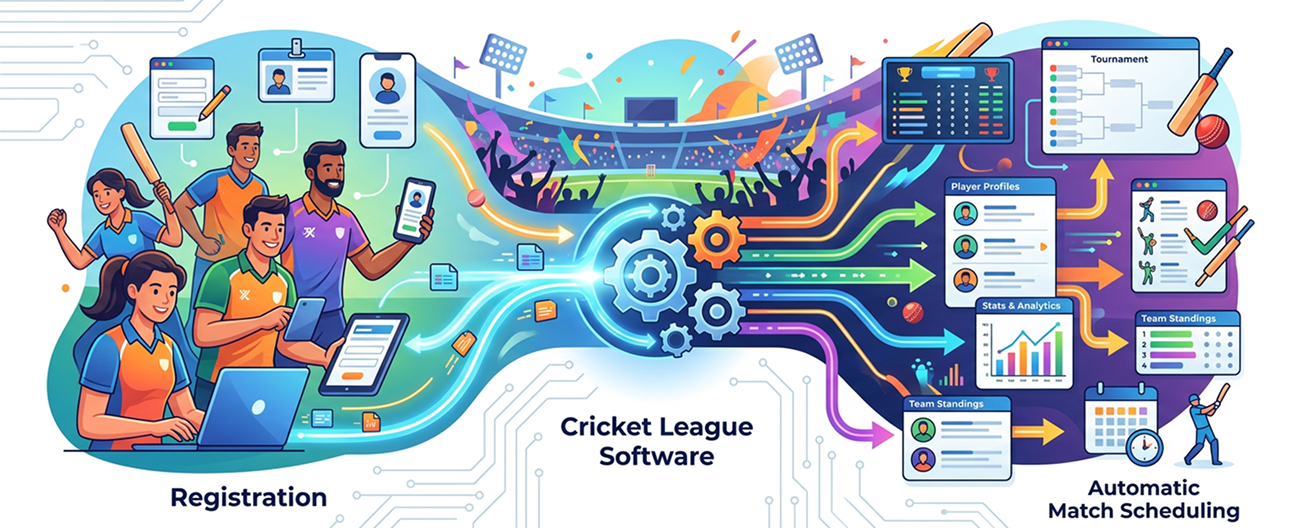
This is where a registration tool can either become useful or become another data island.
Suppose 180 players register for an auction based league.
Registration closes Friday.
The auction is Sunday.
With disconnected systems, somebody exports the names, cleans duplicates, confirms payments, reformats categories, uploads photographs, and prepares player profiles.
After the auction, another person creates team rosters.
Then those rosters have to reach the scoring platform.
Same people. Again and again.
A connected cricket league software workflow changes the sequence:
Registration → Verification → Payment → Auction Pool → Team Assignment → Fixtures → Scoring → Player Statistics
The player record moves.
The organizer does not rebuild it at every stage.
The12thMen's auction and scoring workflow, for example, is designed so players selected during an auction can move into team squads, after which fixtures and scoring use the resulting roster information.
If auctions are an important part of your competition, the site's guide to choosing a cricket bidding platform in 2026 provides a useful next step.
Registration Data Can Become Tournament Memory
There is another reason not to throw registration data away after opening day.
A 2026 applied research paper by Sahil Sandip Shelar, Chaitanya Ashish Kelkar, Rishikesh Prakash Gadge, Uday Suresh Patil, Nilam Patil, and Farhina Sayyad looked specifically at fragmented workflows in grassroots cricket.
Their LeagueOn research described a common setup involving messaging groups, spreadsheets, offline registrations, scattered payments, and missing performance records. The proposed system connected player onboarding, tournament discovery, digital player histories, scorecards, and event operations. The authors reported improvements in their pilot scenarios around onboarding and player visibility.
The interesting part is not the technology stack.
It is the player history.
A cricketer should not become a stranger to the system every time a new tournament begins.
Once identity, tournament participation, team history, and performance records connect, local cricket starts building something it often loses: continuity.
How Does Registration Affect the Player Auction?
More than most organizers expect.
A good auction depends on the quality of the player pool.
Wrong categories create bidding problems.
Missing photographs make profiles harder to recognize.
Duplicate players cause confusion.
Incorrect roles affect team strategy.
Unconfirmed entrants can even be purchased before someone realizes they never completed the tournament process.
That is why registration should feed the auction directly wherever possible.
If you are building an IPL style local tournament, read the 2026 cricket bidding platform guide alongside this article rather than treating auction software as a completely separate decision.
The boring registration screen, it turns out, can determine whether auction night feels organized or improvised.
What Happens After Teams Are Finalized?
Now the player record earns its keep.
Once squads are confirmed, the same information can feed match scheduling and scoring instead of being entered again.
The12thMen's current scheduling system states that verified registrations and payment confirmations can move into scheduling, and finalized team rosters can transfer into its scoring workflow.
That creates a cleaner chain:
Player registers.
Player is verified.
Player joins the auction.
A team buys or selects the player.
The squad becomes available for fixtures.
The scorer selects the same player during the match.
Runs, wickets, catches, and results begin adding to that record.
Registration has now traveled all the way to the scorecard.
For organizers planning that wider setup, the Cricket Tournament Management Software 2026 guide explains how scheduling, scoring, teams, and tournament operations fit together.
How Do You Choose Cricket Player Registration Software?

Do not start by asking how many features the platform advertises.
Give it a messy situation instead.
Ask what happens if a player pays twice.
What happens if a phone number is wrong?
Can an organizer edit an approved record without creating another player?
Can incomplete registrations be separated from confirmed entries?
Can categories be changed before the auction?
Can registrations move directly into team selection?
Can payment status be checked without opening another system?
Can the same player information appear inside scoring later?
Those questions are less glamorous than looking at dashboard screenshots.
They are also much closer to tournament day.
| What to check | Basic tool | Better tournament setup |
|---|---|---|
| Online forms | Yes | Yes |
| Player verification | Sometimes | Built into workflow |
| Payment tracking | Separate | Connected to registration |
| Categories and roles | Basic fields | Tournament specific |
| Auction connection | Manual export | Player pool sync |
| Team creation | Manual | Connected roster |
| Scoring connection | Re enter players | Existing records used |
| Historical records | Limited | Season and event history |
A simple registration form can still be the right choice for a tiny event.
Once you are running repeated leagues, paid registrations, auctions, or multiple teams, the arithmetic starts changing.
The First Ball Is Not Where Your Tournament Starts
Most players will remember the auction.
They will remember the six that cleared the boundary.
They might remember the final over for years.
Nobody is going to tell stories about filling in the registration form.
That is exactly why it should work.
Registration should happen quietly, collect the right information once, confirm who is actually taking part, and send clean player records into everything that comes next.
The The 12th Men platform brings registration together with payments, auctions, scheduling, live scoring, and broader sports event management.
If your next cricket tournament is already outgrowing spreadsheets and scattered forms, start with the first place confusion usually enters the event: player registration.
Explore the The 12th Men cricket platform and build your next tournament around one player record from registration to the final scorecard.
Frequently Asked Questions
What is cricket player registration software?
Cricket player registration software lets tournament organizers collect and manage player details digitally. Depending on the system, it can also connect registrations with fees, approvals, player auctions, team rosters, fixtures, and scoring.
Can players register for a cricket tournament online?
Yes. An online cricket registration system can provide a link where players submit their details and, where supported, complete the required tournament payment.
Can registration fees be collected through tournament software?
Yes, when the platform includes payment support. A connected tournament payment software setup can link payment status with the individual player record, making it easier to identify confirmed and pending entries.
Can player registrations connect directly to a cricket auction?
They can if the platform supports both functions. This avoids recreating player profiles manually and lets approved players move into the auction pool with their categories and tournament details.
Is player registration included in cricket league software?
Many full tournament platforms include it. If you run recurring leagues, look for cricket league software that connects registration with teams, scheduling, standings, scoring, statistics, and tournament records rather than treating registration as a standalone form.
Related Articles

Guide
Badminton Tournament Bracket Generator: Easy Guide
Learn how a badminton tournament bracket generator supports singles and doubles events, fair seeding, court scheduling, live result updates, and smoother competition management for busy clubs. It also highlights practical steps, common pitfalls.
Read More >Yug Shah|Sep 21, 2026|
Guide
Real-Time Tournament Notifications: Organizer Guide
See how instant alerts reduce confusion on tournament day. This guide covers fixture reminders, venue updates, score notifications, delay announcements, and practical communication workflows for organizers. It also highlights practical steps.
Read More >Yug Shah|Sep 17, 2026|