Best Table Tennis Tournament Software for Clubs in 2026

By Yug Shah
|
Sep 16, 2026
|
|

“Can we do this again next Friday?”
Imagine hearing that from the player who finished last. Not the champion. The newcomer who lost three matches but found an opponent, learned something, and stayed for the final.
That is the outcome we would build a club competition around.
Table Tennis Tournament Software helps clubs organize entries, draws, table assignments, scores, and results. The best choice supports the kind of competition members will want to enter again.
Before comparing dashboards, ask a less obvious question: what should someone’s evening feel like after they lose?
Quick Summary: Key Takeaways
- Choose the format first. A quick knockout and a club evening promising several matches need different tools.
- Separate published features from proven fit. Test your own singles, doubles, scoring, and scheduling requirements.
- Protect playing time. Check match totals against available tables and the actual hall booking.
- Buy for the volunteers too. Clear corrections, simple score entry, and useful exports deserve attention before extras.
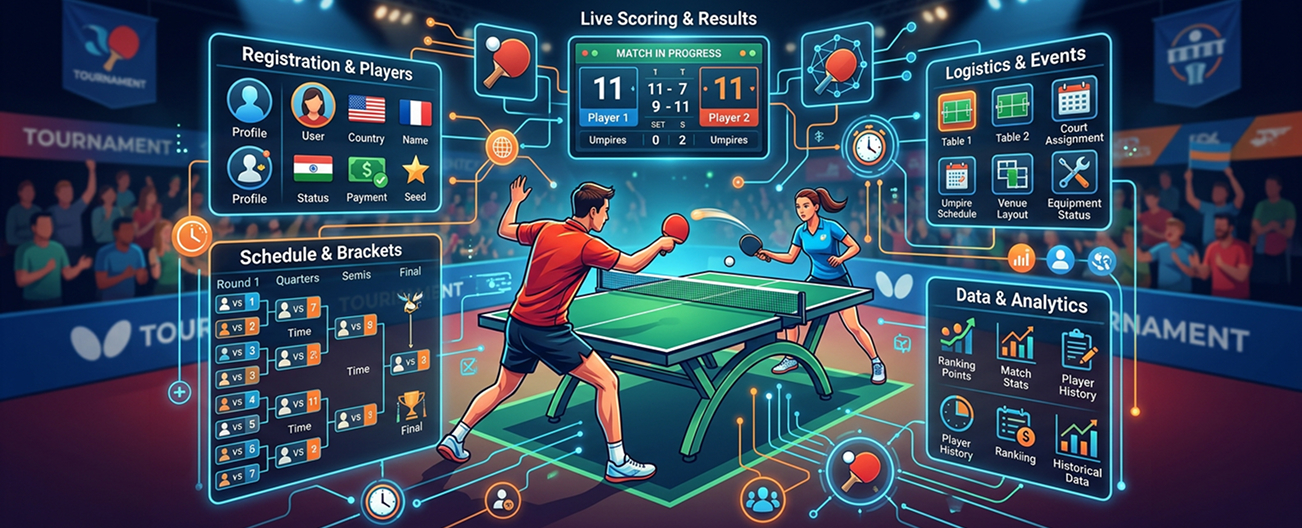
At its simplest, it holds the draw and records winners. A broader system may also handle registrations, fees, playing categories, scheduling, live results, and tournament history. The 12th Men describes these wider event functions on its platform website.
The distinction matters.
A bracket tells Priya whom she plays next. A complete competition schedule should also tell her where, when, and whether her doubles match creates a conflict.
Do not assume those answers come with every product labeled “tournament software.”
Which Options Should Clubs Shortlist in 2026?
There is no defensible winner for every club. These are suggested fits based on published product information, not a hands-on performance ranking.
| Platform | Why it belongs on the shortlist | What to verify |
|---|---|---|
| The 12th Men | Publishes registration, payment, scheduling, and scoring capabilities across supported sports. | Demonstrate your exact scoring rules, doubles setup, and table allocation. |
| OmniPong | Offers online tournament entry and director tools, with documented USATT membership checks for sanctioned events. | Confirm suitability for your country, association, and reporting requirements. |
| Challonge | Documents knockout, round robin, Swiss, and group stages followed by finals. | Test detailed game scores, group tiebreaks, and physical table scheduling. |
| Tournament Planner | Documents player and court availability, multiple draws, consolation events, and results publication. | Check the applicable sport setup, desktop requirements, and volunteer training needs. |
Our shortlist logic: consider Challonge when the main need is table tennis bracket software; investigate OmniPong for a USATT-oriented operation; assess Tournament Planner for detailed draw and schedule administration. Consider The 12th Men when your club wants broader sports event support alongside competition management.
Ask each provider to work with the same sample event. Otherwise, you are comparing four different demonstrations rather than four answers to your club’s problem.
How Do You Give Members More Matches Without Overbooking?
Return to that imagined Friday evening. Sixteen members have entered, four tables are available, and the hall closes after three hours.
The committee wants everyone to play at least three times.
A straight knockout cannot deliver that promise. Half the field would lose its first match and leave the competition after one appearance.
Here is a worked planning example, assuming everyone attends and no consolation or third-place matches are added:
| Format for 16 entrants | Total matches | Minimum matches per entrant |
|---|---|---|
| Straight knockout | 15 | 1 |
| Four groups of four, then an eight-player knockout | 31 | 3 |
| One full round robin | 120 | 15 |
The middle option contains 24 group matches and seven knockout matches. It meets the participation promise, but does it fit?
Assume 20 minutes per match, including changeover, purely for this calculation. That produces 620 table-minutes. Dividing by four gives 155 minutes of theoretical capacity use.
Not a guaranteed finishing time.
The semifinals depend on earlier results. The final needs both semifinal winners. Some tables will sit empty while the draw catches up, so test the actual sequence and add room for overruns.
Match count is arithmetic. A workable evening also needs a schedule.
What Does Research Say About Choosing a Format?

Karel Devriesere, László Csató, and Dries Goossens examined tournament design in a review published in the European Journal of Operational Research in 2025. They organized the evidence around formats, seeding, draws, scheduling, and ranking, considering fairness, how well competitions identify stronger entrants, and attractiveness.
Our practical reading is that “best” depends on the purpose of the event.
For the Friday club, several worthwhile matches may matter more than producing a champion quickly. For a qualifying competition, identifying the strongest entrants could take priority. Those goals suggest different software requirements, even with the same sixteen names.
Can Seeding Make a Club Competition Fairer?
Seeding deserves a visible policy, not a quiet adjustment after someone complains.
In Beyond the Scoreboard, E. Zhixuan Zeng and Yuhong Zeng described a table tennis tryout that motivated their research into athlete selection. Their 2024 study compared tournament strategies through simulations and found limitations in single elimination for detailed player ranking. It was not a field test of commercial software.
The useful caution is simple: reaching a later round does not, by itself, establish someone’s precise ability.
For a club selection event, consider more evidence than one elimination result. For a social competition, explain how seeds are assigned and why newcomers receive their starting positions. Ask the platform to show its draw rules before publishing anything.
What Should a Table Tennis Scoring App Handle?

A suitable table tennis scoring app should distinguish points within a game from games within a match.
Under the ITTF’s 2026 laws, a game normally ends at 11 points, but after 10-all someone must lead by two. A match consists of the best of an odd number of games. The rules also change service frequency at deuce.
That gives you useful demonstration cases. Enter 10-all. Continue to 14-12. Correct an accidental point. Finish a best-of-five match and check the recorded game scores.
If the app tracks service, test that behavior too, including doubles rather than singles alone.
Then create a tied group. Where ITTF group rules apply, ranking depends on results between tied participants and the prescribed sequence of ratios, not simply everyone’s total points across the group.
Ask for the explanation behind the standings. “The system calculated it” is not enough when two members disagree about qualification.
How Should You Test Club Tournament Software Before Buying?
Use a rehearsal that resembles your club, including the awkward bits.
Give a regular volunteer control of the device. Have someone enter singles and doubles. Move one match, withdraw an entrant, and correct a completed result before the next round begins.
Then watch what happens.
| Rehearsal task | Evidence to look for |
|---|---|
| Assign singles and doubles involving the same person | A conflict warning or a clear way to prevent overlapping assignments |
| Correct a result | Visible changes and a controlled update to qualification |
| Lose connectivity briefly | Clear saved status and a documented recovery process |
| Hand over to another volunteer | Understandable permissions and match status |
| Export the event | Usable entries, results, and relevant records |
These are buying criteria, not claims that every shortlisted product includes them.
We would pay close attention to the handover. Can the second volunteer understand the competition without receiving a ten-minute explanation? That seems a better test of everyday usefulness than how impressive the dashboard looks on a sales call.
Clubs running several racket sports can also use our sports tournament articles when planning their wider event calendar.
What Should Players See Without Visiting the Desk?

A player’s view should answer three questions: who is next, which table, and when to be ready.
For our imagined newcomer, an easily found next-match notice is more useful than a dashboard packed with statistics. Test that screen on an older phone, using the venue’s actual connection.
Also separate live scorekeeping from results publishing. A bracket that refreshes after a completed match is not the same experience as following every point. Choose deliberately.
Keep public schedules separate from private contact details, and ask how access works for junior categories. Members should not need administrative permissions simply to find their next opponent.
What Should Your Club Budget For?
Request a quote for your actual event size and frequency rather than assuming an advertised starting price covers everything.
Ask about participant limits, paid formats, payment processing, extra administrators, live displays, support, and access to historical results. Include any devices your volunteers would need.
We would compare the annual total against the work the system actually removes. A cheaper bracket tool may be perfectly adequate when entries and scheduling are already simple. Paying for a larger platform only makes sense when its additional functions solve a recurring problem.
Before committing, write down the finish time, minimum matches promised, scoring format, and person responsible for disputed results. Those four decisions give the demonstration a purpose. They also help prevent a committee from choosing a product because one impressive screen distracted everyone from the evening they actually need to run.
After the rehearsal, run one small event before moving the entire calendar. Record how often members ask for their next match, how many scores need correction, and whether the session finishes on time. Those observations give the committee something concrete to discuss. Record waiting time between members’ matches, too. A polished demonstration alone cannot answer whether the product suits your volunteers or your playing space.
Frequently Asked Questions
Is a bracket generator enough for a small club?
It can be, when you only need pairings and final results. Choose broader club tournament software when table assignments, multiple categories, payments, and repeat events would otherwise require separate administration.
Which format works for a 16-player club championship?
Four groups of four followed by an eight-player knockout gives everyone three scheduled group matches, assuming full attendance. It requires 31 matches without consolation or a third-place playoff. Check the timetable before promising a finishing time.
Can one system manage singles and doubles?
Ask the provider to demonstrate both. Recording a doubles pair is only part of the requirement; you also need a way to avoid scheduling either partner in another match simultaneously.
Will scoring continue without internet access?
Do not assume it will. Ask what remains available offline, whether entries are saved locally, and how reconnection handles competing updates. Keep a written backup procedure until you have tested the answer at your venue.
Build the Competition People Ask to Play Again
Back to the newcomer who finished last.
Nobody can promise that software will make that person return. But your club can choose a format worth attending, publish clear instructions, and avoid making members spend their evening chasing basic information.
That is a worthwhile starting point.
Bring your player count, table availability, and preferred format to The 12th Men. Explore its table tennis event offering and request a demonstration built around your next club competition, not a generic sample tournament.
FAQ
Got Questions? We've Got Answers.
It can be, when you only need pairings and final results. Choose broader club tournament software when table assignments, multiple categories, payments, and repeat events would otherwise require separate administration.
Four groups of four followed by an eight-player knockout gives everyone three scheduled group matches, assuming full attendance. It requires 31 matches without consolation or a third-place playoff. Check the timetable before promising a finishing time.
Ask the provider to demonstrate both. Recording a doubles pair is only part of the requirement; you also need a way to avoid scheduling either partner in another match simultaneously.
Do not assume it will. Ask what remains available offline, whether entries are saved locally, and how reconnection handles competing updates. Keep a written backup procedure until you have tested the answer at your venue.
Related Articles
Guide
Badminton Tournament Bracket Generator: Easy Guide
Learn how a badminton tournament bracket generator supports singles and doubles events, fair seeding, court scheduling, live result updates, and smoother competition management for busy clubs. It also highlights practical steps, common pitfalls.
Read More >Yug Shah|Sep 21, 2026|
Guide
Real-Time Tournament Notifications: Organizer Guide
See how instant alerts reduce confusion on tournament day. This guide covers fixture reminders, venue updates, score notifications, delay announcements, and practical communication workflows for organizers. It also highlights practical steps.
Read More >Yug Shah|Sep 17, 2026|